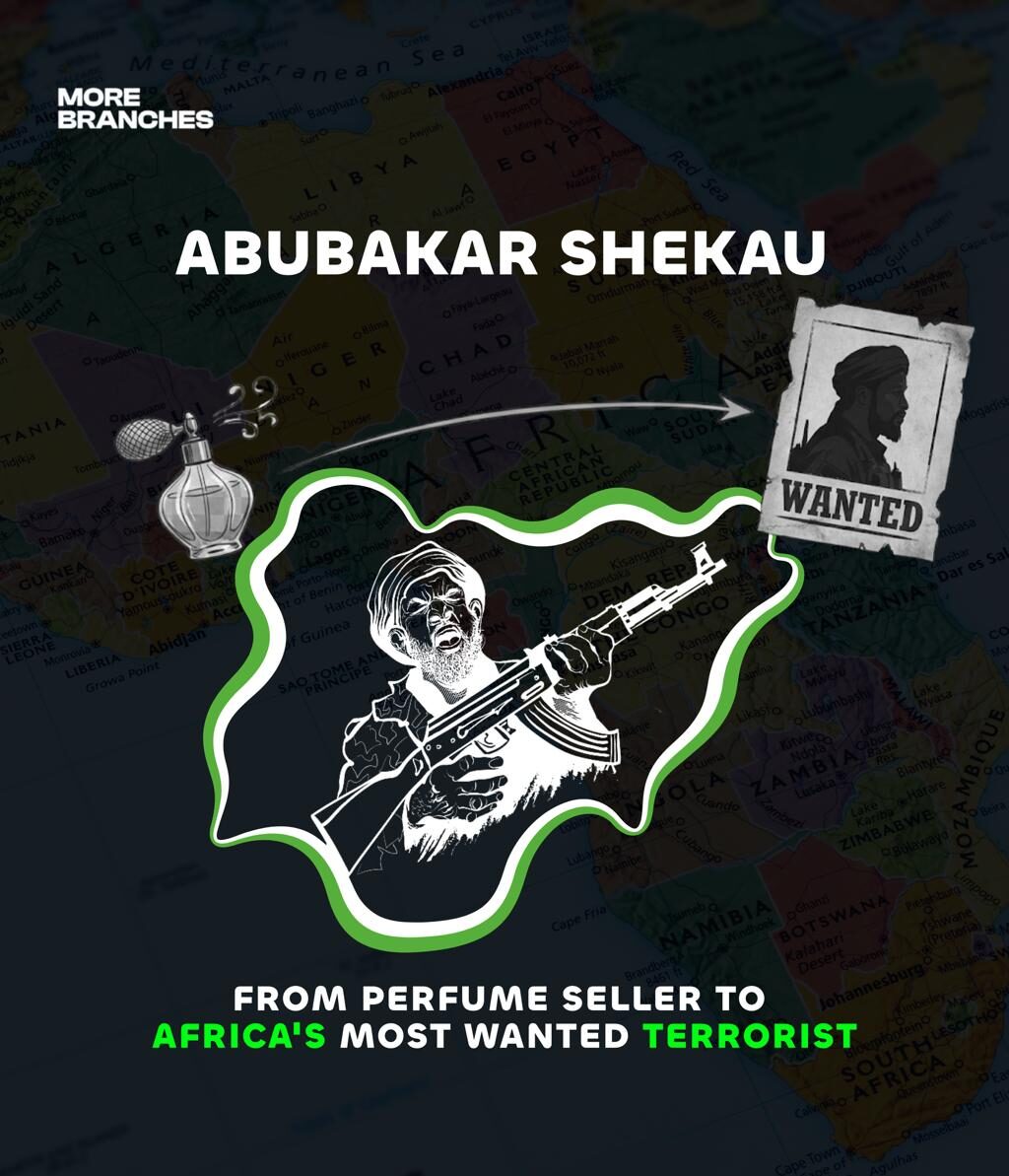
Before the terror, they called him Babson. He played football on dusty village fields in Yobe State, the kind of player whose presence you always felt on the pitch.
As a young boy, he left home for Maiduguri to study the Quran as an almajiri, one of thousands of children who live under Islamic teachers, memorizing scripture from wooden slates while begging for food to survive. His teacher rewarded him with a bride after he memorized the Quran. They were both still teenagers.
By his twenties, he was riding through Maiduguri on a rickety bicycle with perfume bottles tied to the back. They called him Mai Turare, the perfume seller. He’d dab a drop on your wrist, wait for the scent to settle, then quietly ask if you wanted to buy.
His young wife died giving birth. The baby died too.
The Unraveling
In 2004, drowning in grief, Shekau found Mohammed Yusuf, a fiery preacher in Maiduguri who was building something dangerous. Yusuf’s mosque had become a magnet for angry young men who felt abandoned by a corrupt government that had crushed them under military rule for decades.
Shekau’s mother would later say she never saw her son again after he met Yusuf.
In July 2009, everything exploded. Clashes with security forces left hundreds dead. Soldiers captured Mohammed Yusuf and executed him extrajudicially, his body riddled with bullets behind the police headquarters.
Shekau took a bullet to the thigh that night but escaped. He hid in Kano under a fake name, nursing his wounds in a rented house. When he emerged months later, the perfume seller was gone. In his place was something else entirely.
The Fortress
For seven years, Shekau ruled from deep inside Sambisa Forest. His compound sat just seven kilometers from a Nigerian army garrison, close enough that both sides heard each other’s call to prayer echoing across the trees every day. But a field of landmines lay between them. Nobody crossed.
The forest he chose was almost impenetrable. Trees so dense that sunlight barely reached the ground. Mud so deep it swallowed boots whole. He made cutting down trees punishable by immediate execution; he needed the thick canopy to hide from surveillance aircraft.
They ran electricity underground so generators wouldn’t be spotted from the air. Teenage boys with rusty rifles manned checkpoints. Visitors had to surrender weapons a full kilometer away.
Inside, Shekau lived in a modest house with a prayer mat worn smooth from years of use and a small metal box containing his radio, documents, and Quranic commentaries. Every bombing, every execution, every raid was ordered from this room.
The “Clout Chaser”
Shekau was obsessed with being famous. He’d order his media team to contact journalists; he called them “useful infidels,” then wait by his radio listening to every bulletin about himself.
If the news ignored him for too long, he’d summon his camera crew again. Sometimes to threaten the government, sometimes to lecture the UN, sometimes just to prove he was still alive after another rumor of his death.
He celebrated every time a new bounty was placed on his head. The U.S. eventually offered $7 million. To him, it meant he mattered.
But this same man who craved attention kept a suicide vest within arm’s reach at all times. He fathered 26 children with his four wives and the women he enslaved. He forced people to dig their own graves before shooting them. His bodyguards remember victims shaking so hard they couldn’t hold the shovel. His close associates described him as petty, paranoid, and painfully addicted to attention. A warlord who ruled through terror but couldn’t stand being ignored.
The Victims
Since 2009, his insurgency has killed tens of thousands and displaced millions across Nigeria, Niger, Chad, and Cameroon. Western media often focused on Boko Haram’s attacks on Christians, and yes, they deliberately hunted Christians because of their faith.
But here’s what often gets buried: for every two Christians killed or enslaved, eight Muslims suffered the same fate.
Shekau labeled them ‘murtadd’ (apostates). Anyone who worked for the government, anyone who refused his ideology, anyone who wouldn’t submit to his rule deserved death. Muslim or Christian didn’t matter if you rejected him.
Too Extreme for ISIS
By 2012, even his own commanders were done with him. A splinter group called ‘Ansaru’ broke away, partly because he allegedly kept ₦40 million from a bank robbery for himself.
In 2015, desperate for legitimacy, he pledged allegiance to ISIS. They accepted and rebranded his group as ISWAP – Islamic State West Africa Province.
It didn’t last. Within a year, his new ISIS bosses were calling him out. He was enslaving women, executing fellow Muslims on paranoid whims, and shooting his own commanders for buying houses. They had a name for what he was doing: “the Shekau deviation.”
Even al-Qaeda had distanced itself years earlier, citing his “indiscriminate killings and theological excesses.”
When terrorists think you’re too extreme, that tells you something. By 2021, ISWAP wasn’t just criticizing him. They were hunting him.
The Feared became Fearful
In May 2021, ISWAP fighters rolled into Sambisa Forest in two columns. Loudspeakers mounted on trucks blared through the trees: “We seek only Shekau. Surrender, and you will live.”
Shekau was already falling apart. He’d suffered from seizures for years, violent episodes where his body convulsed during prayers and meetings. His childhood friends say he never had them as a teenager on the football pitch. The condition seemed to grow worse with age and stress.
Now, surrounded and terrified, his body seized up to twice a day. The man who’d sent suicide bombers into markets and mosques, who’d executed hundreds with his own hands, was trembling in a forest hideout as his empire collapsed around him.
The negotiations lasted hours. His fighters were surrendering. ISWAP kept calling through the loudspeakers, promising safety.
Then came the blast.
He triggered his suicide vest, killing himself and several others around him. The man who used death as his sermon chose it as his final act.
He was about 51 years old.
The Captive Who Stayed
Among the handful of people with Shekau in those final moments was Abraham Amuta, a Christian graduate from Benue State who’d been doing his national service in Borno when Boko Haram abducted him in 2019.
He and a pastor were traveling to Chibok for evangelism when Shekau’s men took them. Boko Haram demanded ransom. The ransom was paid.
The pastor left. Abraham stayed.
Nobody forced him. He refused freedom. Instead, he worked his way up through Boko Haram’s ranks, first in their media unit, then as Shekau’s Chief Security Officer.
When ISWAP attacked that May night, Abraham fought alongside Shekau until the end.
We don’t know if it was Stockholm syndrome, genuine conversion, coercion we can’t see, or something else entirely. But he stayed.