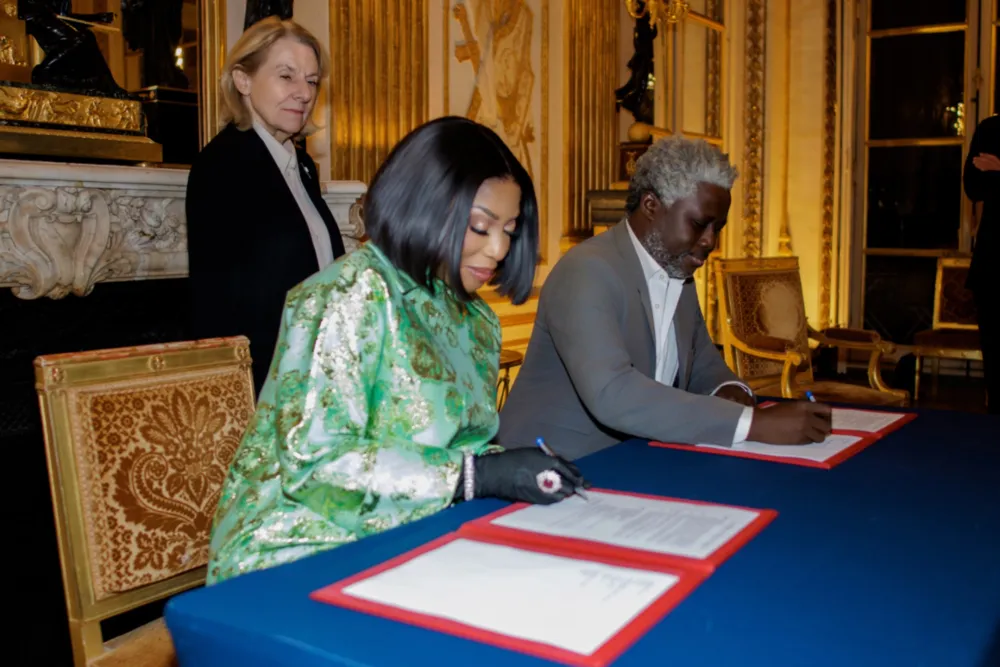
EbonyLife Group has signed a deal in Paris with Logical African Partners to launch the Afro Film Fund, a $50 million vehicle for African cinema. The plan is to finance roughly 35 films over eight years — between four and nine projects a year — with the first money going out in late Q1 or early Q2 2027.
Logical African Partners is the African investment arm of Logical Pictures, the French group. Its vice president, Pape Boye, signed alongside Mo Abudu, who founded EbonyLife. The fund will back projects it considers commercially viable, culturally relevant and internationally competitive, aimed at audiences in Africa and the diaspora, with the larger productions built to travel further.
What $50 million actually buys
Split across 35 films, the fund averages about $1.4 million a project. That is not a full budget for most of what it will back, and it is not meant to be — a fund of this shape takes a position in a film alongside other money rather than paying for the whole thing. What it does is make the rest of the cap table possible. A producer with $1.4m committed can go and raise the rest; a producer with nothing committed usually cannot.
Which is the actual problem it is aimed at. Nollywood has never been short of stories, and it has never been short of audience — it is one of the most prolific film industries on earth by volume. What it has been short of is anyone willing to underwrite a budget at a scale that lets a film compete outside the continent. Abudu has framed the fund around exactly that: the need for structured financing for African filmmakers.
Eight years is the number to sit with
The headline is $50 million. The timeline is eight years, and the first disbursement is still a couple of quarters away. That is not a criticism — film funds are slow by construction, and a vehicle that deployed $50m in eighteen months would be a worse vehicle. But it does mean the first films this money makes will not reach anyone until 2028 at the earliest, and the full thesis will not be testable until the mid-2030s.
It also means the fund will be deploying through at least two full cycles of whatever the streaming business decides to do next. The international buyers that made African content look like a growth category in 2021 have spent the years since cutting commissions across every market they operate in. A fund with an eight-year horizon is making a bet that the demand comes back, or that the diaspora and continental markets are large enough on their own.
The other thing Abudu signed
Alongside the fund, Abudu signed an agreement with France’s Centre National du Cinéma et de l’image animée supporting its Audiovisual Next Gen programme, an 18-month accelerator offering mentorship to 15 professionals under 35. She is its global ambassador. Netflix, RTL Group and Mediawan are also behind it, and the first cohort — all women — is due to be announced in late January 2027. The programme itself was announced in September at the Lumière Summit.
Read together, the two deals are the same argument made twice. One puts capital into films. The other puts training into the people who would make them. Both run through Paris, which is worth noting on its own: the money and the institutional backing for African cinema’s next decade are being structured in France, with French partners, under French cultural institutions.
What to watch
- The first slate. Four to nine films a year means the opening slate lands in 2027. What gets picked will say more about the fund’s real appetite than the press release does.
- Whether the $1.4m average holds. If the fund puts $8m into three films and spreads crumbs across the rest, it is a different fund than the one announced.
- Who else comes in. No additional backers have been named. A $50m fund that becomes a $150m fund because other investors follow is the outcome that matters.
- Whether the films travel. “Internationally competitive” is the stated bar. In 2028 we will be able to check it.
For now, the money is announced and the paper is signed. That is further than most African film finance gets.