Tag: mental illness

  • #Safezone: Are You Paying Attention to ADHD in Nigeria

    #Safezone: Are You Paying Attention to ADHD in Nigeria

    Previously, More Branches began a series of articles with the tag ‘#SafeZone‘ the first installment of which, was on Social anxiety disorder; soon after we received a submission from a reader who resonated with the first article and decided to write about his experiences surviving through ADHD in Nigeria.


    Silence, I was going to start with that. Then drift into how I would think of silence and forget that I was supposed to clear my mind, then start thinking of how to clear my mind and end up falling into the bottomless pit of my endless thoughts. I open up my notes to begin, I find out I have my old notes from last year, I signed into my old iCloud finally yesterday, I was curious about what I had been writing last year, I found my old poetry, plans, to-do lists, etc.

    I begin, after the first sentence, Ayuba plays an episode of Archer on the TV, they’re talking about a disc; the struggle begins, the battle for my attention, my own thoughts only coming to me between the pauses of the conversation; all the while my mind wanders, my attention is drawn away, by the white noise in the room, the blast of the air conditioning right above my head, cars passing by outside the window, I could probably count how many cars have passed in the last hour. Wait I’m supposed to be telling them what it’s really like to live with this condition through my experiences in a country that doesn’t believe in cognitive disorders because everything is spiritual. One that also believes the saying ‘all humans are equal’ = ‘all humans are the same’.

    For me, finding out I had ADHD was one of the best things, finally, I could tell what the brick wall I had been hitting all my life looked like, I could finally see the invisible enemy I had been wrestling with. The mole in my efforts to get shit done, why my days seemed like I had only 8 hours even though I sleep less than most people (exempting days with major depressive episodes). Even why I couldn’t just quite resonate in perfect harmony with school. The worst part is, I had no idea there was a wall or a battle, to begin with; people just always told me that I forget stuff, I’m too distracted, not listening/paying attention, I didn’t realize this was something happening not of my own volition and whenever I read, heard or watched the stories the “scientists” tell about it, I’m always like “LOL, that’s fucked up, I’m glad that’s not me”; I refused to accept my own diagnosis, in a state of denial of what I’m going through.

    And at that moment when Adedayo Laketu said, “Bro, I think you have ADHD, you should really research it, you’re always never focused or over-focused”, and I went and took the test, revealing a fate I’d been running away from for years. The more I read through the symptoms, the more I felt the fog dissolve and I clearly remember saying, “My whole life has been a lie!

    At that moment, I flashed back to every time someone had pointed out one of the symptoms and said, “What is wrong with you, I don’t know why you just can’t……” (Mom, dad, yes I’m talking about you guys. Those teachers too); in secondary school, when I would sit in class with the teacher dictating and halfway through the paragraph, my mind is creating a comic based on the teacher’s narration; why reading is always such a bitch.

    40% of ADHD patients also suffer from dyslexia.

    When I would stare so hard at something and someone would call my name 300 times without me flinching (fuck you all for pinching and punching me for attention); why I kept stuff (boxes, papers, random shit) and end up never using them; why my things were often scattered even though I have OCD; why all my past girlfriends complained “You stopped paying me any attention(but I still had feelings though); why I created my two week rule for my feelings (Yes, if you fade from my mind in two weeks, I stop texting you as often); why I would crave coffee at 12:00 am, make a cup, drink and have the best sleep of my life (Coffee helps you focus on anything, sleep included); why I would talk so much given the opportunity (on days when social anxiety didn’t get the memo that the office would be open); why I have so many unfinished projects (apologies to everyone I told I would do that logo or art for you and you’re still asking me over a year later); why I’m so picky about my food (I can identify every fucking ingredient and sweet food, it’s annoying as fuck); why I could sometimes give so vivid with my descriptions, I get scared when asked, “nigga, why do you know so much about that shit?”; why I omit so many words all the darned time (I’m more focused on finishing the paragraph); why I love my earphones and music turned all the way up; why someone would ask me how I feel and my response would be “static, I can’t tell”; why I would get so angry at my phone for ringing and fling it across the room (yes, emotions are also stimuli and can be overbearing at times); why I keep coming back to add more shit, because it isn’t published yet; why I described my experiences so much and still forgot to add some of the ones I thought to put down (so much to express, fuck!).

    Going through all this in a country that reacts to any uncommon behavior as generally, bad, a “spiritual” problem, or general denial of its existence; all I’ve gotten all my life is prayers and scoldings, which didn’t do well for my self-esteem, feeling something but thinking nothing is wrong so its just in my head, a persistent oddness, always the sore thumb; it sucked major ass. I felt like I couldn’t be average let alone excellent. I remember when I told my mom that, I got a heavy praying for and a morale speech that came across as a scolding session; sucker punched in the nuts, twice.

    Since my discovery, I couldn’t give less of a fuck about other people’s scales of comparison (your rulers are only 1/100th of me). I’m not cut out for what normal people do, I’m made for more. My parents are still texting me every day, “Remember you said you’re going back to finish school”; “Nehhh!!!

    Scientists and Researchers, define ADHD (Attention deficit/hyperactivity disorder) as a common chronic condition which includes a combination of persistent problems, such as difficulty sustaining attention, hyperactivity and impulsive behavior.

    From my experience, I define it as a condition where one has a higher memory capacity than most people and tends to often drift and hop between thoughts and stimuli (sight, hearing, taste, touch, smell, emotion), basically like a supercomputer running hundreds of processes at a time, all the while receiving input through multiple varying media and still giving its output. I don’t think that’s dewatering, I think its evolution, an upgrade to the human psyche; and like superheroes when they first get their superpowers, we just don’t know how to control it yet.

    So if I meet someone who meets all the expectations, put some respect on their name.

    I wrote this article because my mom always says, “You go through stuff so you can let other people know how not to go through it or get through it with ease” and that I believe. You’re not alone in feeling this particular way, ADHD is not something to be ashamed of, it’s not a spiritual problem, it’s a uniqueness existent in African kids that shouldn’t be pushed aside because it’s not understood by archaic parenting and our slowly progressive society. We need to embrace the special, undefined minds around us and not keep them as outcasts because tradition doesn’t reference their peculiarity.


    Written By Ose Adeniyi.

  • #Safezone: Let’s talk Depression & Mental Health

    #Safezone: Let’s talk Depression & Mental Health

    For as long as I can remember the topic mental health has been treated as taboo. In fact, in most African countries sources of mental health issues have been qualified as demonic possessions, spiritual attacks and even punishment from God. Many people in this part of the world fail to accept the wholeness of the body is not complete without wholeness of mind.

    Mental health is defined as a state of well-being in which every individual realizes his or her own potential, can cope with the normal stresses of life, can work productively and fruitfully, and is able to make a contribution to her or his community.

    Stress is normal, anxiety and nervousness in certain situations is normal but when you cannot check all the boxes in that definition, it is safe to qualify one as ill.


    Depression is one of the numerous mental health disorders in the world today. It is a mood disorder marked especially by sadness, inactivity, difficulty in thinking and concentration, a significant increase or decrease in appetite and time spent sleeping, feelings of dejection and hopelessness, and sometimes suicidal tendencies.

    To complete that definition this feelings span over a long period of time at least two weeks.
    Depression is different from grief and sadness. These are natural feelings that are usually a result of sad occurrences such as loss of a loved one, losing a job or even a break up.
    As our faces are different so are our coping abilities. The grief process differs from person to person and maybe mistaken for depression.
    Depression is responsible for a major percentage of suicides that are committed worldwide every year.
    Over 50 percent of suicide cases are a result of depression, when you include depressed alcoholics the number rises to over 70 percent. Let’s face it, depression is a cankerworm we have ignored for too long.

    What causes depression? What are the types of depression?

    Depression is a result of a shift in the social, psychology and physiology in a person from the normal. It happens as a result of numerous factors coming together. It is ranged from mild to severe based on the symptoms and severity of each episode.
    During a mild depressive episode, the individual would have problem performing normal activities while during a severe episode there’s a possibility the individual coping with regular activities is almost nil.
    Depression cannot be diagnosed by blood tests (if the underlying cause is physiological this may be necessary like in hyperthyroidism), x-rays or scans. An examination by a specialist would help diagnose depression, the type and the necessary treatment needed.

    Some forms of depression are :

    • Major Depression – also known as clinical depression marked by a depressed mood most of the day, fatigue, feelings of worthlessness, insomnia, lack of interest in any regular activities and thoughts of death/suicide for about two weeks.
    • Dysthymia (Chronic depression) – where the symptoms are milder but may last for as long as two years. This form of depression could be hereditary or idiopathic.
    • Atypical – where the symptoms are specific. They include increased weight, excessive sleep, marked fatigue or weakness, extreme reactions to situations. In postpartum depression occurs within four weeks of delivery. It is a result of various chemical, social and emotional factors.

    [ There is also psychotic, manic and seasonal forms of depression. ]

    When depression is ignored the symptoms keep progressing and affects all areas of the individual’s life. Depression could begin at any point in a someone’s life, even in childhood. It is the role of everyone involved in the depressed individual’s life to make things as easy and comfortable as possible.
    In Africa, it is undeniably sad that parents cannot wrap their heads around the fact that children could get depressed.
    Bullying of any kind, maltreatment, physical/sexual harassment can lead to depression in children.

    Kate Middleton said, ‘a child’s mental health is just as important as their physical health and deserves the same quality of support. No one would feel embarrassed about seeking help for a child if they broke their arm and we really should be equally ready to support a child coping with emotional difficulties.’

    As it continues to be ignored, depression develops into something worse. A person may actually have atypical depression or dysthymia at first. When it is ignored it could develop into psychotic or manic depression which is way worse.
    The symptoms of depression could also lead to other mental disorders. It could be eating disorders such as anorexia or bulimia. It could also lead to alcoholism, drug addiction, gambling addiction and some psychotic symptoms such as hallucinations and delusions. The worse of its symptoms is thoughts of suicide. When a depressed person gets to this point, he/she has given up hope on life.

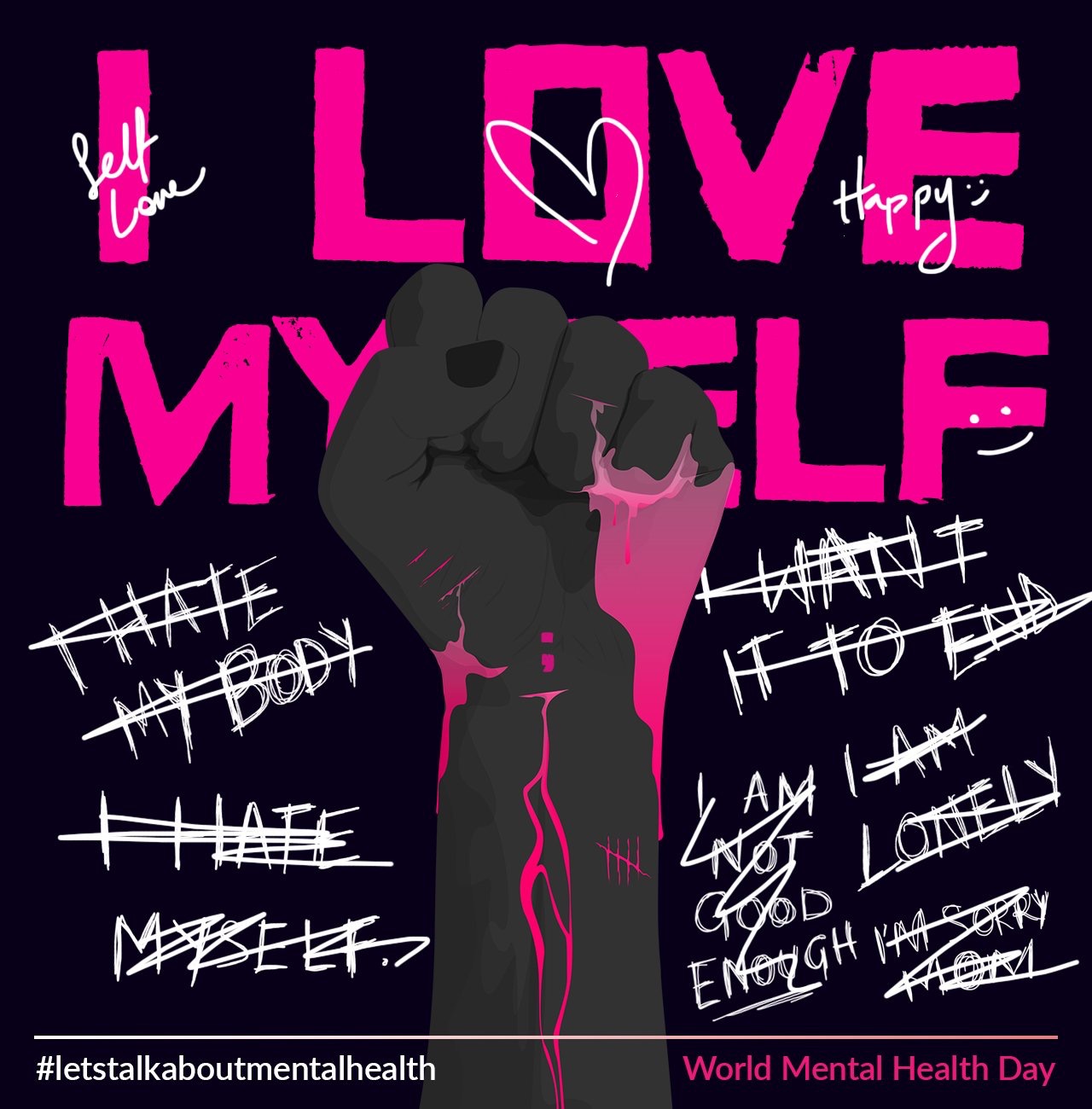
    #LetsTalkAboutMentalHealth by multidimensional creative from Lagos, Nigeria, Niyi Okeowo.

    Our parents might have made mistakes due to ignorance or the fear of the unknown but it does not mean we should. Depression is the number one cause of suicide in the world.
    Do well to communicate with your kids and know what is going on in their lives. You should be able to detect a change in their behaviours and eating habits and know the reason why.
    When an adult is depressed, the people closest to him/her notice. The key is to know what triggers their episodes and ensure that they avoid those triggers as much as possible. As an individual if you suspect you could be depressed, do well to seek medical assistance as quickly as possible. Suicide is not a solution to depression.
    Feeling depressed, talk to someone about it.


    Please if you experience suicidal feelings or thoughts [ Nigeria ], call these HOTLINES; +2348062106493 or +2348092106493. Remember you are not alone.