
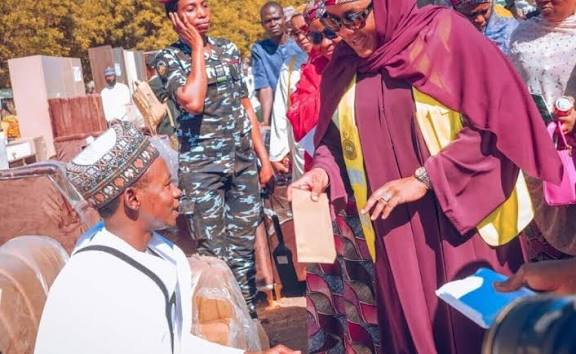
On Monday, 23rd November 2025, the Zamfara state Government sponsored a mass wedding involving 200 orphans (100 men and 100 women). The ceremony, held in the state, included the payment of ₦200,000 as dowry for each groom, alongside a ₦30,000 cash gift and household items presented to every couple.
Huniyya Dauda Lawal, the state governor’s wife, said the initiative was aimed at promoting dignity and comfort, adding that providing newly married orphans with household items and settling their basic needs would help them make better financial decisions.
Habib Balarabe, the official in charge of the state’s Zakat (Islamic almsgiving) board, also added that the mass wedding was a strategy to clear the streets and reduce begging. He commended Governor Dauda Lawal for staying true to his administration’s slogan, “Government of Rescue,” describing the initiative as a rescue mission against poverty.
Historically, mass weddings have occurred in different parts of Africa. In 2017, a charitable association (SOS 3e-age EL-Ihsane) in Algeria organized a mass wedding for 30 orphans and underprivileged couples. It was presented as a form of social support for couples who could not afford the financial demands of marriage.
In mid-October 2023, the Kano State Government organized mass weddings for 1,800 men and women. The programme, introduced in 2012, was designed to support widows, divorcees, and the less privileged who cannot afford the rising cost of weddings and family responsibilities.
Also, in May 2024, the speaker of the Niger state House of Assembly, Abdulmalik Sarkindaji, announced plans to organise a mass wedding for 100 female orphans who lost their parents to banditry in Mariga Local Government Area, offering to pay dowries as part of an empowerment project for girls. This announcement drew immediate opposition from the then minister of women’s affairs, Hon. Uju Kennedy Ohanenye, who condemned the initiative as a violation of Nigeria’s child rights and the Violence Against Persons Prohibition Act, which criminalizes forced marriages for women and girls.
The proposal caused public outrage, especially among men who planned to marry the girls and complained that they had been expecting government-provided household items as part of the marriage rites promised to them. Some of the girls also said they were not children and wanted to go ahead with the marriages. After discussions, a truce was reached. The marriages were later approved on the condition that all intending couples undergo medical tests, particularly genotype screening. The minister also stated that any girl who wished to continue her education should be supported to do so and urged each couple to open a bank account where they would receive financial support from the government.
While the intentions behind these initiatives are often framed as benevolent, they raise troubling questions. When did marriage become a charitable act or a tool of social intervention? How did marriage evolve from a social institution into a key poverty-alleviation strategy? Where does education as the path to success now stand?
In a country ranked the 12th poorest in the world, where 40.1% of citizens live in poverty, 63% are multidimensionally poor, and 18.3 million children are out of school, education and job creation should be treated as a national emergency. The rise of Almajiri children begging on the streets, enduring harsh living conditions, and facing exploitation, including child marriage, is a direct result of this entrenched poverty and lack of access to education.
Originally, the Almajiri system was designed to teach children, mostly from poor families, about the Qur’an and Muslim culture. It was a meaningful initiative until the Zakat (Islamic almsgiving) could no longer provide allowances for the Mallams who taught the children. To survive, many Mallams turned to farming and livestock rearing, and in the process, forced the children to beg for themselves.
Although both federal and state governments, particularly the Kano State Government, have attempted to reform the system by enrolling Almajiri children into formal education, it remains a persistent social problem due to its root causes: poverty and government neglect.
For many parents, sending children to Almajiri schools reduces household expenses, and without social welfare support for families and children, the system continues.
During the Goodluck Ebele Jonathan administration, 157 model Almajiri schools were built to integrate Western subjects and improve students’ quality of life. However, after his tenure, these schools were largely abandoned, teachers were left unpaid, and the system reverted to the informal structure.
These state-organized mass weddings expose the same governance failures that allow the Almajiri system to persist. Rather than addressing the root causes of child vulnerability, poverty, lack of education, and weak social support, the government opts for short-term, highly visible interventions that do little to solve underlying problems.
As a result, Nigerians continue to lack access to quality education, proper healthcare, stable security, and gender equality, while regulatory systems meant to protect citizens remain weak or ineffective.
Marriage, as an institution, began to lose its credibility when it became a marker of social and economic status used to pressure women into staying with men, while granting those men greater power and social standing in return.
When social problems in Nigeria are consistently “solved” with marriage, one begins to wonder if men have become the new occupation and source of income. When women are forced to rely on men for survival, they are placed beneath men, widening the gender equality gap.
Many of these men, who are themselves poor and lack the skills to survive under Nigeria’s harsh economic conditions, are unable to provide adequately for their wives and children. This means women cannot access proper maternal healthcare, nutrition, or safe delivery services, leading to high rates of maternal mortality. When a mother dies, her children are frequently left without care, forcing them onto the streets or into the hands of relatives or traffickers, further perpetuating cycles of vulnerability and exploitation.
According to UNICEF, children from the poorest households are disproportionately affected, with traffickers exploiting both economic desperation and parental helplessness. In northern and southern states alike, traffickers prey on out-of-school children, forcing some into domestic servitude, street begging, or sexual exploitation, while others are trafficked across state and national borders for labor or sex work.
Women are widely perceived as objects, fragile, incomplete beings who are only considered whole and socially acceptable once they marry a man. Hence, the extreme and often absurd measures taken to ensure women are married, including state-sponsored mass weddings.
Patriarchy, in its form, is a social madness, and the damage it causes is too numerous to mention. To dismantle this virus, society must critically examine both its actions and its silences. Women and girls are complete human beings. Education remains the primary pathway to social mobility, and orphans need therapy, financial support, and practical skills, not marriage, to survive.