We’re back with the #SafeZone series with a new submission from Nana Prempeh in Ghana talking about the suicide/mental health issues being a reaction to the inner workings of a mind being troubled.
I don’t remember winning many fights. In fact, I haven’t been in enough to warrant counting. In JSS 2, however, I slapped someone. Hard. He was for all intents and purposes, my best friend at the time. And to be honest I was more shocked than he was at that slap and its ferocity. Being petit, it had always been my wont to extricate myself from rapidly escalating volatile situations — typically through humour — or avoid them altogether. But that morning as the school assembled, I could not let the threats being thrown in my direction by Lero — after he had hurled a fistful of sand at me — go unchecked. I figured with nearly the whole school bearing witness if I didn’t defend myself then, whatever thin insulation had kept me from being bullied more often would thereafter be useless. So, I slapped Lero. My best friend. Back then, (and to some extent even today) a slap was a more concrete determinant of who had won a fight. Anybody could throw or take a punch. But a slap? That was reserved for parents and high ranking military officers. To be slapped therefore simply implied that whoever did the slapping had psychologically declared some sort of authoritative dominance over whoever was slapped. Lero was dazed. Furious, but dazed. He was taller and most certainly bigger. He could have easily beaten me had he not been held back and kept from retaliating. So according to the unspoken law of the street, I had won the fight. Consequently, he took the liberty, as most people in his shoes would, to even the scales of our mutually but unevenly bruised dignities, by calling me all sorts of names and going so far as casting aspersions on my mother.
I recently recounted the story to someone, adding that I don’t think that Lero meant what he said about my mother. To this, the person replied “No. He meant it. It must have been on his mind for a while.” In other words, the fight offered him an outlet for something he had been harbouring in his heart. I have often thought about that fight. I have thought about how we moved on after a few weeks as though nothing had happened. Neither of us ever brought it up. For a very long time, I lived in fear that he was planning some sort of retaliation. It never came. Even though we have remained friends (it’s been years since we last spoke though), the words he said about my mother never went away. I tried to convince myself that he said them in anger and therefore did not mean them. But a part of me didn’t believe that. Sure, in anger we may make regrettable utterances, but does that mean they are untrue (as far as our perception of them is concerned)?
Anger is a dangerous thing not because it destroys per se, but because it reveals.
It strips the soul into a bare form of utter nakedness. As fire, it refines by burning away the comfortable fat we routinely parade ourselves in. As water, it washes away all the extra clay we wear so we can easily blend in. It is dangerous because it is powerful in its rawness. In its purest and scariest form, more commonly referred to as rage, it reveals more about a person’s heart than anything else, except love. At the tipping point of a person’s temperament, there are no filters, just an aggregate of personhood. Lero did mean what he said about my mother. At the moment he made this known, it was from a place of anger and therefore meant to injure me. But while it lay as a dormant seed in his heart, he may well have weighed it in a different light; as only a matter of fact without any personal prejudice. That is until the moment his heart had to make a judgement call on the said matter of fact.
This idea of people being fertile soil for holding dormant seeds of various behaviour has become increasingly intriguing to me. People often assume that when the unexpected happens it must be the result of some form of transformation. And that such a transformation is evidence of change. So, during a spousal conflict, for example, one may say to the other “You’ve changed!” This usually suggests that the “changed” person has moved away from a previous state; a predictable state. I somewhat struggle with this idea. I believe in change and changing, however, I find that in many cases the transformations we encounter are not ones of change necessarily but of evolution. Evolution — not in the strict Darwinian sense but a banaler one — offers a more reliable barometer for gauging transformative human behaviour. In this sense, a change would suggest a resolute departure from a previous state whereas evolution would imply a gradual growing into or coming of age of those parts of an identity that was theretofore latent.
Some people subscribe to the theory that given the right conditions anyone is capable of anything. Others believe that it is merely in the nature of certain people to do certain things.
The current epistemological framework wherein the nature vs nurture debate sits supports the idea that the two are practically interwoven. Genetics influence the formation of an individual’s identity and how that identity interacts with prevailing environmental factors. But also, the environment an individual is formed in bears great weight on their identity, even to the point of affecting how certain genes are expressed. What this proves to me is that while people’s behaviour is determined by competing for sociological and biological factors, we are all susceptible. Each of us is susceptible to evolving in a particular direction. As socially interactive (or not) and emotive beings, we are particularly susceptible to mood variations and behavioural swings that could very well be symptomatic of an underlying mental health issue.
It is almost becoming hackneyed to hear that people who may have committed suicide (as a result of depression or any other mental health battles) seemed fine or happy. In such situations, people usually set off looking for signs of what may have triggered a series of eventually fatalistic changes. What changed? Sometimes, nothing specifically. Sometimes, it is just that a beastliness within evolved without notice, and eventually devoured a person that appeared okay.
When we look at people, we tend to see only those things that we are willing to see. A lot of times the reason heartbreak, for instance, hurts so much isn’t because it is a sucker punch. Au contraire, it’s because somewhere in the abandoned abyss of our hearts, we saw the gradual unfolding of a potentially destructive seed and brushed it off as nothing. It is more or less the same thing with mental health issues such as depression. It is easy to ignore but certainly not something that is absolutely inconspicuous. We can see it. We see the stealthy crawling and the gradual creeping of a seemingly inconsequential plant, snaking its way around a tree destined to be mighty. We see the life being choked out of what is supposed to be living, but in our minds “it’s such a small thing,” “it’s no big deal.” And then in a blink of an eye, the work of destruction is done and something beautiful is stolen and killed. At other times too, we see and try to act, but in the end, it is not enough. It hurts. Speaking to People Magazine, a source revealed that just hours after his reported suicide, producer and DJ Avicii had his brother arrive in Oman to bring him home because the family was worried about him. In a statement released to the public, the family said: “He could not go on any longer.”
Too many people are tottering on the edge of “can’t go on any longer.” You may have heard it said that “When people show you who they are, believe them.” Let me take it further and say “When people show you what they are going through, believe them.”
It is bad enough that in places like Ghana (and Africa in general) there is a generally poor disposition toward mental health issues. It does nobody any good for us to blend in with the precarious norm of such an environment. An environment where schooled individuals obdurately insist that mental health matters are un-African. Without a genuine willingness to be open to seeing the signs that people may (or may not) show us, suicides and other related mental health problems will continue to take us by surprise.
I spoke of anger earlier and how pure it is as a revealer of identities. I mentioned how it seems to only share this with love. Anger is dictatorial; tyrannical. Love, on the other hand, offers us a more surgical and refined path toward unpeeling. When love is true, the revelation of self is easier to come by and mostly, more readily provided. Where anger lends itself to forcefully stripping us naked, love lends itself to voluntary bareness. We reveal the pith of our being in love. Love is a surer key to unlocking the concealed self. If I love my neighbour better, it is easier for me to see them and what they are. In love, it is easier to see their laughter and their pain and to be able to tell the difference even when one mimics the other. Most importantly, it enables me to offer an arm of support to my brother or sister who may be fighting to keep the beastliness of mental illness at bay. It isn’t always about dramatic changes and big triggers. Pay attention to the little signs as well.
Written By Nana Prempeh
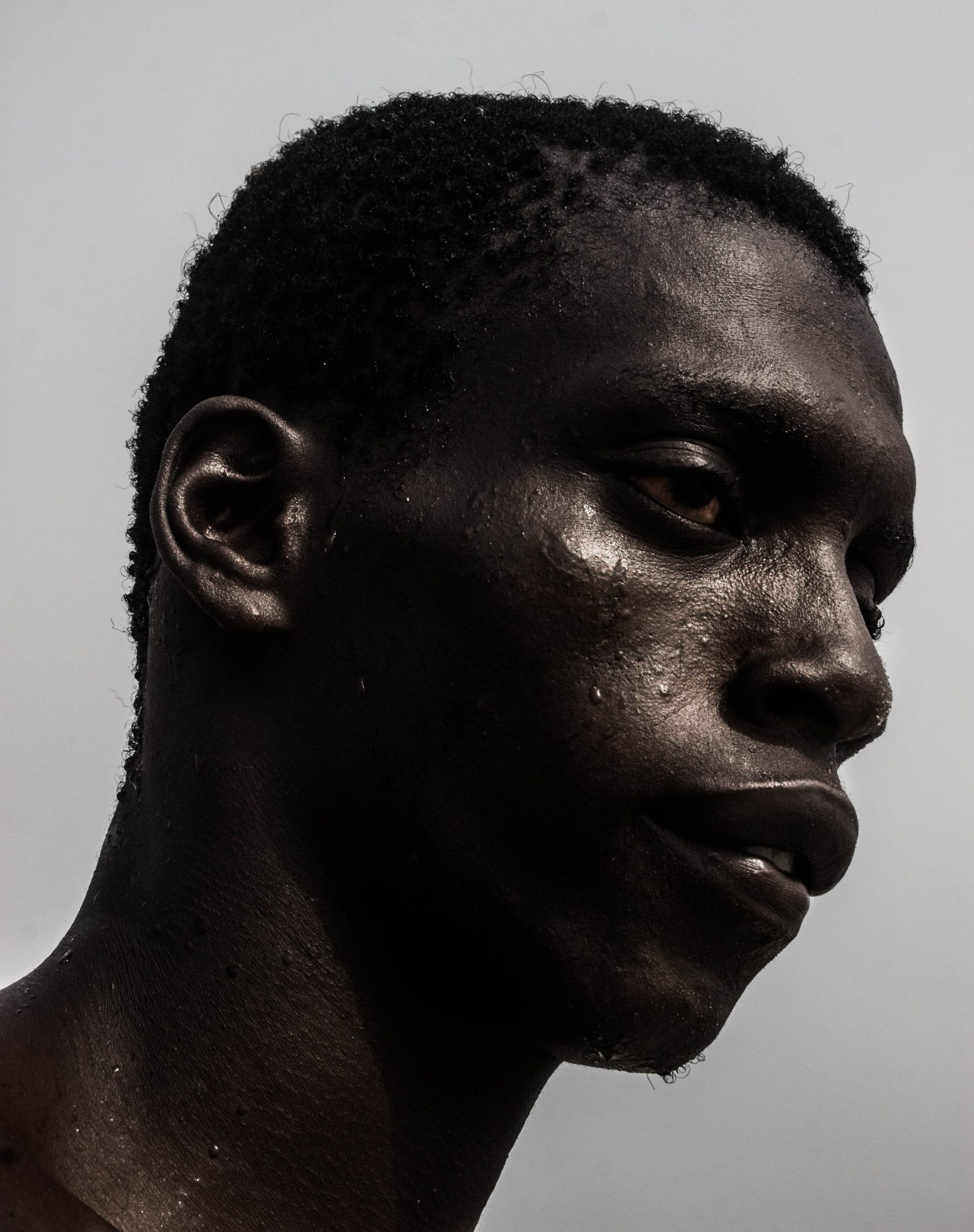
Feature Image By Thompson. S. Ekong