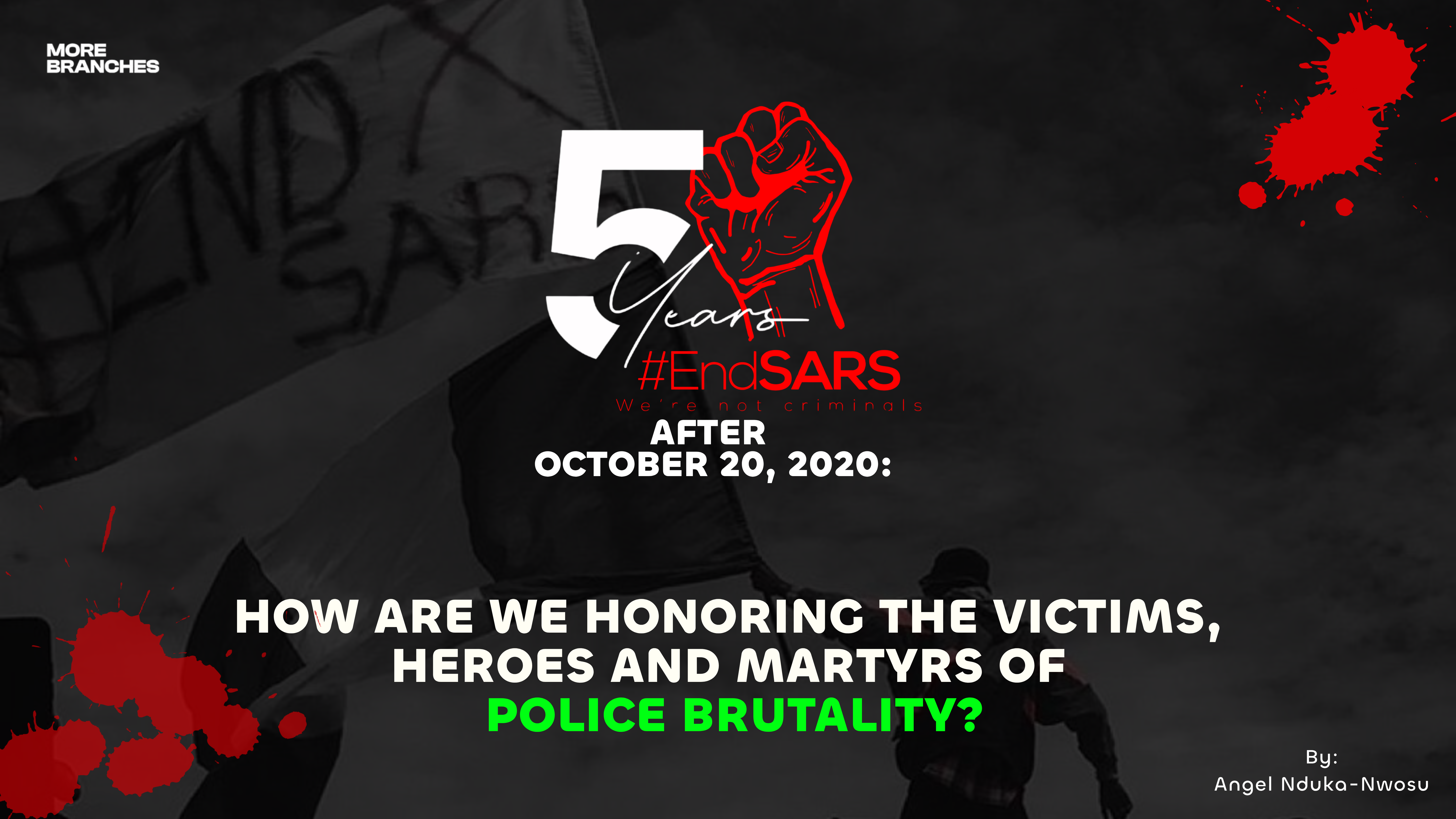
Today is October 20 2020, a very pivotal date in the history of Nigerian protests against the police. This is because the Lekki Massacre happened five years ago during the ENDSARS protests.
Protesters at the Lekki Toll Gate were shot by military officers, even though some of them were waving the Nigerian flag; an act they believed would save them from violence. Till date, one of the emblems of the Lekki Massacre is the picture of a bloodied Nigerian flag.
What were they protesting against? An end to the violence and brutality of the Special Anti Robbery Squad (SARS), notorious for harassing mostly male youth and accusing them of being cyber criminals.
Although the ENDSARS protests came into full limelight between October 6 and October 20 following a tweet by Nigerian singer Runtown, the hashtag #ENDSARS had been in use since 2018 to draw awareness on the fear of being killed by the police and arrested arbitrarily. While the ENDSARS movement is the most visible of protests, Nigeria has a long history of using the police force to rein its citizens in.
When I think of the events of April-May 2019, I remember a series of protests that I co-organised called #SayHerNameNigeria.
What happened? Officers at the Abuja Environmental Protection Board (AEPB) had worked in partnership with police officers to arrest over a hundred women non-constitutionally. Some were in a lounge. Others were walking randomly in the street.
The most heartbreaking of all was receiving the news that some arrested mothers who were breastfeeding were denied the right to breastfeed their children. Even more heartbreaking was hearing that the police raped the women who could not afford the 5k bail and did so with sachet water nylons as makeshift condoms.
Now fast forward to June 2020, and yet another teenager was on the receiving end of police brutality. Tina Ezekwe was her name, and she was shot by a police officer.
In my quiet moments, I have often wondered why #SayHerNameNigeria and the ensuing protests in June following Ms. Ezekwe’s death, like #StateofEmergencyGBV did not see a global revolution.
Even in issues not particularly centered on women, the Nigerian police have been used to drive fear in the lives of its citizens. One movement that stands out is the #AcquitThe57 movement. In 2018, 57 gay men and those assumed to be gay were arrested at a party in Lagos and subjected to dehumanising treatment at the hands of the police. Knowing how much Nigerians have hatred for those who are queer, their arrest was not given adequate amplification it deserved online.
The overarching question remains: “Five years on, how are we ensuring as Nigerians that the murder and massacres of those at Lekki, Mushin, and other places are properly honored?”.
Five years on, how are we ensuring that the murders and lives of Nigerians lost to police brutality push us to create a better Nigeria? How do we ensure that these martyrs and heroes who died protesting against police brutality did not die in vain? What systems are we putting in place to ensure that not only are their memories preserved, but also that their labour for a better nation is documented and taught to the next generation?
Five years on, how do we ensure that the murders of people like Oke, a budding designer, translate to a proactiveness in protecting those who are designers from the hands of brutal police officers who assume that anyone with a laptop is into cyber fraud?
Can we do that and draw a line from the public’s growing unlooking of fraud in our music lyrics to our apathy and emotional tiredness in holding the police accountable? Can we even hold the police accountable, or have we become so tired of the truth that to live in Nigeria is to be bombarded constantly with the knowledge that death is a constant shadow waiting to force you into its hands?
It is all of these dilemmas and seemingly contradictory questions that we must contend with on this anniversary. Aside from mentioning the names of victims of police brutality like Oke and Tina Ezekwe, in our little corners, we must ensure that as Nigerians, we are intentional in building the Nigeria of our dreams. We must be intentional in honoring those whose lives were lost in the fight to ENDSARS and in the battle for a better and equitable Nigeria.
It can look like writing petitions to ensure that streets and major roads are named after the victims of state-sanctioned police brutality. The way women victims of the military era, like Alhaja Kudirat Abiola, have roads named after them in Lagos, we should push for women victims of police brutality, like Ifeoma Abugu, to have roads named after them.
There should be films made in honor of people like Oke. Special days should be set aside to honor the women who were victims of the April 2019 AEPB unlawful arrests.
Until there is a collective sense of anger at injustice, we shall remain confined to the state of resigned collective amnesia and fizzled anger that seems to now define the state of Nigerians.