What was once promised as a coastal road from Lagos to Calabar has moved deadlines, changed its cost story, drawn a court challenge over how it was awarded, and sparked an argument over an environmental law. This week it is being diverted onto an older road. The government says it is on track, but the reality says otherwise.
On Monday, Works Minister David Umahi stood outside the State House in Abuja and said what he has had to say a lot lately. Nobody, he said, has abandoned the Lagos-Calabar Coastal Highway. In the same briefing, he said President Bola Tinubu had told him to pass part of the road through the existing East-West Road, and that the ministry would ask for approval to add 400 km of that older road to the programme.
The project, put at 750 km by the government, is the signature infrastructure promise of the Tinubu administration. 31 months after the March 2024 flag-off, only a 47-kilometre stretch in Lagos has been built. Behind it is a trail of moved deadlines, legal cases, and an unresolved question about whether a law that requires an environmental assessment before construction was followed.
No court, auditor or investigative body has found fraud or wrongdoing on this project, and the government rejects the charges. Many of the loudest accusations have come from opposition figures and the general public.
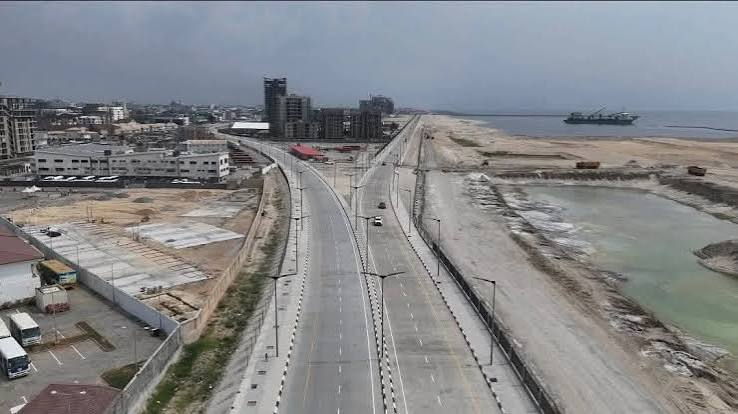
The Lagos end is the best test of the government’s word, because it is the part that exists. In February 2025, Umahi said the first 30 km would be commissioned before 29 May 2025, and the contractor’s managing director, Dany Abboud of Hitech Construction, said the company would work “day and night” to meet it. The stretch opened temporarily on 12 December 2025, 197 days later, to ease festive traffic. The ministry said then that the full 47.474 km would be done by the end of the second quarter of 2026, and that Sections One and Two, 106 km together, would be finished by December 2026.
In February 2026, Umahi said Section One would be commissioned on 20 May. On 7 May, officials said the road was about 98% complete, and the Federal Controller of Works, Olufemi Dare, called it “completed and ready for commissioning,” even though about 200 metres of pavement had been left unfinished because the soil was still settling. On 16 July, Umahi announced the highway would carry Tinubu’s name, citing the completion of Section One and describing the road as a dream the president has held for 27 years, since he was governor of Lagos. By 12 October, reports of Umahi’s briefing described Section One as “being fully constructed,” and Section Two, 55 km to the Lagos-Ogun boundary, was due to have its dual pavement done by mid-November.
The record is not one of failure everywhere. A real road with flyovers and interchanges stands in Lagos. But each date has slipped by months, and each new date arrives with the same confidence as the last. In May 2026, Umahi said motorists would drive to Ondo “before this time next year.” The ministry’s own account of the Ondo section has since changed.
The Environmental Impact Assessment Act of 1992 (No. 86 of 1992) says public and private bodies “shall not undertake or embark on or authorise projects or activities without prior consideration, at an early stage” of their environmental effects. Its schedule lists the construction of expressways and national highways among the projects that must go through a mandatory study, and the Act provides for the public to comment on the screening report and for public hearings. The penalty for non-compliance is modest on paper: a fine of N100,000 or five years in prison for an individual, and N50,000 to N1 million for a company.
Construction was flagged off in March 2024. On 3 May 2024, the Minister of State for Environment, Iziaq Salako, told Arise News that the Works Ministry had received a “preliminary impact assessment certification for site clearance and scoping for compensation.” He said certification would be done in phases and that the government was taking what he called loopholes in the law to the Federal Executive Council to be closed. On 25 May 2024, Umahi told stakeholders the assessment would be “ready and made public in the next three months,” and that “no project will be allowed to go on if the environmental and social needs are not taken care of.”
In October 2024, five months later and with the road under construction, a panel set up by the Environment Ministry was still reviewing the draft. Panel member Engr. Dr. Musa Emoabino said, “We have not seen the technical justification for the change” to the Okun Ajah alignment. A stakeholder, Engr. Femi Adekoya, said the Works Ministry had “put the cart before the horse.” In January 2025, lawyer and politician Funso Doherty asked the Federal High Court in Lagos to declare that starting construction without an assessment was unlawful.
The government’s position is that the process is phased and that preliminary approvals are allowed under the regulations. Salako said as much. In the reporting we reviewed, we did not find confirmation that the final assessment was published within the three months Umahi promised. A contractor summary cited by Within Nigeria, which attributes it to BusinessDay, gives a Section One approval date of 8 November 2024, after work began; we could not check that document. And since the route has now moved, CSR Reporters and others are asking whether the new Ondo and Edo alignment needs fresh assessments. Nobody in government has answered publicly.
Doherty’s suit names the Attorney General of the Federation, the Bureau of Public Procurement and Hitech. He alleges the first two sections were awarded by single-source procurement, in breach of the Public Procurement Act 2007. Umahi’s account, as summarised by Within Nigeria, is that the project began with restrictive procurement sent to the Bureau and the Federal Executive Council, and that Section Two was then opened to selective bidding, which Hitech won. Doherty has said the case is before the Court of Appeal. No judgment had been published. A separate land suit brought by Winhomes was struck out in July for lack of jurisdiction.
On cost, the figures do not line up. In April 2024, Umahi said the road cost N4 billion a kilometre, about N2.8 trillion for 700 km. Former vice-president Atiku Abubakar said the N1.06 trillion allocated to the 47.47 km first phase implied about N22.5 billion a kilometre and a total near N15.7 trillion. In October 2025, Atiku said Umahi’s own recent figures were closer to N8 billion a kilometre and about $11 billion overall. A $747 million financing for Section One was announced in 2025, a syndicated loan led by Deutsche Bank, and one analysis divided it by 47.47 km to reach about $15.7 million a kilometre. That is an imperfect comparison, since a loan is not a contract price.
Atiku also alleged in April 2024 that the contract went to a company owned by Gilbert Chagoury without competitive bidding, and pointed to a business relationship with the president. His statement offered no contracts or budget documents. On 12 October, he alleged that a loan of up to $20 billion tied to the highway was being prepared for the National Assembly. CSR Reporters noted he provided no documentary evidence, and the Presidency, the Works Ministry and the National Assembly leadership had not responded in the reports we saw. On Tuesday, a presidential campaign organisation linked to the APM demanded publication of procurement and payment records, an independent engineering assessment of the Ondo change, and a cost audit. The budget trail is also murky: BudgIT flagged in 2025 that the highway seemed to be missing from the budget, and Umahi said it had been listed by mistake under the Lagos-Port Harcourt name.
The diversion is the clearest sign of the problem the critics describe. The government now says that part of its flagship coastal road will run along the East-West Road, an older route that, in Umahi’s words, was built before climate change risks were well understood and floods badly near Ughelli in Delta State. Those sections are to be raised by about 2 metres. Umahi’s reasons for leaving the Ondo coast are specific: pits more than 100 metres deep, and no suitable sharp sand even at depths of up to 300 metres. He called it “a very serious engineering decision,” said he welcomed the petitions against it, and said the government had no regrets.
The objections come from several directions. The Ugbo Development Congress and the Ilaje Omuro Community Connect say coastal Ilaje communities in Ondo could be bypassed and want an independent comparison of both routes before the original is dropped. The lawyer Ebun-Olu Adegboruwa asked the president to say which communities the road will serve and which it will leave out. Donald Duke, a former Cross River governor now running for president, argued that a continuous coastal road through that terrain would need many bridges. The YPP presidential campaign council said on Tuesday that existing roads should be repaired and rail should connect east and west, instead of a new road.
What we could not find is a published comparison of the cost of fixing the existing Lagos to Calabar routes against the cost of building a new coastal highway. Nor did we find a published explanation of why the coastal alignment was chosen beyond what officials describe as a long-held presidential vision. That comparison is the thing critics keep asking for.
When the statements are placed side by side, there’s an evident pattern. In May 2024, the works minister said the environmental assessment would be public within three months and that no project would be allowed to go on without its environmental and social needs met; five months later, a ministry panel was still reviewing a draft, and the road was already being built. In February 2025 he promised 30 km by the end of May; it opened in December. In February 2026 he promised commissioning on 20 May; in July the road was renamed for the president, and in October it was still being described as being finished. On Monday he said nobody had abandoned the highway, and also that the president had told him to divert it. A reader trying to work out the route, the cost and the approvals from the minister’s own statements will find that they disagree with each other.
The arithmetic is not kind either. The government said in April 2024 that the whole road would take eight years. Thirty-one months have gone, about a third of that time. The 47.47 km built is about 6.3% of 750 km. That is our own calculation from the government’s figures, and the first phase was always the pilot, but it is the number the project has to answer to. Add three cost figures that do not agree, a contract under challenge in court since January 2025 with no published ruling, no final environmental assessment that we could find, and a new route with no published approval.
The government may be right about the engineering. Pits 100 metres deep are a real problem. But a government that wants to be believed publishes the documents: the environmental assessment, the procurement approvals, the payment certificates, the cost of the new route. Until it does, the claim that the project is on track rests on one stretch of road in Lagos and the word of a minister whose word has changed too often to carry the weight. The people of Ilaje, Okun Ajah and the Niger Delta are being asked to take it anyway.