
Behind the brand Kkerelé is a talented designer and lawyer. Raised in Ondo state, Christiana Akerele carries a world of structure and creativity with her. For her, design wasn’t something to be admired; it was something she did.
Years later, this idea brought about Kkerelé. Right now, she designs the things she always wanted to wear and shares them with others who understand that language of style. Her process is where mood, memory, art, and intuition meet. It’s a place where design is never rushed. What some once called “weird” has become the brand’s strength.
Christiana also practices other forms of art; she paints for leisure, sculpts, and is interested in interior architecture and designing spaces. Telling the brand’s story is just as important to her as the designs themselves. Her journal entries communicate her values, bridging the gap between what she feels and what her audience sees.
“I see and I know that Kkerelé is more of a business, but I also see Kkerelé more as a practice.”
In this way, she deliberately invites her consumers to consider how her designs look and how wearing them makes one feel.
What was your “origin moment”? The first time you knew you were meant to create?
I have been designing for the longest time. So, I can’t pinpoint the “origin moment”. One of the impactful moments that I can reference would be when I was in uni and I had these hideous rubber slippers that I was trying to (in my usual style) upcycle. And I remember I had to work with this printed fabric I had lying around in the wardrobe. I did my little magic and just sort of created something completely new from discarded fabric and revamped the sandal. That was a very fulfilling moment for me, and it also cemented me as a self-proclaimed designer at that time. So while I can’t pinpoint the exact moment, that’s a very nice memory to have.
Let’s start from the beginning. What’s the story behind starting Kkerelé? What made you want to make shoes?
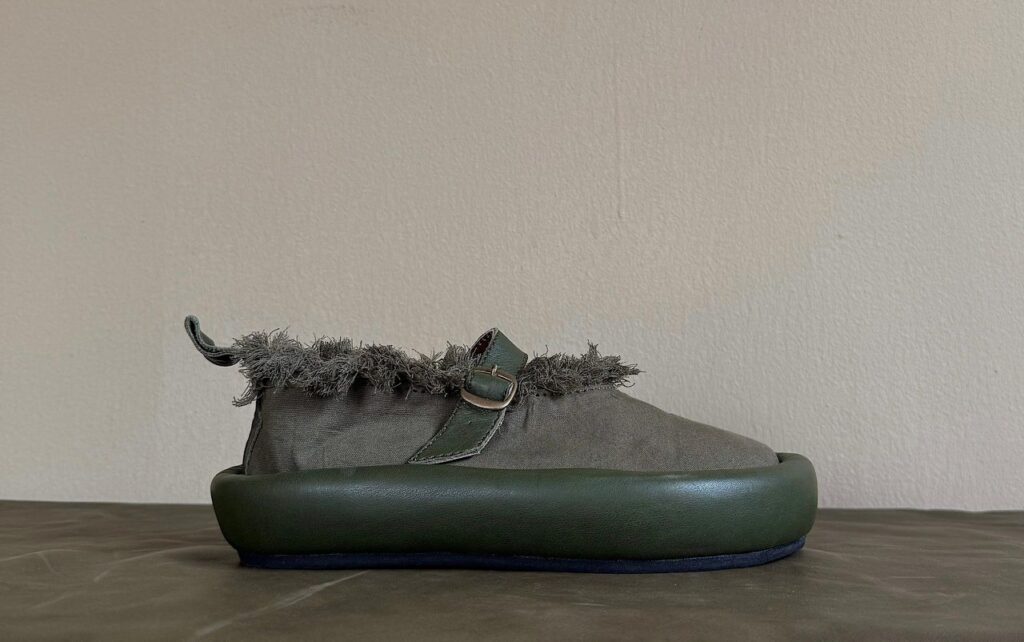
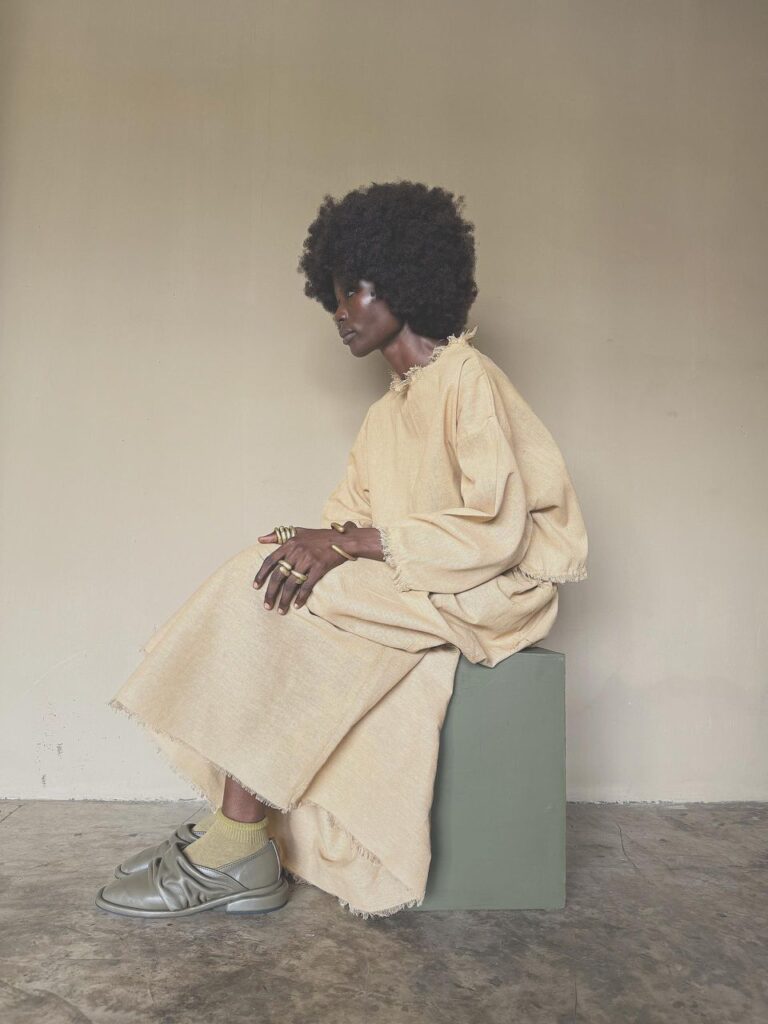
Back when I was in uni, I used to like quirky, unconventional shoes or shoes that were considered masculine. I used to get a lot of weird comments about it: “Why do you like weird shoes? Why are you weird? Why are you this?” But then, very few times, some people sort of resonated with what I was wearing and said, “Oh, nice shoes”, “I love your shoes”. That was what informed my design approach and has always been my design principle: designing for myself first and then sharing with people who have a similar sense of style.
And that still translates to how Kkerelé operates today—having a cluster of people who have a genuine interest in the quirkiness and the general form of the shoes.
What does Kkerelé mean to you personally, beyond being a brand?
Kkerelé, like all the work that I do, is a form of self-expression, a way of translating what is internal. The footwear, in this context, is simply the medium. But the impulse behind it is always the same: to express something of myself, honestly and intimately, through form. I am hoping that what I create touches those who carry a similar sensitivity and who understand the subtle emotional and psychological relationships we develop with the objects in our lives.
Last year, you opened your first flagship store in Lagos. What did that moment mean to you?
Since we started, the brand has existed entirely online. And while that’s been beautiful in its own way of reaching people across geographies and building a community through the screen, there came a point where it felt necessary to embody the brand in a physical form.
I’ve always believed that what we do goes far beyond footwear or even design as an object, so creating a physical space felt like the next natural extension of that dialogue. I wanted people to step into a space that carried the same intentionality as the objects we make. Watching people interact with the space, with the shoes, and with each other has been truly magical.
What’s the earliest memory you have of falling in love with an object?
A Vintage Mercedes-Benz 220.
It was the first object I remember falling in love with as a child. I didn’t have the language for “design” back then, but I remember being intrigued by the form. I must have drawn that car a hundred times.
How would you describe what you do to someone’s Yoruba grandma and someone’s 10-year-old niece in the same sentence?
Kkerelé creates really cool shoes for really cool people. Period.
A lot of your work feels rooted in reflection, like it’s not just “designed,” but listened to. Do you design from memory, imagination, or mood?
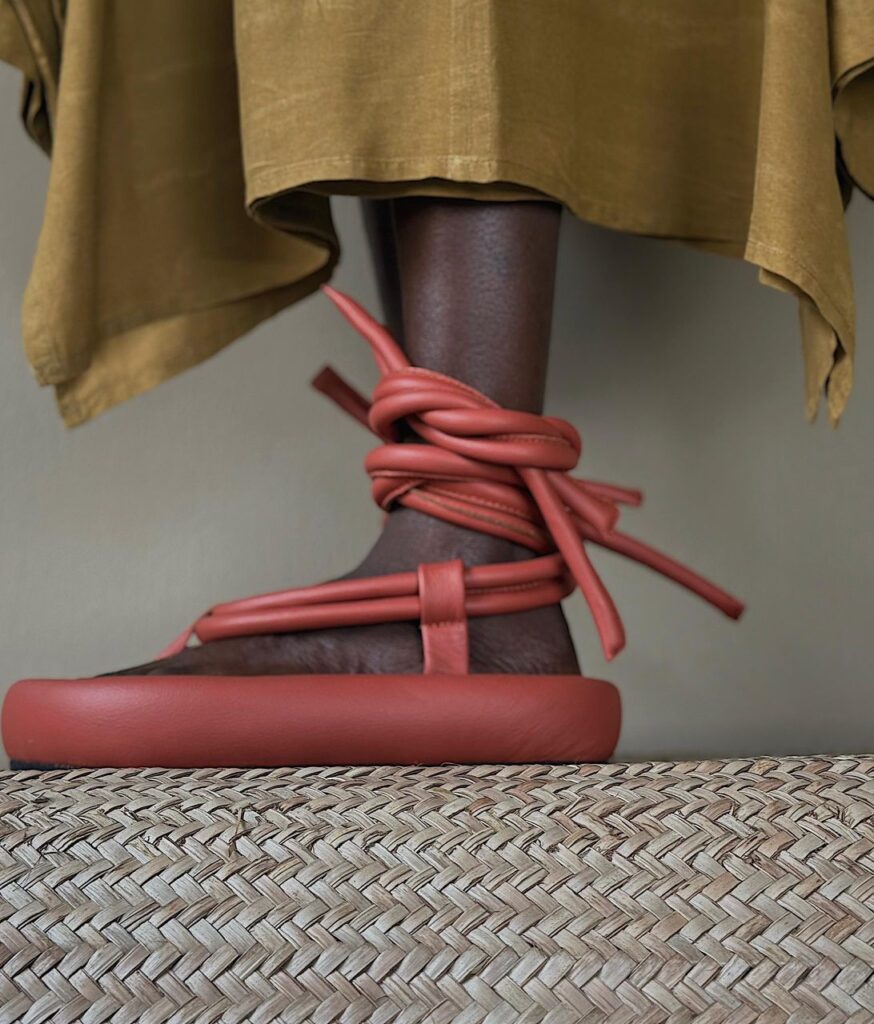
Ultimately, most of my designs are very intuitive. Most of our designs are also a reference to past silhouettes that I saw when I was growing up. Like the school sandals we wore when we were younger. A lot of my pieces, a lot of Kkerelé pieces are referenced from that particular era or time. Memory has a role in our design process. Intuition for me is: what do I need to design right now? What is that thing that needs to be put into the world right now?
Our use of colour shows how mood comes into the design process. I use colours to communicate how I’m feeling at a particular time. There are times when I just gravitate towards certain colours; I was obsessed with peach at the beginning of Kkerelé, so there were a lot of peach, pink, and red undertones. It was an emotion that I was feeling. Right now, I’m very attuned to suede textures and colours. That also means something emotionally.
If one of your sandals could whisper something to its wearer, what would it say?
It’ll probably tell them to be deeply aware of the physiological and emotional relationship they have with the objects they surround themselves with.
Your work is so rooted in identity and culture. What parts of your background show up most in your designs?
Growing up, I was quite shielded, and although much of my early life was shaped by quietness, I’ve always sensed and longed for the other side. There’s the part of me that is deeply introverted, reflective, pulled toward silence and solitude, and then, just as present, is the part of me that wants to explore and make loudly, and live expansively.
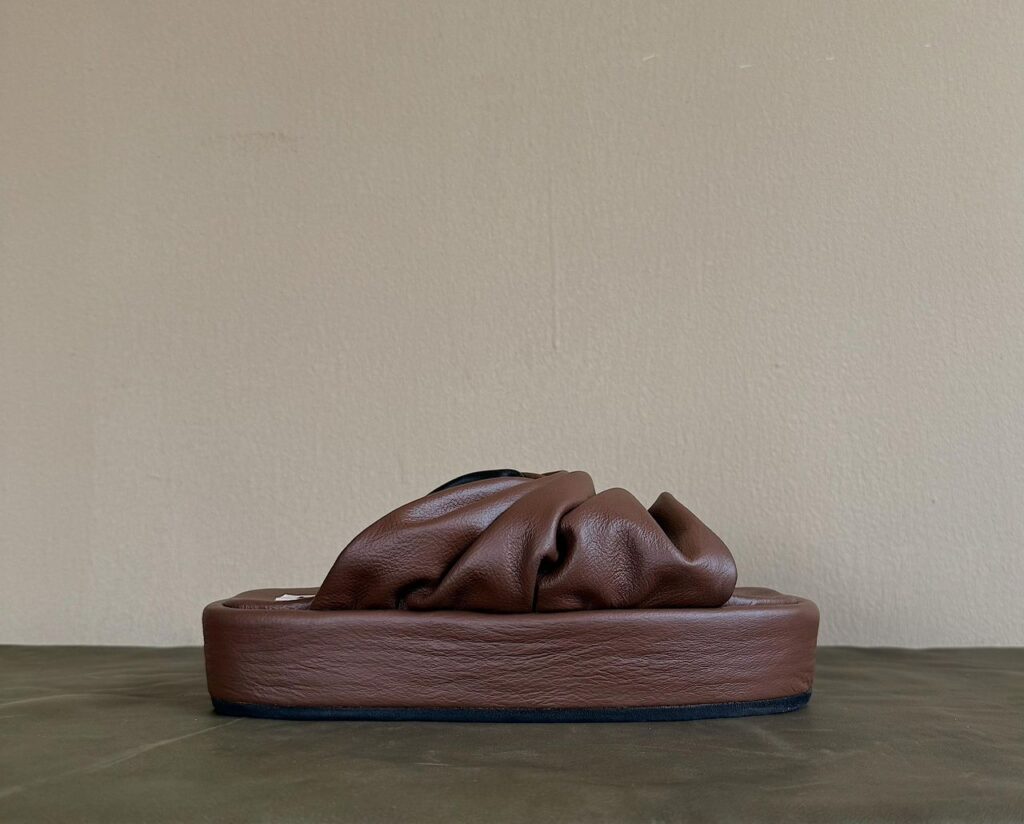
This inner polarity and the push/pull between containment and expression definitely show up unmistakably in my work. The shoes I design often carry that duality. Understated, almost meditative in their form, whilst also bold, pronounced, and expressive.
On the cultural side, my approach is grounded in responsiveness. Many of my design choices are shaped by what is locally available: materials, processes, and tools. There’s something powerful about building a design language from what surrounds you.
What do you think Lagos has taught your hands? Or how has Lagos influenced your craft?
The city has this way of forcing you to engage and respond. It sharpens your instincts. It teaches you to work through the chaos.
You talk about “making slowly” and embracing imperfection. In a world obsessed with speed and polish, what does it mean to design from limitation?
Design can be read as a form of knowledge that encodes the conditions of being human: vulnerability, desire, memory, contradiction. It resists the fantasy of flawlessness and refinement.
We constantly try to translate those sensibilities in our work. Much of it is handmade, which by nature carries slight irregularities, subtle marks, shifts, and textures. Something beautiful doesn’t arrive perfectly formed, but earns its beauty through the process of making and through its flaws. That middle ground is where I feel most at home.
What does it mean for you to live with the things you make? Do they surprise you?
Sometimes I look at my shoes and I can’t believe I designed that. Up until now, it’s still very surreal that I get to wear the things that I actually designed. For the longest time, it felt like an out-of-body experience. And I don’t think that feeling would ever go away. It gets me every time that I get to wear the things that I design.
Last one. What’s something you’re learning to unlearn?
I’m trying to unlearn the value system we’ve attached to speed and immediacy. Good design and process take time.