What to expect from Buhari’s 2nd Term?
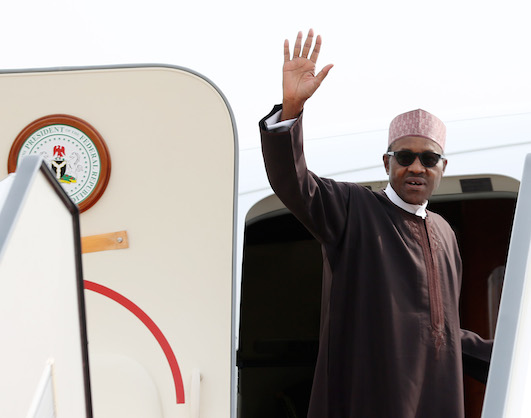
It’s a recurring joke on social media; the picture of Buhari waving farewell to God knows who followed by a litany of comments ranging from jokes insinuating Buhari is a travel and lifestyle blogger, to the claims that he also, like most Nigerians, would much rather prefer to live abroad. I love those jokes I really do. We know he travels for health reasons, he travels for religious reasons, sometimes he even goes just because he was invited. What we don’t know is if there’s some sort of foreign policy direction behind his numerous trips. We can only hope, as there’s no clear pattern to his travels. As we wave farewell to his first term in office, let’s take a look at what to expect from Buhari’s next 4 years as president.
Forecasts can be tricky, not making any promises but these are the broad strokes to be expected in the next 4 years. To be concise I’ve decided to break it down into 3 priority categories; Security, Economy and Power, then one more general category to cover the others.
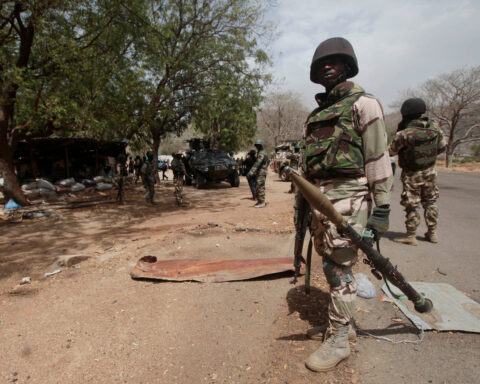
SECURITY: Preservation of human life must always be a top priority for any government. In his first term, the General wasted no time mobilising the military to reclaim all territories lost to Boko Haram insurgents. This aggressive strategy may have worked a little too well, as the army then took their foot off the pedal and this laxity was duly taken advantage of by their opponents. There’s also the issue of violent herdsmen rampaging across the north and the sporadic religious attacks in states like Kaduna and Katsina. Going into the next level I expect Buhari to continue to support strong military action with an early shuffle in Military leadership. The military’s ‘Operation Safe Haven’ seems to have curbed the herdsmen issue, but don’t expect the issue to be fully solved until a lasting solution to the grazing issue is found. Promises have also been made to decentralise police funding, which may improve quality of law enforcement at the community level, this may help curb the kidnapping issues. All in all, security is Buhari’s strong-suit, Nigeria’s internal conflicts may be complex and multifaceted but expect at least a satisfactory performance from the general in this regard.
Performance Prediction: 8/10
ECONOMY: For those living in more secure parts of the country, this is the area most likely to affect their day to day lives. Economically speaking, Buhari’s first 4 years were up and down, maybe a few more downs than ups. We can’t overlook the fact that the economy had not been managed that well beforehand but the bedding in period/time for excuses has passed. Buhari’s first term ended with one damning statistic ringing out for the entirety of campaign season, Nigeria is now the poverty capital of the world.
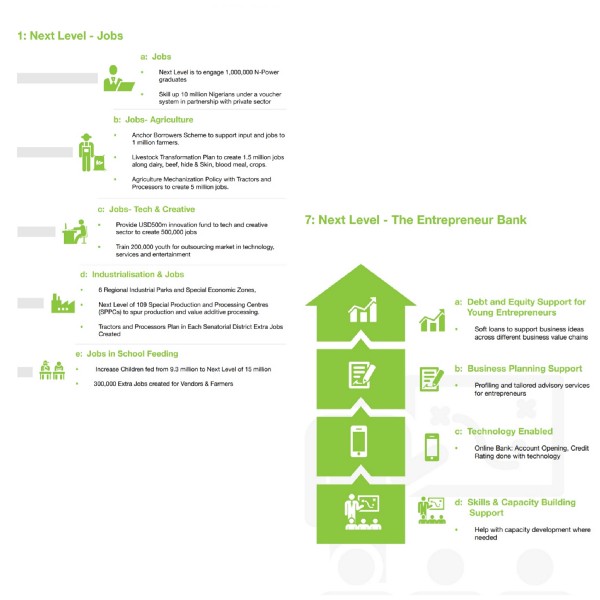
So far, this government’s plan has been to respond with massive social investment schemes, huge investments in infrastructure and avid support for MSMEs. They’ve also looked to reduce dependency on the dollar by cracking down on unnecessary imports, and improved trade relationships with China. Agriculture has been heavily supported with incentives and subsidies as well, and local production has seen growth in the past few years. While these are all great, the social investment programmes being a point of particular pride, question marks remain surrounding Buhari’s economic policy. The key concerns going forward will surround Forex policy and whether to devalue the Naira or not, best fiscal policy to get more money into circulation and curbing the poverty endemic. It’s not an easy task and for a Nation we now have to admit is poor, it will require a great deal of creativity. Going forward, expect more of the same and increased support for small business owners and local industries. The refineries nearing completion will also be a major boost for the economy and with the senate and house of representatives now aligned with the centre, policies to improve ease of doing business should be moved along quickly.
Performance Prediction: 6.5/10
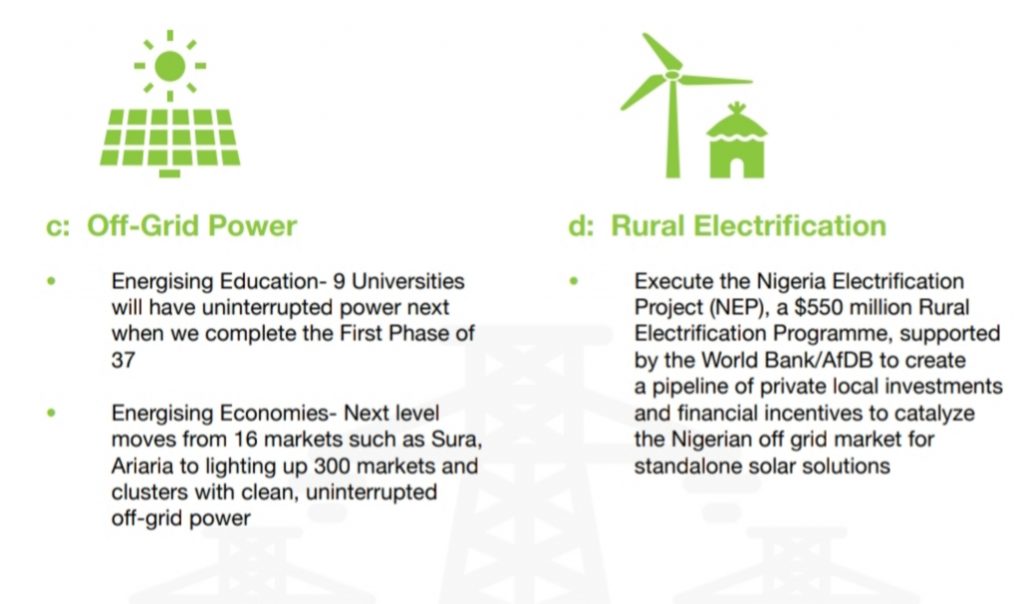
POWER: I recently came across a chart detailing the interrelationship between a countries power production and its economic prosperity. Not surprisingly, the countries with higher power outputs had better performing economies. Nigeria may be Africa’s giant economically, but specifically in terms of power we are definitely of below average stature. For businesses, the lack of steady power means increased overheads due to running and maintenance costs for a generator or whatever alternate power source they decide to use. On an industrial level, running a factory on a generator can be a high cost burden and is definitely a contributing factor in the rash of companies packing up and leaving Nigeria. If this government is serious about making life easier, power must be a priority. There’s one hold up though, the government isn’t exactly in charge of the power sector anymore. Back in 2013, the Goodluck administration privatized the power sector, PHCN ceased to exist and the Nigerian Electricity Regulation Council (NERC) took its place. The idea was that private sector involvement would improve efficiency and the government would only need to serve a regulatory role, funny how ideas don’t work in Nigeria. It’s a complicated situation, one which I’m sure Buhari hadn’t envisaged before entering office. It’s no surprise then that his 2nd term manifesto includes revised, more realistic, power targets. Expect a modest increase of 1,000 MW per annum to the grid and distribution to get up to 7,000 MW, dull. What’s exciting is their plan to power 9 universities as well as major markets and commercial hubs across the country, small but the journey of 100,000 Megawatts begins with a single watt (See what I did there?). Personally, I’d prefer faster growth in this sector, but I’m not sure the funds are available.
“There’s one hold up though, the government isn’t exactly in charge of the power sector anymore…The idea was that private sector involvement would improve efficiency and the government would only need to serve a regulatory role, funny how ideas don’t work in Nigeria.”
Performance Prediction: 6/10
OTHERS: There are quite a few things I couldn’t group into the 3 main categories, which are still very much important. They include, but aren’t limited to, areas like the Anti-Corruption war, Education, broadband and internet infrastructure, improved legislation and last but not least health.I’ll briefly run through what to expect from a few of them.
Education First; if there’s anything history has taught us it’s that a lack of investment in education will always come back to haunt us. Perhaps heeding this, following a poor performance in this regard during his first term, Buhari’s 2nd term manifesto includes promises to renovate and modernise 10,000 schools per year across the country. They’ve also vowed to work on the curriculum with a focus on digital literacy and retrain teachers (maybe they should take a page out of El-Rufai’s playbook for that). These are all great ideas that can help utilise our numbers and create a valuable workforce within a generation, whether they will be implemented properly remains to be seen.
Health: It’s a major indictment of our health sector that even our president seeks treatment abroad. Buhari, more than anyone, must know that this can’t continue to be. Questions surrounding national health insurance schemes, investment in the health sector, and the brain drain of medical professionals moving abroad have been asked for years. This term we may see some effort towards answering those questions as the manifesto includes a full page on healthcare; the administration is promising a co-payment health insurance scheme that will exclude payments for the poor, 1% of the CRF (Consolidated Revenue fund) dedicated solely to healthcare, and a healthcare package that’s supposed to cost just N500 monthly. The N-power programme also promises to send more young doctors to rural communities. For the sake of the average Nigerian, I hope that these ideas come to fruition.
I won’t speak on the anti-corruption war right now, while it has served to deter the kind of brazen theft witnessed under the Goodluck administration, it has also been highly politicized. The best case scenario right now is for Buhari to sit back and let bodies like the EFCC and the CCT etc. do their jobs, properly. The war is over, let the system work and grow.
Overall Assessment: I think Buhari’s 2nd term will be satisfactory. The man, popularly known as ‘Baba go slow’ has a lot to do; he will attempt most of it and get some of it done. Perhaps after years of rushing without getting anything done properly, slow and steady may get us further in the race than expected. With 4 years of experience under his belt and his able vice president by his side, Nigerians, whilst remaining vigilant, can at least be assured that there will be some progress. 2nd Terms are about leaving legacies; we’ll see what Buhari’s will be.
Overall 2nd Term Prediction: 7/10
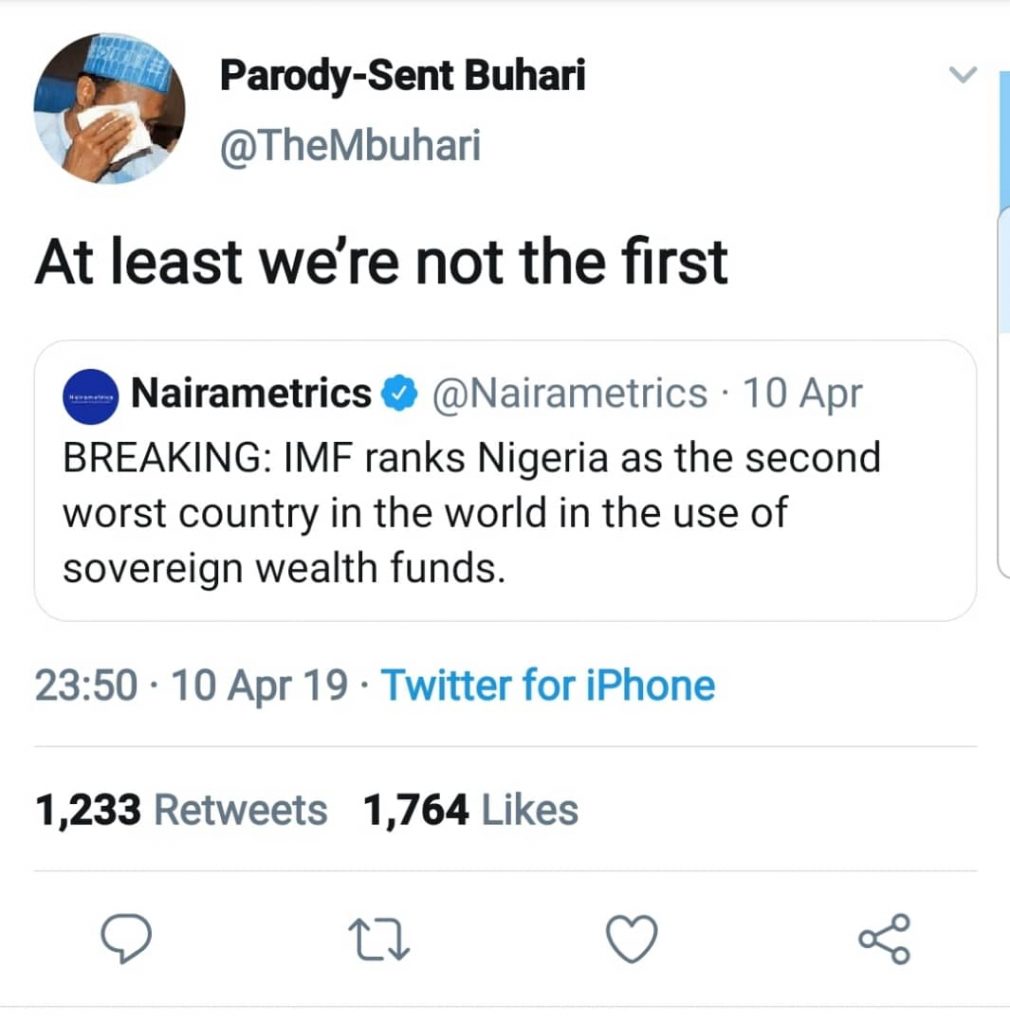
I’ll leave you with one of my favourite tweets from everybody’s favourite Buhari parody account