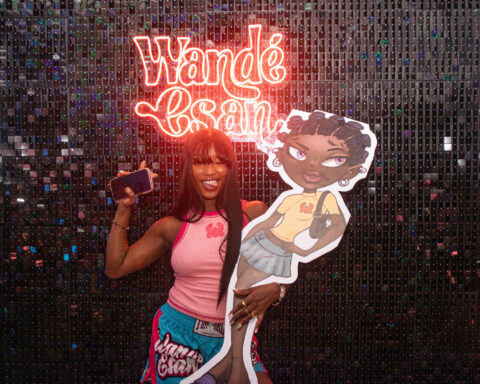
The ember months mark the season for Nigeria’s most anticipated fashion shows, one being the GTCo fashion weekend. Last year, GTCo took to Instagram to announce that it is stepping away from traditional casting methods and will give ladies around Africa a fair opportunity. The only requirements are that the participant must be 5 feet 9 and above and at least 18. This year, chaos ensued when Alexandra Obochi said the silent part loud, the participant should be under size 10.
“Maybe I never dressed like a pretty girl because I never felt like a pretty girl,” Once upon a time, Ms. Rachel Berry from the hit 2010s show, Glee, made this statement in the Britney episode. The show often tackled societal topics like teen pregnancy, sexuality, and body dysmorphia. In the episode, Berry talks about using clothes as a tool of empowerment, because Berry realized at a young age that while she was skinny, she was not the right type of skinny. A similar sentiment resides in Nigeria; Nigerian women are praised for their curves, however, there is an acceptable type of curvy that’s not the average curvy.
WHO BELLED THE INCLUSIVITY DISCUSSION CAT.
On the 18th of September, 25-year-old Obochi, took to her TikTok account, Fatshionistaa, to upload her submission for GTCo’s casting. Seconds into the clip, Obochi pokes fun at her hopeful audition stating, “Let’s be f-cking for real, you and I know that GTCo is not going to pick me. You have never seen a woman like me on GTCo’s runway, have you?” As a frequent attendee of GTCo’s fashion weekend, the fashion designer and model, Obochi is confident that she has never seen a plus-size woman. Considering its continent-wide search for models, it is time someone said it.
@fatshionistaa I attended gtco fashion weeked last year. I didnt see any plus size model on their runway. And by plus size i don’t mean mean a size 12 with a huge behind, i mean a woman that looks like me and bigger in fact. Rolls ,fupa and more. I said i wasn’t going to apply this year because its always one disappointment after the other, but after i thought about the reason i keep coming back to preach body positivity i decided to apply and use it as a avenue to educate y’all. For the people in the comments that bodyshame me, remember , your sisters and mothers and friends and family look like me and most even bigger, how would they feel if you told them what youre telling me ? Exactly !!! So here’s to hoping once again. #gtcofashionweekend #plussizemodel #plussizetiktok #model #abujatiktokers ♬ Active – Asake & Travis Scott
“Did you know that the average size African woman is a size 14 and above? Yeah, and 67% of Nigerian women fall into that range, yet I have never seen one on your runway.” In a WhatsApp discussion with Obochi, she cites Google as her source for statistics. There is no conclusive research on this, determining the exact average size of an African woman is challenging due to the continent’s vast diversity. Body types vary significantly across different regions, ethnicities, and even within individual countries. However, studies have shown that many African women tend to have a higher body mass index (BMI) than women in Western countries.
While the object of Obochi’s video was GTCo, that was a microcosm of the larger problem– Nigeria’s lack of inclusivity. “I think in many ways, simply existing and doing what I do is a challenge in so many industries. It is a challenge to society too. My very existence is a challenge but this is the first time that a video of mine is going viral. It [GTCo audition clip] reached a lot of people from every platform. Lots of people kept talking about it, people reached out to me and there was a lot of hate online. However, this is just the first time people are seeing me challenge a brand but it is not my first time doing it.”
Obochi’s tape struck a negative chord with multiple internet users who described her actions as gaslighting– manipulating someone into questioning their perception of reality. One of the top comments on the Nigerian gossip account, Yabaleftonline, reads, “This is not curves; this is obesity. This is not body positivity; this is a delusion. This is not self-confidence; this is emotional blackmail. Self-confidence is acknowledging your strengths and weaknesses, making peace with them, and thriving in your strengths. Not trying to force people to see your weaknesses as strengths, just because you exist. That’s emotional blackmail.”
The quick-witted Obochi deduced the true issue people had with her. While her size played a huge role, she was aware that people were simply appalled that she thought she was deserving of an inclusive industry. However, she wanted them to know that this was not a reverse psychological trick; this was her demanding inclusivity.
THE PROBLEMS WITH THE LACK OF INCLUSIVITY.
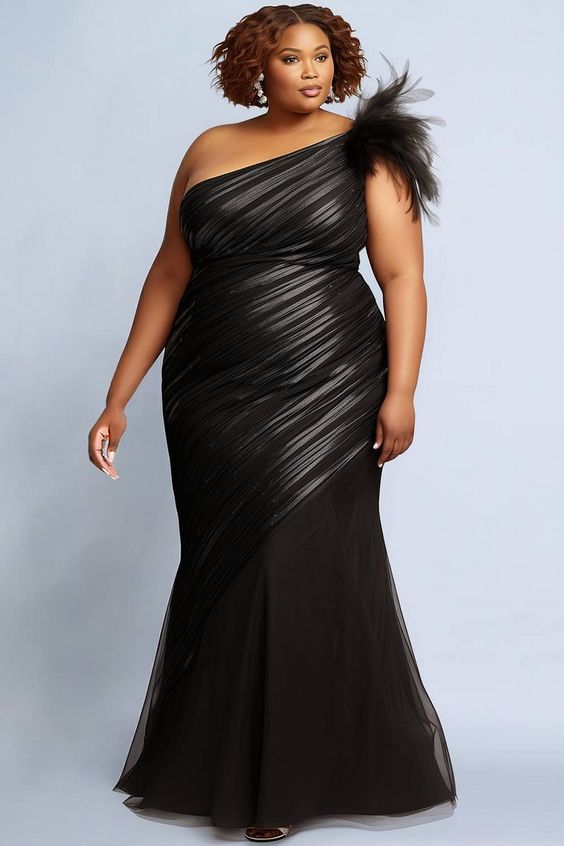
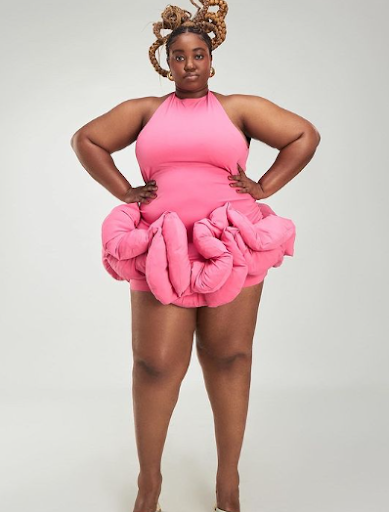
Demanding, is an act that women within the plus-size community have had to do for years. For Obochi, this demand for inclusivity led her to create a fashion brand, NDIICHE. “One of my long-term goals is for NDIICHE to become a global brand. Known for amazing pieces, inclusivity, and sustainability.” Several women have followed this path with a notable organisation being the Plus Size Fashion Week Africa.
In 2017, More Branches writer, Amarachi Okere detailed her experience at the first edition of Plus Size Fashion Week Africa (PFWAfrica). “Scrolling on Instagram, I stumbled on a page that was advertising a plus size fashion competition/show and when I saw it was in Lagos, I rushed to get my tickets for the show without caring if I’d be free that day.” The existence of a plus-size fashion show meant so much to her for two reasons; she got to see herself represented and plus-size clothes were sold at a reasonable price. The latter is another huge problem in the industry, women who fall on the bigger size of the weight spectrum are unable to get basic clothes at an affordable rate.
“The first stand I visited was the Jpk brand where they sold dresses as low as N3,000; a price unusual for women of bigger sizes as our clothes usually go for N15,000 or more,” Okere explains. Obochi corroborates this as she can mention a handful of brands and events that do not include an extra fee for larger sizes. “No, there are not a lot of clothing options, some brands are trying. I like Ọfẹ́ and Maison Mystic.” A few other brands with inclusive marketing and sizing are Kadiju, Desiree Iyama, Shop Bawsty, and Good Road.
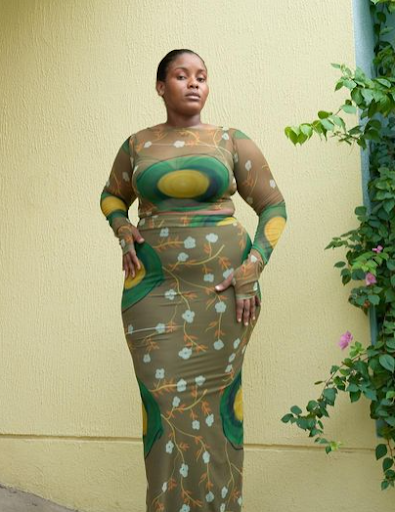
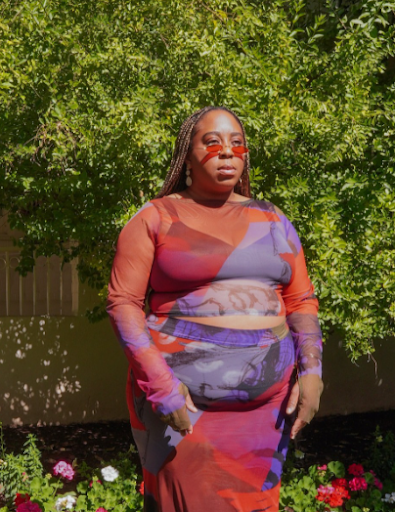
Plus Size Fashion Week Africa, founded by Temi Aboderin-Alao, answered the demand for affordability but as an event hosted on Lagos Island, many women across Nigeria do not have the opportunity to attend. But why do plus-size women have to go through obstacle courses for clothes? Even in the second-hand industry, thrifting is more expensive for bigger sizes and Instagram thrift stores often stop the count at size 12.
Obochi believes the reason for the disconnect is because African brands model themselves after the European structure. An example is Nigerian brands using Spring-Summer and Autumn-Winter to differentiate their collection despite Nigeria having two seasons.
WHAT DO THE DESIGNERS HAVE TO SAY?
A Nigerian designer who would like to remain anonymous explains that he uses this seasonal format so the internet algorithm picks his collection up during the international fashion season. But for the lack of size inclusivity in campaigns, he admits, “There is the financial angle; for campaigns, the aim is to draw attention to the garments so we use sample size because the more expansive the size range is, the more pricey the manufacturing cost. But since it is made to measure, we offer larger sizes on the website.”
A brand that does not shy away from inclusivity is Good Road. When speaking with founder, Uzoma Ndulue, she admits there is an extra cost, “Yes, it does cost more. The reality is you’ll need more fabric and it just costs more to sew more sizes so sometimes I understand why people tend to stick to 3 standard sizes.”
However, she does not think it is a burden to feature plus sizes in her campaigns because it is simply what reality is. “It was important because it was just common sense to me. Looking around me, I have women of all shapes and sizes around me and when I was designing the pieces, I had them in mind so it would be crazy not to have the clothes in their sizes. It was just right. Plus, almost all my friends and family are plus-size so I had to.”
To identify the gap in thrift stores, I spoke to Odion Akhetuamhen, founder of Corset Closet, an online thrift store that sells vintage corsets. Akhetuamhen’s love for fashion led her to start a thrift store and eventually a clothing line. Akhetuamhen explains that the size of the corsets she sells is out of her hands, “Content of bales is determined by people that pick them, not us. So we basically just get what’s available, sometimes it includes larger sizes and sometimes it does not.”
Bale is a large bundle of goods; Akhetuamhen says that there are often 100-200 pieces of donated clothes and she picks the ones in the best shape. Akhetuamhen plans to be more inclusive with her yet-to-be-launched clothing line, Studio Odion.
The industry has a symbiotic relationship with the European market and this has unconsciously led Nigerians to create a similar structure. It was a few years ago that wearing Made In Nigeria became socially acceptable. Awareness is a pivotal step and Obochi might have taken the fall as she was subjected to cyberbullying. But that is a mirrored version of what plus-size models are victims of. As the internet’s reaction to Obochi’s body shows.
As the designers said, sometimes the problem is out of their hands; thrift stores work with what they are supplied and creatives stick to sample sizes to cut costs. Nigerian brands offer larger sizes on their websites to avoid potential loss of revenue from a significant portion of the market. Despite the progress made, the Nigerian plus-size fashion scene still faces challenges. Limited access to clothing options, societal pressures, and a lack of representation in mainstream media remain significant hurdles. Brands are entitled to how they display their craft, however, for a country that is known for curves, why do curvy women have to demand recognition?