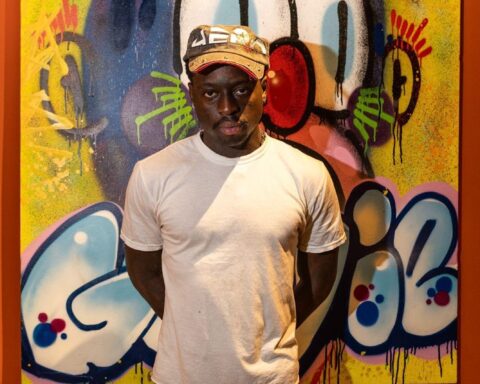

In a world of storytellers, Ademola Falomo is a contemporary trailblazer in the visual sector of Nigeria’s music scene. Through music videos, he has been able to seamlessly navigate the intersection between narrative voice and visually engaging cinematography. Falomo is a multifaceted filmmaker whose remarkable contributions to the field of music and cinema demonstrates how his influence goes beyond the boundaries of traditional filmmaking.
Gaining popularity for his work with Nigerian music stars like Davido, Mr Eazi, Tems, Boj, Cruel Santino, Oxlade, Magixx, Odunsi the Engine, Nasty C and a long list of others. His lens showcases the work of a director whose projects echoes in both the visual and audio domains, weaving an incomparable tapestry of art.
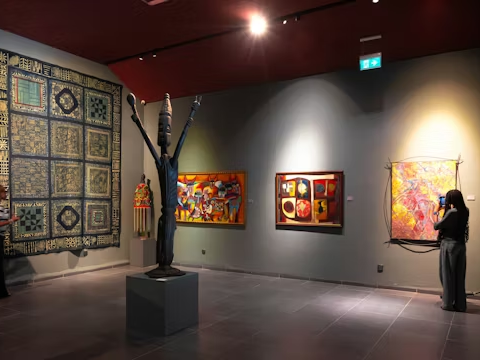
However, Falomo has recently shown his desire to expand beyond music videos into his personal artistry, curating an exhibition in Barcelona in October 2023 titled “Compass.” The project incorporates music, videography, photography and his unique artistic vision. Providing the spectator with a multimedia compass, in their quest to find serenity amidst chaos. Completely immersing viewers into the mind of the man behind the lens.
In Q1 2023, he directed a short film called “Finding Serenity” which debuted in December 2022 at the Family.inc (his production company) FamilyFilmClub event before being featured at indie festivals across Europe and North America.
The film’s incorporation of familiar views of the Lagos coastline, intertwined with dark sky blue hues makes it visually comparable to directorial masterpieces like “Moonlight” by Barry Jenkins.
We sat with Falomo in November after his exhibition, as he touched on significant points in his journey; from being one of the pioneering directors in Nigeria’s Alte scene, to his directorial debut, and the curation of his recent exhibition.
Can you share your journey into the world of filmmaking and where you are at now?
Ademola Falomo: (Laughs) Where do I start from? I started with music when I was about 11. That was my first exposure to movie making apps. When I was 13, I eventually got into photography. My journey into filmmaking was as a result of not wanting to settle between either sound or pictures. This led to my exploration of a word to describe this.
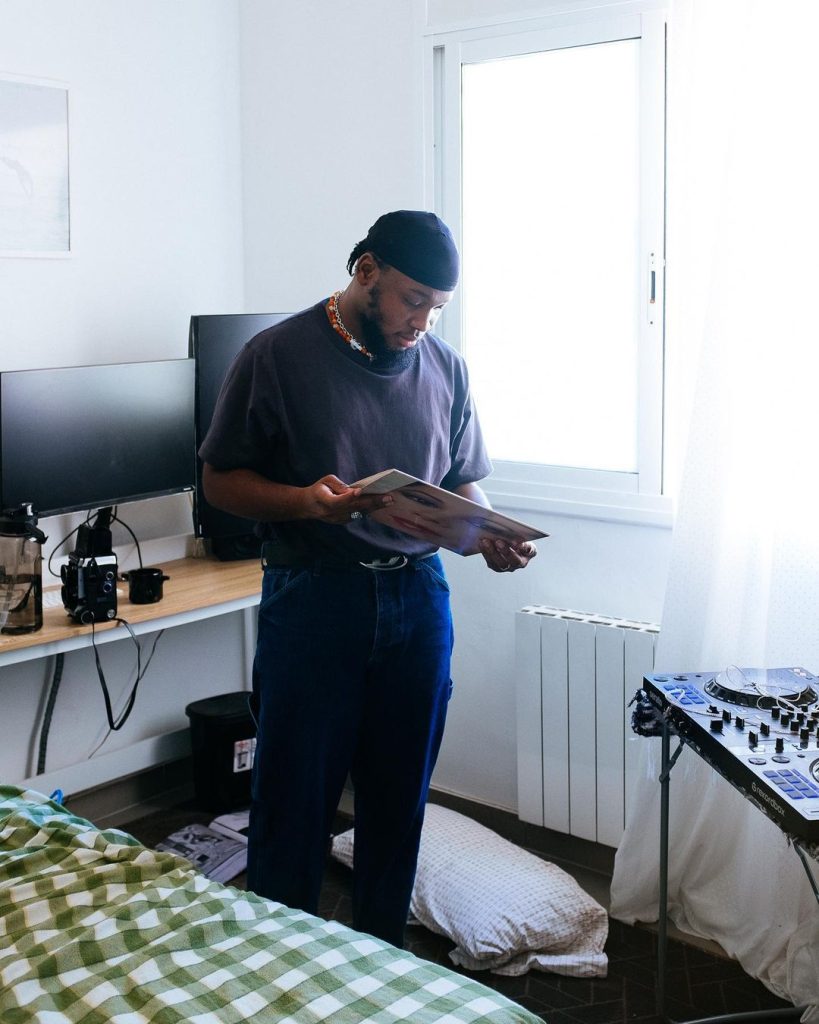
I remembered the term “cinematography” coming out and called myself that for a very long time. I even found out the meaning of the term 2-3 years later and had to remove that from my description. Generally with the filmmaking process, my older brother used to be involved in Photoshop and I stumbled on Adobe Creative. I got involved in the experience and my thought process was that I really want to do this. This was how I found myself in filmmaking.
Music videos often require a unique blend of storytelling and visual creativity. How do you approach the challenge of visually representing a song’s narrative or emotions?
I never wanted to do music videos. I wanted to go straight into films or narratives. With capturing emotions, that’s something that I have always been learning. Understanding yourself and realizing that it is one of your strongest points. When I started filming, I would just take my camera and film around. I would set the tone of the video to make people feel a certain way without any form of dialogue.
I took that same theory into music videos and applied it to shooting videos for artists. The extra layer I would say of working with some of these artists was the role of branding in music videos by understanding who your artist is. Working with different artists, I had to realize that you can’t clash their brands. I really learnt how visual storytelling was.
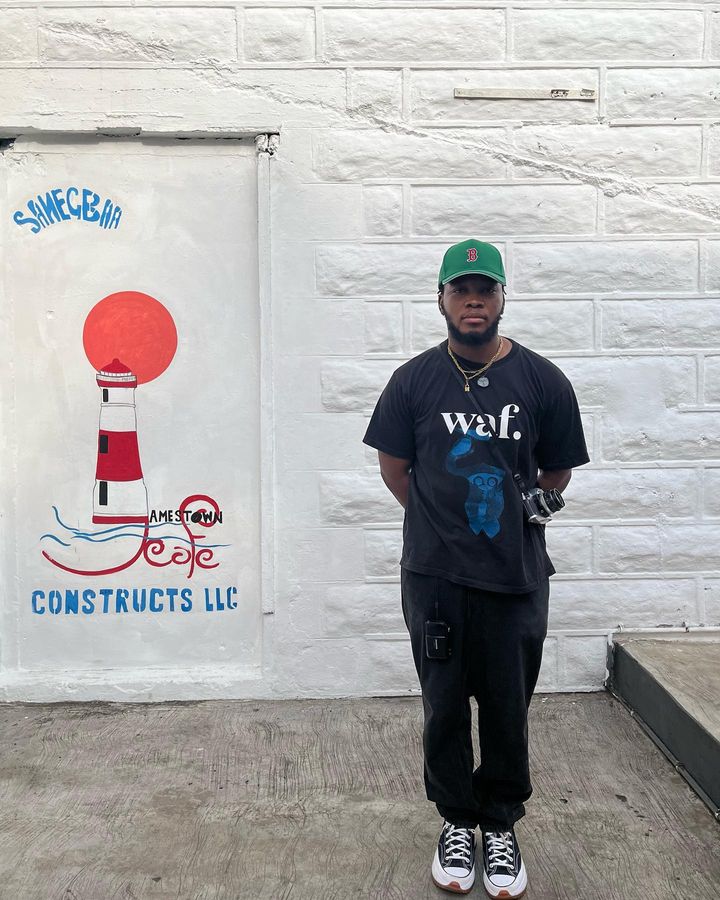
Given the visual impact of music videos. Could you describe your creative process, from conceptualization to production, when working on a music video?
Ademola Falomo: Usually when it comes to music videos, I first listen to the song and work based on how I feel. I am not very lyric-moved but for me it depends on how the song makes me feel. This makes me feel that when other people listen to it, they will feel particular feelings as well. I work up from there and build the foundation of that emotion around the music video. “Pull up” made me angry as you can feel that in the music video.
Even with Tems on “Try Me”, I was like this has to be a video for misfits which she wanted to do as she had that same idea all along. In that way, the audience has a particular connection with the work because it comes from a genuine point. My creative process comes from a genuine place. When you watch movies, you can sense the pretentiousness despite how beautiful cinematography can be. At the end of the day, genuinity from your work cannot be replicated.
Collaborations are essential in the music industry. Can you tell me about your experiences collaborating with artists and how these partnerships have shaped your work?
Ademola Falomo: Having to work with Odunsi, Santi, Wavythecreator and so many more was super interesting and my greatest lesson was probably branding. This shaped me as I got to know that each artist’s brand is different. I have two objectives when I work with each artist. Firstly, I know that it is to either enhance an artist’s branding or make people see the artist in a different light. I select one when working with artists. The power of video elevated Santi and Odunsi.
Coming from that background, I was able to film in terms of shaping people’s identity as an artist. I grew up with a collaborative community that made me learn a lot of things such as innovation. By taking cinematography styles from even all the cool anime we watched or even old nollywood ideas. You create a new product from this by taking and making something completely new. To summarize, I learnt branding, collaboration and innovation from these artists.
Finding Serenity” explores the theme of self-discovery. Can you share the inspiration behind the film and what message you intended to convey to the audience?
Ademola Falomo: Finding serenity is a poem that was written by Yimeeka, an artist. I remember her sending me a poem and had goosebumps reading it. This was about finding peace when it felt like the end of the world and you could understand how that felt especially with the pandemic. I showed the poem to my business partner and said we need to shoot a video on this. I spoke to my DP (Director of Photography), Fedworks and wanted to work on a short film surrounding this.
Mind you, I was coming from a music video space. I made it experimental because I was scared of making it a narrative given my background. I wanted to converse the poem to moving images as I tend to associate my work with colors and feelings. I thought of dark blue when I read the poem which is whole theme of the film. I remember a conversation we all had before proceeding to shoot for three days in Tarkwa Bay.
This was with my Producer Adeniyi, Yimeeka, Fedworks and Next Dot company. This was a huge partnership with all hands on deck. The most important line which stuck out to me was the ending which said, “it is possible to find peace in the midst of chaos”. That poem felt right to express it.
I have to explore your choice for dark blue as you mentioned color is important in your work?
Ademola Falomo: That is a very good question. It was not meant to first act as a symbolism to water but I still can’t really describe my choice for blue. It just felt right to represent the person in that light. The movie captures you in a way due to the colour. As I said earlier, transferring your thoughts and genuine process into your work is important and that is how the poem made me want to represent it in that light.
The use of water is a recurring motif in the film. I always see it as being peaceful yet full of chaos. However, I have to ask you what symbolic significance does water hold in the context of the narrative?
Ademola Falomo: Exactly how you described it on water being peaceful yet chaotic captures the significance of water in that narrative. That was how I felt when I read the poem the first time. I knew I had to do it in a place where this character represents my world and completely out of my comfort zone, which is the beach.
Finding Serenity” is a short film, but it carries a deep and contemplative tone. How did you manage to convey complex emotions and themes within the constraints of a short runtime?
Ademola Falomo: I will keep on saying this, I am super blessed I started with music videos because you don’t have that luxury with it. You have to tell a story in 2-3 minutes. When I was moving from music videos to narratives, that was one of my strongest points visually. To be able to make people feel a certain way. I realized taking elements of tone, sound and visual language was important which I had learnt earlier.
(Laughs) I can even call finding serenity a music video but with poetry as it was not even really outside my comfort zone. People are listening to how dialogue is being done and to communicate that is harder. If you know how long to frame stuff, you will realize you can do it by understanding the theory and balance.
With my history, I just utilized that in short films. Now that I am refining the style, I am finding out how to transfer this to feature films. Maybe we will have this conversation again with longer films.
Many artists go through different phases and evolve their style over time. How has your current form of art evolved from your earlier works?
Ademola Falomo: That’s a very good question! I think one of the things I realized is that I always love to be involved in every process. I am a very curious person about products and anything visual growing up. This is just me tapping back into my childhood and being experimental now. It is different now because I have access to products. I love when things are aesthetically pleasing.
With my current growth, I am evolving myself to express myself beyond videos in creative spaces and experiences for people. It is not too far off because in music videos I have to create an environment and tone for people feeling a certain way.
I am just now taking that concept and applying it in a different way to objects, design and spaces now. I want people to have that same emotions and feelings when they used to watch my videos. It’s no longer videos but making things to make people feel a certain way. It’s like taking what you are good at and exporting it into other things.
What is Family studios?
Ademola Falomo: Family studios is a playground for us. We have two arms, production company, content creation studio and community. Family is owned by myself and partner, Adeniyi. It is a company where we help create music videos but also focus on in-house contents and narratives because we believe we have an interesting way of telling our own stories.
We explored producing music videos and commercials last year and in 2023, we wanted to create our own films and products.Since then, we have been able to create producers, recess and other contents. It was created for the community of filmmakers such as indie filmmakers.
Right now, it is nice that we are producing in Nigeria but we want to operate in many places in Africa. Family is a content creation studio and a home for indie filmmakers. We have been successful in doing a film club for rising filmmakers where we showcased their works. It is important that we help reflect a community.
Congratulations on your first solo exhibition? Could you take me into what “Compass” is?
Ademola Falomo: “Compass” is a project that I started working on about four months ago. I remember speaking to my friend that I want to do an exhibition and was initially meant for it to be called “by Ademola Falomo”. We will still have that in the future. When coming up with the whole concept, I had all the pictures which were taken in film. I had gone to Ghana and Barcelona before eventually moving there.
I went around Spain taking pictures all over. Around 4am, I was looking for something to connect all these pictures and was reminiscent about my growth as a director. I wanted Compass to be about movements, spaces, people and direction. That tied everything together.
I was looking at my work as a middle ground and navigator point for different places I had gone to and where I am currently at. I saw it as my pictures becoming a journey and getting to this particular place. I am also bringing people from different ethnicities and cultures to one place. I think of the simplest words to describe stuff and compass has that weight. It represents this space I am trying to create.
Your body of work involves a wide range of video formats, from short films, music videos to photography. What drives your choice of format for each project?
Ademola Falomo: To be very honest, it depends on how I feel. Also, it’s because I am always curious to try different formats. You understand emotions, feelings and the end goal of your project. I always lean to what I have not done before. I love a challenge.
Thinking about it, thank you again for bringing this up and asking me this question. Answering this has made me realize why I set out to do an exhibition. Sometimes, it has to do with reinventing yourself which you can only achieve by putting yourself in scenarios and doing more things.
I found myself constantly evolving from selecting what format works, I choose the most challenging one. You make mistakes which could even end up being beautiful. That’s the beauty.
What is the next phase we can expect from Ademola Falomo?
Ademola Falomo: I don’t know yet which is interesting. Funny enough, you are not the first person to ask me this. With my exhibition closing soon, there were so many people who helped me put this together. I had a very good supportive system in bringing out the vision. When I got asked, what is next. I was like “I don’t know”. After thinking about it, I am curious to exploring design and what I will create with it. I still have my ideas on films and am more inclined to make more narrative/short films. In terms of Ademola Falomo in his exploring journey, it has to be design. I don’t know what aspect yet but let’s see.
Edited by Amirah Deji-Abiola