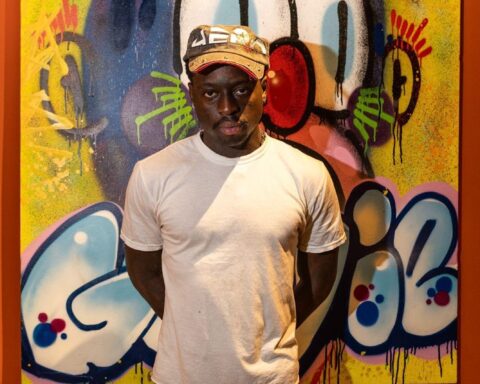

For Lagos-based artist Ayobami Ogungbe, weaving is a language of connection; the kind that binds personal experiences to collective memory. Growing up around the weaving culture in Badagry, his artistic style involves cutting and layering strips of photographs until they form compositions that open up new ways of seeing.
“I was of the notion that the final state of a photograph couldn’t be just print. Another dimension is possible,” he says. This search has guided his journey from a fine art apprentice to a photographer and now a visual artist.
At the heart of his work is memory. Ayobami’s art interrogates the relationship between humans and their environment, asking what it means to inhabit a space and how that space, in turn, inhabits us.
From Lagos to Los Angeles, his pieces evoke a similar reaction—that of curiosity. For him, that is enough. “The aim of my art is not to fit in. It’s also not to fit out. I just want the work to resonate. I want people to be interested. That does it for me.”
Ayobami Ogunbe sits with us to reflect on his journey, his artistic process, and the stories he continues to tell through collage, weaving, and photography.

Your work blends weaving, photography, and collage. What drew you to this medium, and how does every element tell your creative story?
“This particular medium of weaving my photographs is an amalgamation of the culture of weaving I grew up around in Badagry and my practice as a visual storyteller who employs photography.”
You started out as a photographer and now you’re a visual artist. How did this transition happen, and how has your relationship with the camera impacted your art?
“I actually started out as a visual artist. I was an apprentice at a fine art studio before I found photography in university, but you know, these things find a way to circle back in your life. Ever since I found photography, I have always preferred to use it as a tool to document, to tell compelling stories, and visual art allows for that as well, so it was just a natural flow of evolving into something different the more you let your curiosity win.”
Your pieces have been described as “dynamic compositions intimately rooted in the storied realities of your community”. As an artist, what emotions or memories do you want people to feel when they view your work?
“My work heavily relies on memory, you know, photographs can do that. It can transport you back to a time you’ve experienced before or into a new world entirely. My work attempts to do that. It’s the story of my community, so either it causes you to reflect, or it welcomes you to a world you weren’t familiar with.”

What’s your creative process like?
“Mehn, my process is long one, usually with me mentally at the end of a piece before I even start making it. It helps guide me, but often times, the piece will do its own thing regardless of my own interventions.”
Tell us about your recently completed exhibition at Rele Gallery, ‘Process + Place’ in Los Angeles. How did it feel connecting with fellow artist Terrick Gutierrez, despite your different backgrounds and lived experiences?
“The exhibition in LA is special. I think that’s the most I’ve been comfortable making a body of work. Terrick is cool. We hit it off the moment we met. And in an attempt to talk about our work, it became a conversation about our experiences. Then I put him on to Fela. Our works connected because we were employing the same elements in our works. Architecture, public and intimate spaces, how they enforce social structures, and how they affect our communities. These themes show up in our work, and they manifest through painting in one artist and weaving photographs in the other. Such special times.”
On seeing your work displayed across Lagos and LA, what differences have you noticed in how people relate to your art?
“No difference really. People are still just as curious to figure it out. I personally am just grateful that people get to see my work, and they have something to say because it reminds them of something.”

What do you think about the current art space in Nigeria? How do you think your style of art fits in?
“The art space in Nigeria is doing its best. It has come a long way. More young people are now practicing and participating. More institutions are here catering to and fostering communities, and we certainly need more of that.”
Do you feel any personal connections to your work? Is there any piece you’ve created that you felt emotionally tethered to?
“Oh yes, I love all my work, but I love some more. There are a lot of pieces I really like. It just so happens that collectors barely collect those.”
“That’s partly why you can’t make work because of what’s trending. You have to have your own voice,” he adds.

What’s next for you as an artist? What stories are you sitting with?
“Nothing yet. Just mindlessly trying out new material in my studio and trying to rest a bit from all the work for the LA show.”