
The first version of the One Voice art exhibition held at Moeshen Art Gallery, Abuja in June. The gallery was founded by Mohamad Khechen, known for promoting contemporary African art. Titled One Voice, Many Forms, it comprised twenty artists who had one artwork each on display, with a central unifying theme. Following the success of the One Voice debut, the second art show was organized, and aptly named One Voice, Version Two.
One Voice, Version Two was curated by Akpezi Ogbe “Joy” Banks, gallery manager at Moeshen. This second version had ten participating artists and four guest artists. All displayed pieces reflected the connecting theme of unity through diversity.
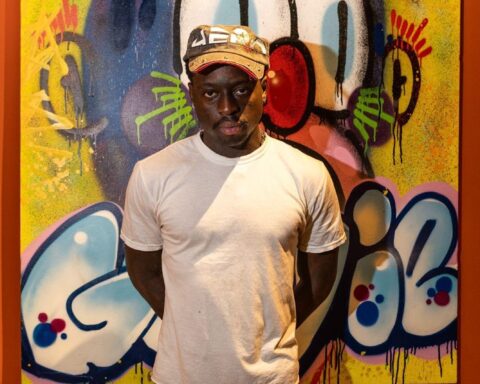
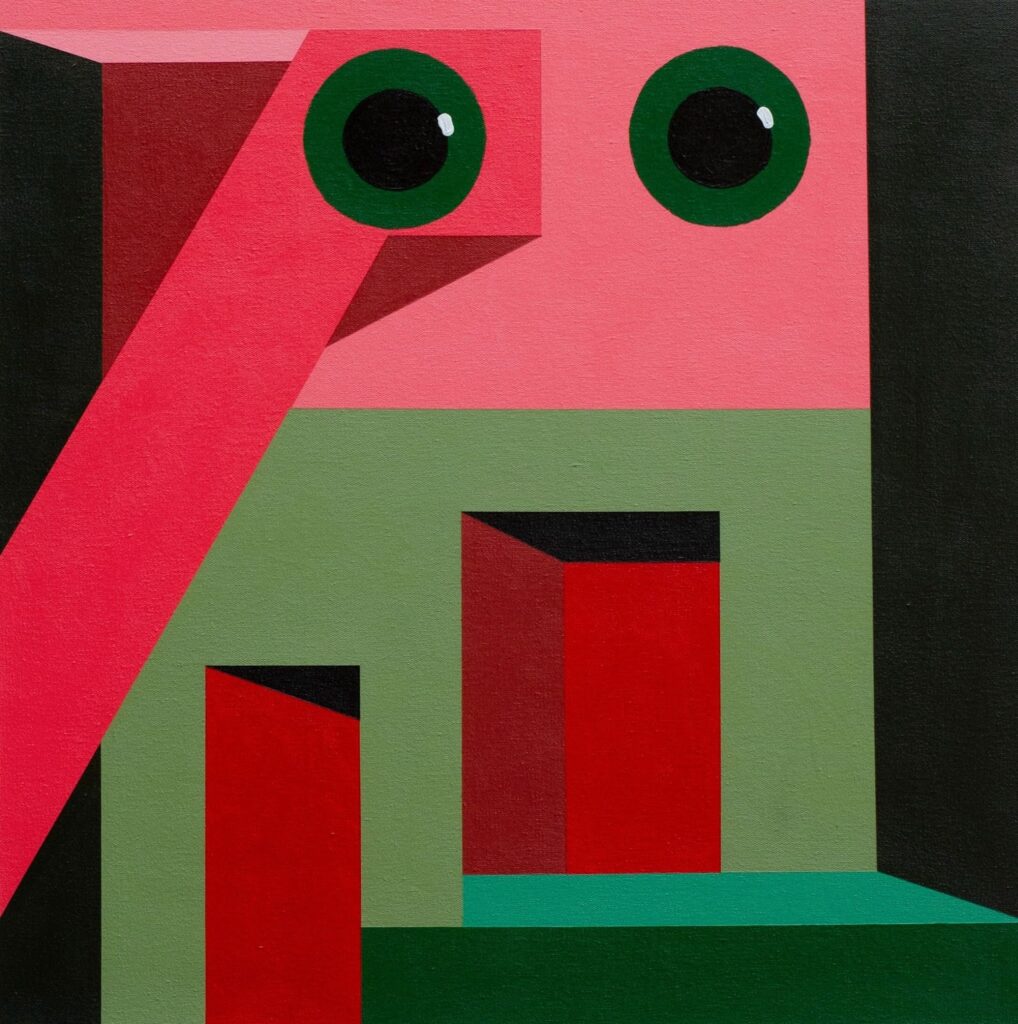
Art works by Chinedu Chidebe, one of the exhibiting artists, stood out due to their unique geometric style, with leanings toward abstraction and architecture. Moreso, the One Voice art show also marked his debut in Abuja’s art scene.
He spoke to MoreBranches about his artistic journey and debut exhibition at Moeshen Gallery through One Voice, Version Two.
How long have you been an artist? Can you share a brief timeline of your journey?
I’ve always had an interest in art since childhood.
In secondary school, St. John’s College, Onitsha, we did not have much access to practical art classes. I started my journey as an artist in 2016 after I graduated by registering at an art studio for some time. Shortly after, I got admitted to study Fine and Applied Arts at the University of Nigeria, Nsukka. I did not depend solely on the classes taught. I practiced with pencil drawing up till 2021, and afterwards, I progressed to oil and acrylic paint.
As an artist, I view my pieces as an extension of me and a reflection of my thoughts. By 2023, I stopped figurative painting because I no longer felt a connection to my work. I knew I needed a change. I just didn’t know if I was ready for the path I was going to take.
During my studio practice, I began to notice that my pieces were looking geometric, and it became a staple in my pieces. I showed this to a mentor, and she recommended I study pieces by artists with similar styles. I pointed out that I did not want to be influenced by existing works. She encouraged me to continue practicing.
Eventually, I accepted that this was my style, so I focused on making it better and shared my work more on social media.
The transition from figurative to abstract painting was a scary progress. As an independent artist, I sold most of my paintings directly, and I worried about the kind of feedback I would get if I shared my work on social media, because my collectors and supporters are there.
Despite these concerns, I mustered the courage to share my work. After sharing my work, my fears were assuaged by the support I got from the aforementioned parties. It was unexpected.
It motivated me to share more of my pieces, and I got feedback in the form of enquiries about the direction of my current style. It made me reflect more on my work and see that it reminded me of nostalgia, reflection, and interconnectedness.
All of these formed the foundation of my work.
Do you have other affiliations aside from being an artist?
Yes, I do. I’ve explored photography for quite some time. It was just on the surface level, and I learned that my interest in working with a digital camera keeps growing day by day. At some point, I’ll get more serious with photography. I also have an interest in videography.
What art media do you have experience with? Which ones are present in your recent group exhibition, One Voice, Version Two?
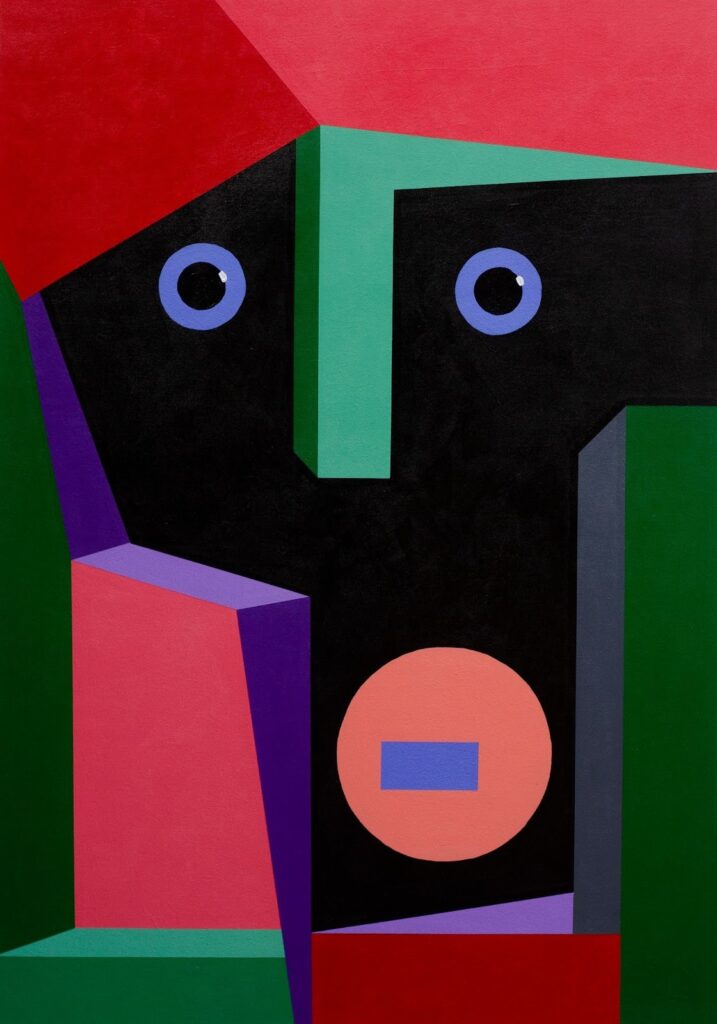
I’ve only explored a few media. Early in my practice, I was a little too obsessed with graphite and charcoal pencils. I did quite a lot with it before diving fully into painting using acrylic paints. For my current exhibition, I exhibited works done with acrylic paint on canvas.
What is your favourite art medium?
This is a very tricky one. I still have that tender love for pencils, but acrylic paint, with all its challenges, does it for me. So, I’d say it’s acrylic paint for now.
Where are you from? Does this inspire your artistic journey?
I was born in Onitsha, Anambra state, but I’m a native of Nawfia in Njikoka local government of Anambra state. My nativity does not inspire my journey in any way. Before 2016, I never knew that art was a thing, and coming from a place where your peers keep choosing careers in medicine, law, engineering, and stuff like that, I just made my decision or take this career path and stick to it.
What motivates you to create art? Do you require an ideal working environment for this?
It’s a lot of things, actually, starting from my personality.
I’m a very quiet person with so much going on within, and when I try to communicate these things, it’s very difficult to find or connect with people who get you. So, art became a channel for me to express myself with so much discipline, commitment, and consistency.
I’ve always had this belief that when you choose art and show so much dedication to it, it chooses you back and begins to deal with you (my current phase).
As I keep evolving as an artist, a lot of things come into play, knowing the things I can do and how I can connect with people. However, my current interests lie in complex things and abstract concepts.
Being in an ideal working environment is very important to me, just like a ritual being performed in the right place. Working in my studio helps me stay in constant communication with whatever divine source feeds my mind with these ideas and thoughts.
What are your artistic influences?
I can name a lot of people, but I’ll focus on the major influences.
At the early stages of my journey, it was people like Arinze Stanley, Ken Nwadiogbu, and Kelvin Okafor; these young artists who have shown aspiring and emerging artists what is possible.
Later on, my focus shifted towards artists whose works tickle my mind and ones I could connect with the ideas they share; George Braque, Piet Mondrian, and Patrick Akpojotor. One of the most important influences I had was my Dad. He’s an architectural draftsman. Growing up, I would usually watch him make these drawings.
That simple act left a mark on me, and that influence is evident in my current work.
How did your experience with architecture influence your work as an artist?
My father is an architectural draftsman. One of my strong memories as a kid was watching him make architectural drawings. That is where my love and obsession with lines started. I even wanted to be an architect myself. Along the way, a lot of things happened that directed my path to places I never expected, and that was towards being an artist.
In learning how to develop my skill as an artist, I was encouraged to stop using rulers and anything that served as a guide to draw lines and shapes. This led me into figurative drawing and painting. Being a figurative artist for a while was fun, really fun, but I got to a point where lines and geometric shapes started reaching out to me again.
At first, I thought it was a bad thing, and it made me stop making art for a long time. During my times of reflection in those tough moments, I started recognizing patterns and connections, which made me develop a personal philosophy about life. And in learning and gaining more knowledge, I learnt about the concept of synchronicity, which taught me that everything is connected. This concept of synchronicity helped me understand these connections better after spotting them.
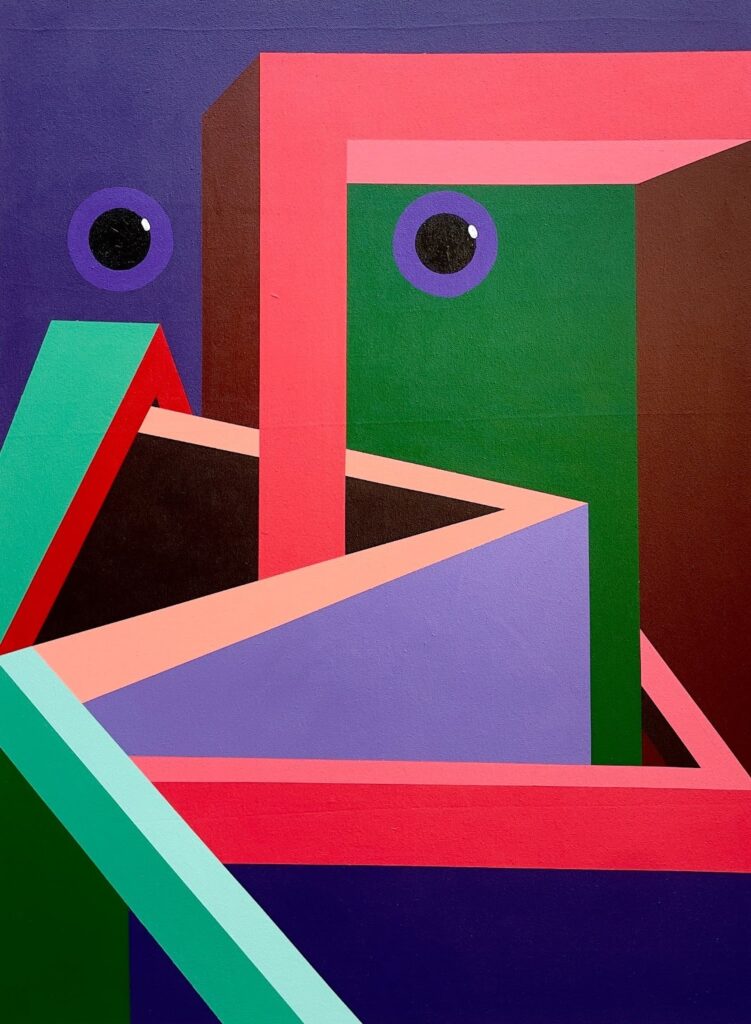
Looking at architectural structures, I see them as fragments of the architect’s mind, and in a broader sense, a reflection of our own. Each compartment holds its own rhythm and activity, forming a space that feels unfamiliar yet deeply human.
When I examined the way things have always happened in my life, I started noticing patterns and spotting connections; small links between events that seemed random but carried meaning when viewed in hindsight. Learning about the concept of synchronicity deepened this understanding, and it taught me that everything is connected, and often the first experience, though it may not make sense at the time, sets off a chain of others that eventually reveal its purpose.
My work is deeply rooted in this philosophy. I imagine the human mind as a space filled with interconnected activities, much like a building with countless unseen rooms. Since the mind has no definite shape or image, my paintings become my interpretation of it; structured compositions built with acrylic paint and an intuitive process. The geometric shapes and forms in my work represent the conscious part of the mind, while the repeated eye shapes symbolize the subconscious, that silent witness that sees everything and stores everything we go through.
Through my paintings, I make sense out of these connections, personifying them on canvas. Each piece serves as a mirror, drawing the viewer in, stirring imagination, and opening a space for deep introspection and reflection.
When viewers look at your work, what do you expect them to see?
The human mind doesn’t have a definite shape, nor does it have an image that represents what it looks like.
So, my paintings are a representation of the way I see the human mind. The human mind has two parts/layers, the conscious and the subconscious. These compositions in my paintings are a representation of the conscious part of the mind, influenced by different activities/experiences, and the repeated eye shapes represent the subconscious part of the human mind.
The reason why I used the eye shapes to represent the subconscious is that the subconscious is like this entity that is part of the mind, but it sees everything that has happened to us, our experiences, our thoughts, and a lot of other things we do, and it stores them.
What I do in my work is to make sense out of connections I spot and personify them on canvas using acrylic paint.
One Voice, Version Two was open at Moeshen Art Gallery from November 2-16, 2025.