Signages are a common display feature placed by businesses in front of their buildings to attract customers and to inform them about their services. These colorful signs are often made from plexiglass, a popular brand name for polymethyl methacrylate (PMMA).
Plexiglass has translucent qualities and is often used in place of glass as an affordable and durable alternative. It is heat-resistant and can withstand several procedures, including polishing, bending, sanding, and polishing. While it is used mostly for making signage, plexiglass is also used to make windows, doors, protective walls, and furniture.
As a designer with fifteen years of experience, Chuma Anagbado has used plexiglass for a significant number of projects, and so, it comes as a pleasant surprise that Red Line shows the public his exploration of plexiglass for artistic expression.
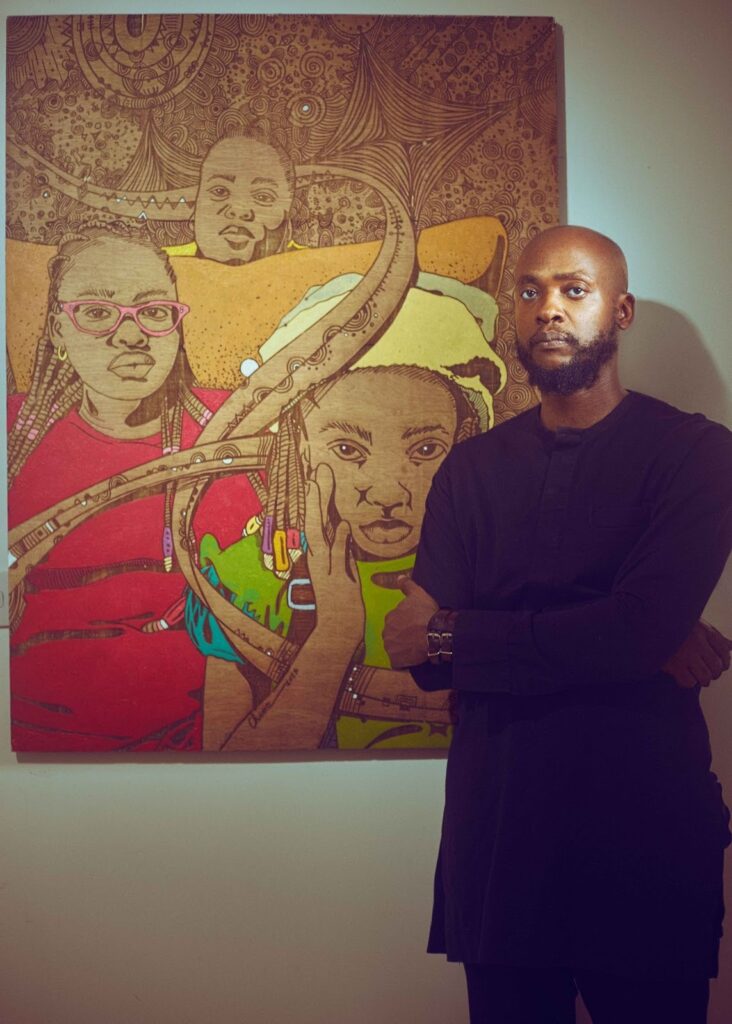
Chuma acquired his first degree from the University of Benin as a sculpture major and a second degree in design from the University of the Creative Arts in Rochester, UK. He carried on with his career as a designer after graduating in 2013 and became a full-time artist in 2021. Since then, he has participated in various art exhibitions and projects, incorporating his design knowledge and heritage as a person of Igbo descent. Red Line, his recent solo exhibition, was co-curated by Theo Lawson and Ugonna Ibekwe.
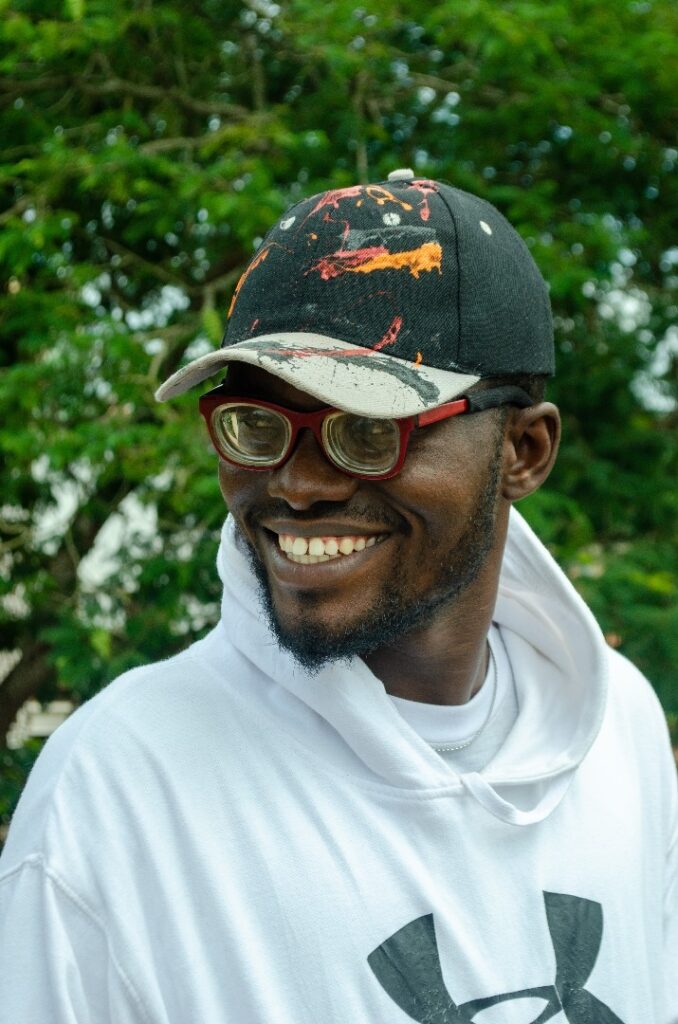
Ugonna Ibekwe is an art historian with a degree in Fine and Industrial Arts from the University of Nigeria, Nsukka. He currently serves as the guest curator at the Institute of African Studies, University of Nigeria, Nsukka, and the Associate Process Officer at the Royal Iwere Foundation, Olu of Warri Palace.
Theo Lawson is an architect with a degree from the Architectural Association School, London. While studying earth construction techniques in Nigeria, he designed the Bauchi State Museum in 1987. He also participated in building the Kalakuta Museum, the University of Lagos Anniversary Park, the Motherland’s Performance Centre, and Freedom Park.
Freedom Park, located at the Marina, Lagos, was known and used as a prison until 1979. It was demolished and reconstructed by Theo Lawson as a cultural centre, retaining some features of the original prison elements, like the perimeter walls, as a reminder of Nigeria’s struggle for independence. It was opened in 2010 and has since been used as a historical site and for recreational purposes.
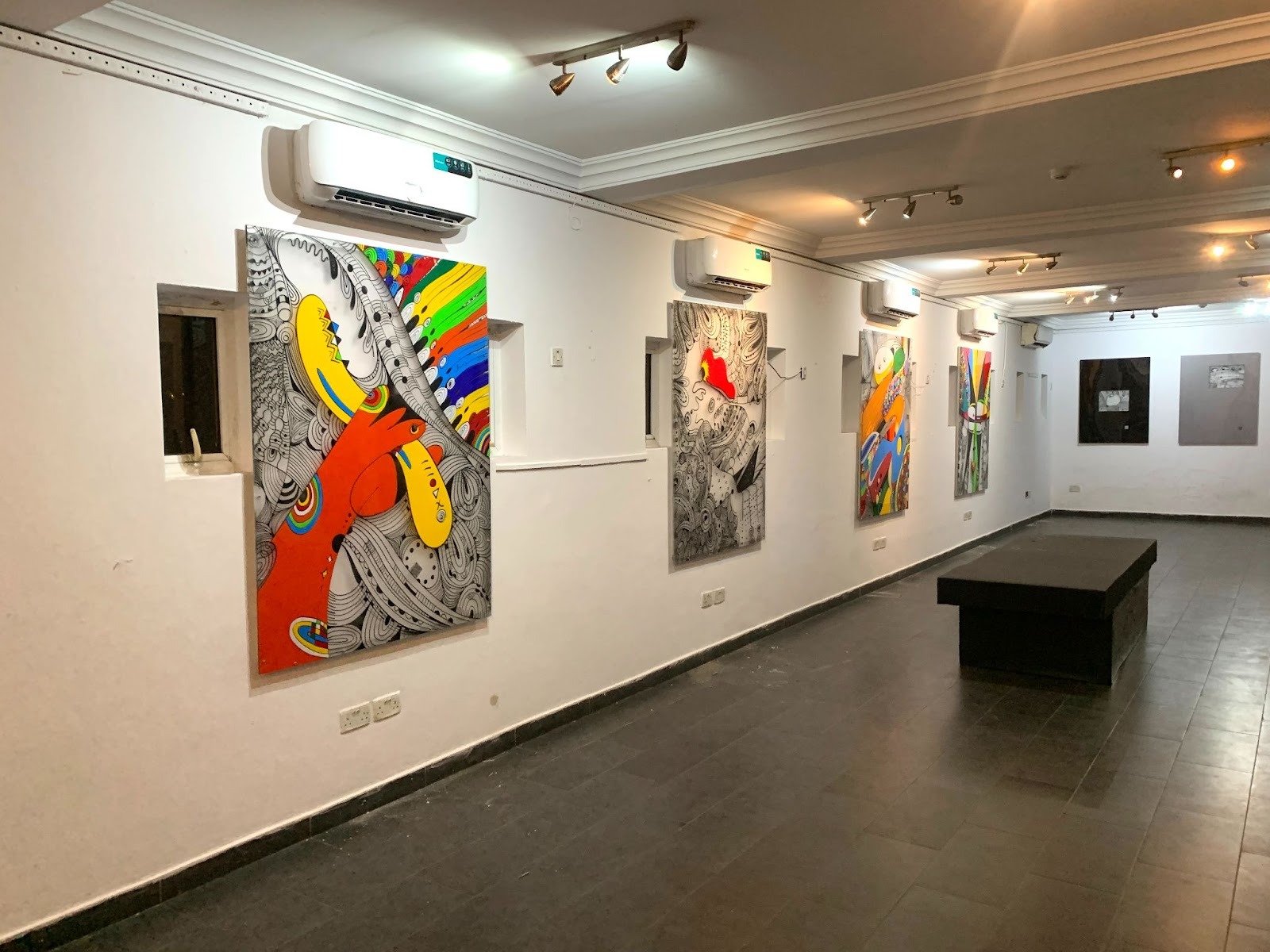
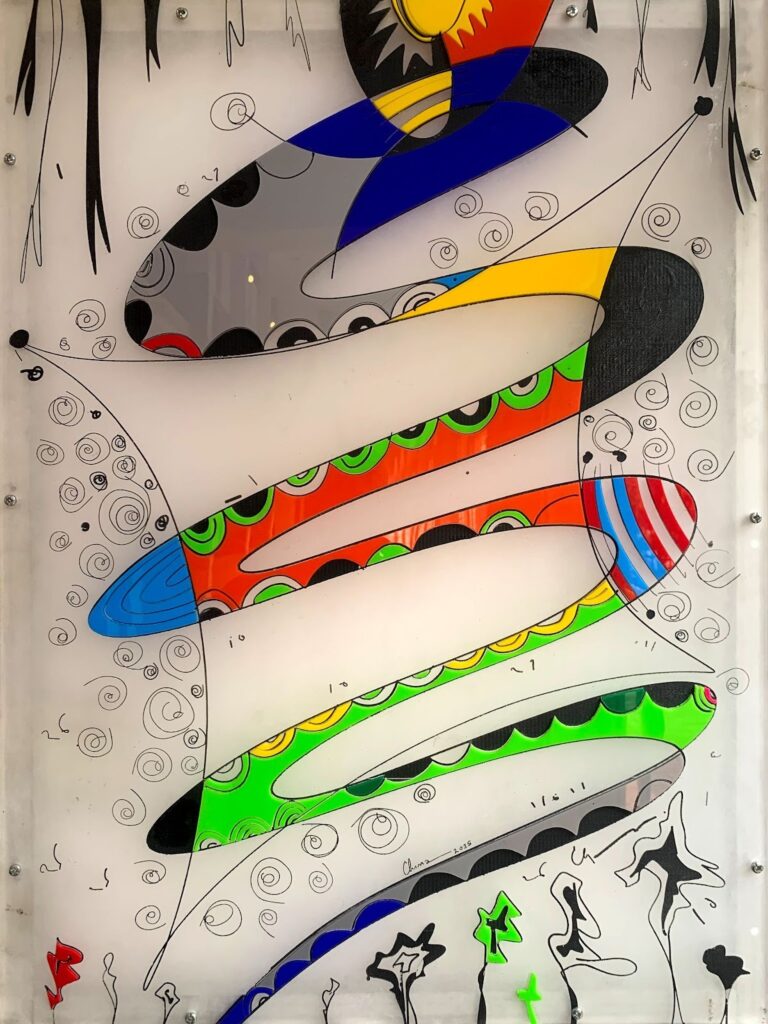
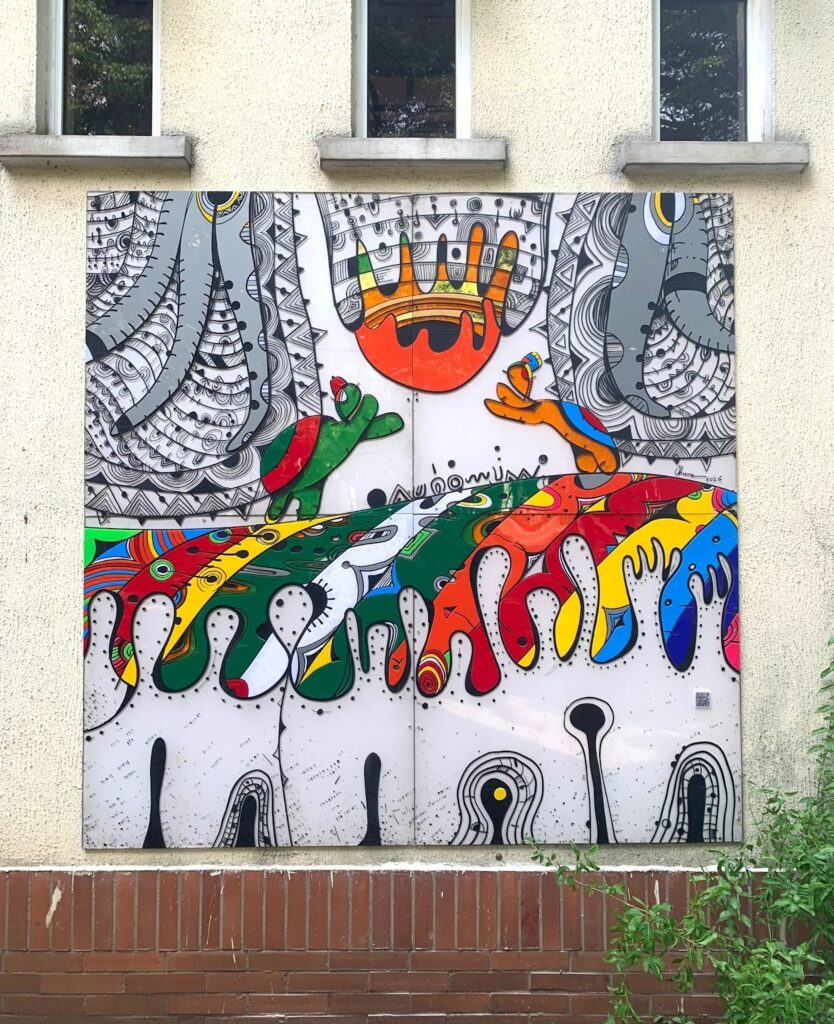
Red Line is notable for Chuma’s stellar use of plexiglass to denote visual representations of concepts from nsibidi, Igbo culture, and spirituality. The pieces share a common characteristic of reds, yellows, and greens bursting from an abstract, plain space. All but two of the pieces are named in Igbo: Mbetocracy and Sit at Home. Mbetocracy is a clever use of the word Mbe, the Igbo word for tortoise, which are central characters in the artwork.
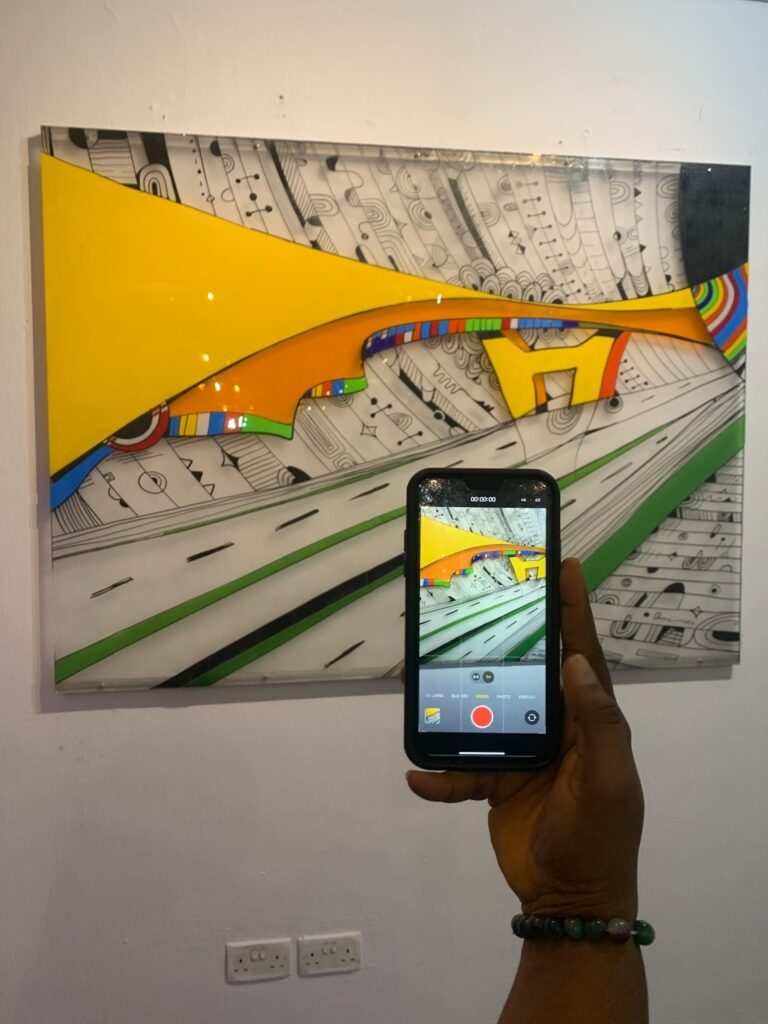
Sit at Home (2024) is a refreshing shift from traditional Igbo values, as it depicts an empty bridge in Awka, Anambra state: a common sight on Mondays in the South-Eastern part of Nigeria. This activist movement was originally initiated in 2021 by the Indigenous Peoples of Biafra (IPOB) to protest against the incarceration of their leader, Nnamdi Kanu, and has continued to this day.
Red Line was supported by the National Council for Arts and Culture (NCAC), Lizaad —a multidisciplinary art and design studio, Blackjack, Mediacrush, and Freedom Park. Some patrons of the project are Obi Asika, Nze Oscar Egwuonwu, Obinna Ajuruchi, Dolapo Sikuade, Okey Obike, Awam Amkpa, and Donald E. Nwankwo.
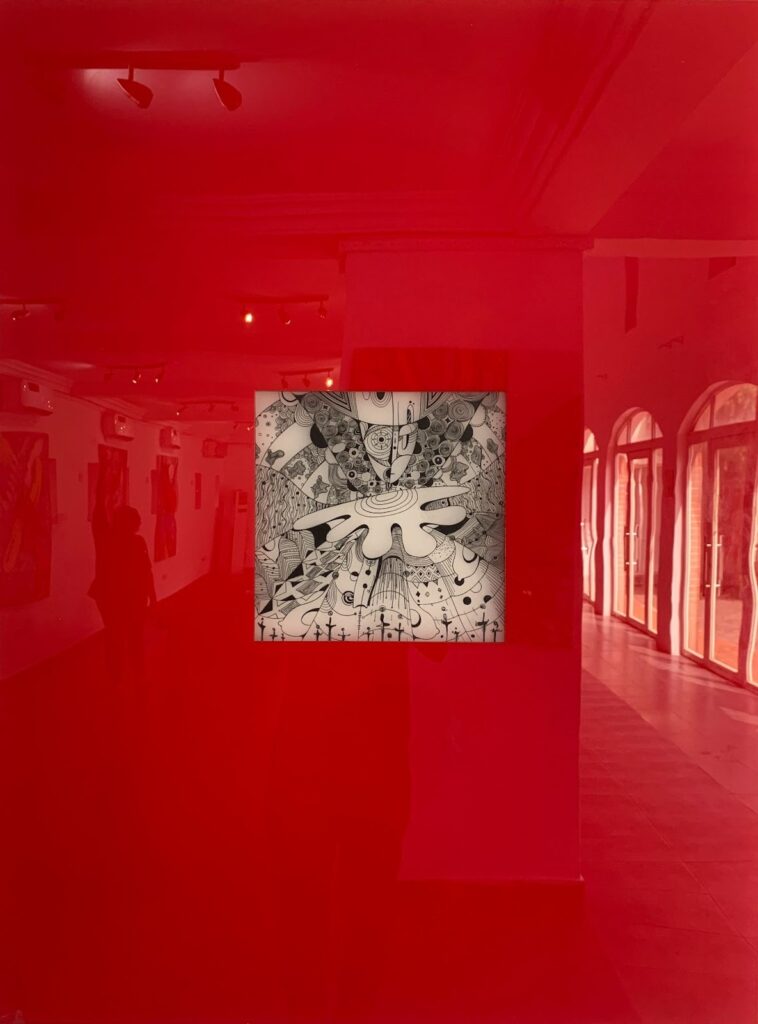
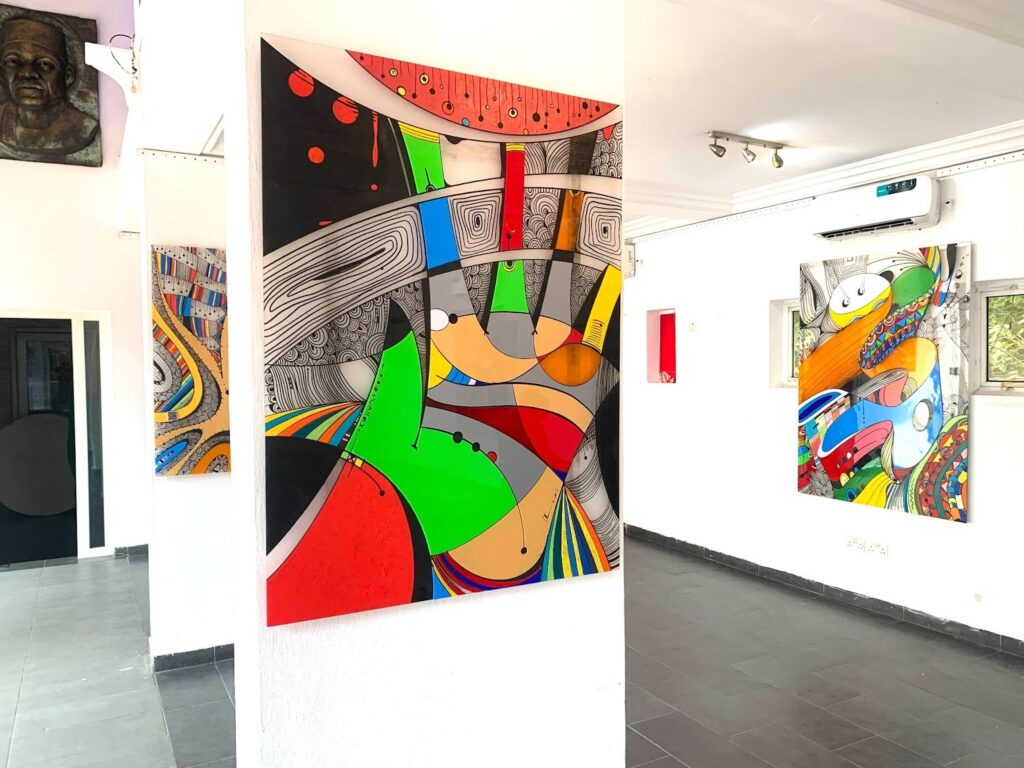
It opened as an indoor exhibition for three days, November 6-9, 2025. After this, the displayed pieces were transformed into outdoor installations for public viewing at Freedom Park.
More Branches spoke to Chuma Anagbado and Ugonna Ibekwe on their distinct roles in making Red Line a success: Chuma on his use of plexiglass, his experience as an industrial designer, and his approach to art as an Igbo person; Ugonna on his curation of Red Line.
Rejoice Anodo (RA): How long have you been an artist? Do you have other affiliations aside from being an artist?
Chuma Anagbado (CA): My first degree is in the arts – I am a sculpture major from the University of Benin. My second degree is in design, and I have practiced it professionally for 15 years.
At the start of COVID, there was a rebirth of sorts. I went back to full-time art practice. I would say my art career professionally kicked off in 2021, with my first solo exhibition called Masks, a collection of 100 masks that I made at the time. I had a second solo, Mmuo, which was a documentary: a documentation of Igbo masks and the culture, fashion, and music that accompanies it. This collection eventually became a permanent collection of The Centre for Memories, and they’ve been using it for educational purposes.
In 2024, I had a third solo exhibition, a collection of woodwork. I headlined Kenya Design Week 2023, with a project called Tracing the Wild, where we created an installation of work inspired by data from the movement of tracked lions. The project was about lion conservation, humanizing these lions for people to know about their plight. That complex data was converted to art. We created a triptych of three lions. Proceeds from that were used in conserving lions through the Kenyan Wildlife Trust. There’s also been Dreaming New Worlds, a grant from the Goethe Institute in 2023, where we created installations and a body of work inspired by traffic stressors.
RA: Where are you from? Does this inspire your artistic journey?
CA: I am from Adazi-Nnukwu in Anambra State, Nigeria. My work is inspired by my origins and my yearly returns to my hometown during Christmas. As a child, I was really fascinated by the drawings on the compound walls in the village. Growing up in Enugu, I was exposed to art activities by the art schools in the Institute of Management and Technology (IMT) and the University of Nigeria, Nsukka (UNN). Living two streets away from the IMT sculpture garden and taking regular walks past it also shaped my decision to become a sculptor. The works of Uche Okeke, and the nameless women who drew the beautiful murals that captured my attention as a child in the village, and being Igbo are major influences.
At the University of Benin (UNIBEN), we were introduced mostly to realism. I met Professor Uche Okeke and visited his studio. Interestingly, he and I are both from Anambra. I visited his village, next to mine, during one of the yuletide seasons. I also followed the Nsukka art story through him. I have been influenced a lot by the Nsukka art school.
RA: Why does your art shine a spotlight on the Igbo tribe of South-Eastern Nigeria?
CA: My work has always been about technology, and I also focus on the material and non-material aspects of Igbo culture as my take-off point for creating new work.
The primary reason I create art is to give marginalised people a voice and identity. In my case, this is the Igbo people who have gone through well-known difficult times in history: slavery, the advent of Christianity, and the Nigerian-Biafran civil war. All three events have taken a huge toll on the culture of the Igbo people, and have taken them to a point where they have denied their heritage just to be accepted.
I take all of this information and create work that not only captures your attention but also tells you a story with different layers. I want every marginalised person or group to feel proud of themselves and what they have. This extends to Black people, and it stretches on to other groups, but my work is about everything Igbo, starting from the spirituality.
My work is rooted in the linearity and simplicity of Igbo culture. As a designer, I have used the Igbo uli system to create work and home objects imbued with meaning. For my post-graduate degree in 2013, I made an existing compilation of 256 motifs into digital versions for the purpose of standardising them, so that designers and artists can use them. I also made some products with them. I also used uli for a lot of my design work. Switching into my art, I have also incorporated uli spontaneously. I think of it as my calling, known as awgu in Igbo. I consider it my purpose.
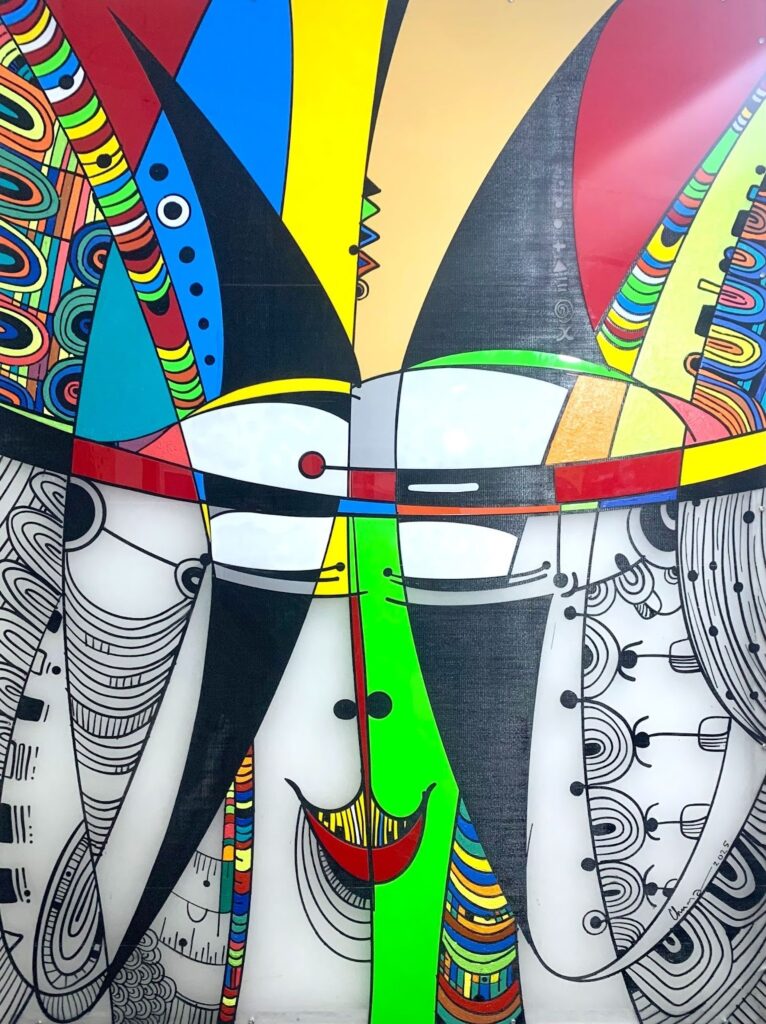
The Uli style is line art, simplifying forms to their barest minimum yet capturing the most meaning with that simplicity. This is what forms the basis of my work. It has gone on from there to become representative illustrations of physical scenes, to spirited illustrations, to the line allegory, what is in the line, and how that connects to everything in the universe. There’s a lot of ancient wisdom in keeping things simple, and I think my work is rooted in that idea. The motif collection I worked on has been published as an academic paper and has been used by designers over the years. Remarkably, the current exhibition, Nigerian Modernism in Tate Modern, the brochure had extensive use of these digital motifs.
RA: What art media do you have experience with? Which ones are present in your recent solo, Red Line?
CA: My favorite medium at the moment is plexiglass. I like wood as a material and the possibilities it brings. I work with prints on canvas. I etch on wood. I etch and collage on plexiglass. I carve wood carving and I weld metal.
My recent exhibition is the first time I am formally showing my recent material: work done on plexiglass, commonly used to make signage all over the street. There is a material connection between my choice of medium and what signages do for people. As a designer, I also happen to design and make signage for brands and organizations. I did some research and found out that I could also use it as an art medium.
There’s the link with stained glass and my desire to place the Igbo culture and identity in a space where we can view images we all grew up with. The whole idea is to make our people feel proud of the work. There’s also the reimagined Mbari practice of painting compound walls. My aim is to integrate that aesthetic into modernity. There is a lot of architecturalness about the work, how it fits in, and the use case.
I have seen myself creating work that has been installed in malls as facades, in corporate buildings, and the materiality of it necessitates that it has to last for a long period of time. So, plexiglass offers all of those possibilities.
Red Line is about me presenting this material. For the first time, we had a three-day opening. Afterwards, it was reopened as an outdoor installation within the grounds of Freedom Park, Lagos, which is what I have always wanted to do: exhibit outside traditional art spaces, like gardens and buildings, because for me, that’s where art lives.
RA: What motivates you to create art? Do you require an ideal working environment for this?
CA: I have a studio where I take interns and train them. I designed the studio myself. My living spaces are also my workspaces. I mostly do collage work there. I work both at home and in the studio. I love beauty and simplicity. I love art. Art heals the soul. What really interests me is how certain humans have the ability to create certain things that affect certain people in certain ways. I think that is where art sits.
There was a time I did not want to be called an artist, even after the conclusion of my first degree. Over time, I have come to realise that all my experiences have prepared me for this phase, which I believe is also grounded in spirituality. My trajectory into art practice came through digital art.
Before this time, I was an active designer who built a thriving design hub in Lagos. In 2021, when I created those digital illustrations, I came across NFTs. I went on to co-found the Nigeria NFT community, trained a lot of digital artists, brought them into the space, and got some remarkable success with documenting Igbo culture and uli on the blockchain.
However, that was not enough for me. At this time, I was switching between being a designer and a studio artist. I continued developing. I believe my work stems from a sum total of my experiences –the industrial designer, the adman, the storyteller, and the crafting of things, which form an integral part of my work.
Aside from the creative practice, I do not separate design from art. I’ve done quite a lot of things in my life, but at this point, I am a full-time studio artist. It is a purpose.
RA: What are your artistic influences?
CA: Demas Nwoko’s work is influential to me as a person. He ended up becoming a personal friend and patron to the design hub that I created. I feel a very strong connection with his work as a person, because I have found myself in such a similar trajectory of making art that we need, that is made by us, designed by us, for us.
I studied the Zaria Rebels as a boy. I was connected to their activism at the time. Meeting and talking with some of them physically has made a huge impact on my work. Their work and their life have been a huge influence on me.
I would like to meet Bruce Onobrakpeya. His work really influences me. I think we share the idea of form and materiality in terms of printmaking and art reproduction. As I work in an art collection, I believe that art ownership should be democratized. So, I try to use technology to democratize ownership of art. I am already seeing that happening with the existence of art platforms like Masterworks, with their fractional art model, something I have also done with Tracing the Wild in Kenya.
RA: Does Red Line serve as a form of activism, history preservation, or a reminder of societal issues?
CA: Red Line touches on all of that.
It is an activist movement –personal activism in my surviving personal challenges. There is strong historic preservation in my storytelling, with my experience in digital art and the blockchain. I am now using these tools to preserve history, so that the loss we experienced the oral transfer of knowledge would not repeat itself.
Every work I create is permanently stored on the blockchain, so that there is a physical and a digital piece. I think that twenty or fifty years down the line, it may be regarded as something remarkable.
The exhibition clearly reminds us of the societal issues, inequalities of people and communities being marginalised because of their skin color and language. It says, “I am here, I am me, I should not be diminished”.
Red Line touches on how we live as a people, the spaces we navigate, the places we call home, the functionality it portends for us, and how it allows us to exist as a people. Many of us live in industrial-designed houses, created for people to sleep, eat, do the basic things, and get back on the road to work. That is not how we are supposed to live; there are a lot more aspects of us as human beings that our living spaces do not capture.
I think that is where I am headed with my art, by first creating that awareness, then crossing the line between art and architecture, and then redesigning living places with the possibility for us to become a people, complete with all aspects of life fit into our living spaces.
Rejoice Anodo (RA): What inspired the curation of Red Line?
Ugonna Ibekwe (UI): The inspiration for curating Red Line stems primarily from my personal relationship with the artist. I have authored the majority of his artist statements, and we frequently engage in critical conversations and review sessions to refine his work and thought process.
For me, the Red Line exhibition was born from the desire to see all these works brought together in one place with a coherent storyline, now deployed for public discourse and criticism. This exhibition emerged from recognizing that the artist has developed a substantial body of work that is consistent in its trajectory.
RA: Is there a theme connecting all the accepted pieces on display?
UI: The connecting line is based on material and style.
RA: Is this your first co-curatorial experience? Briefly share your experience working with a co-curator.
UI: No, this is not my first time co-curating an exhibition, but I can say this is my first time curating with an architect. I have previously co-curated exhibitions with individuals such as Professor Ozioma Onuzulike and Professor Chijioke Onuora. I also had a collaborative exhibition with Chineye Obieze for Goethe-Institut Nigeria, where I curated the temporary library created for the main exhibition “Kedu”.
RA: As an art historian and educationist, do you feel there are any exhibited pieces in Red Line that draw from or relate to history or activism?
UI: As you are already aware, all the pieces are rooted in Igbo tradition and philosophy. Let me highlight a few pieces in response to this question:
“Onye Punuka” features the head of a female figure with braided hair, adorned with a colorful akwete (Igbo fabric) cap and neck beads. Two baskets connected by rope dangle from both sides of her head, symbolizing the baskets commonly used among women in African societies for trading. Her eyes remain watchful and alert, surveying her surroundings with awareness. On the left side of the artwork, a doughnut shape bears the Igbo phrase “Uwa bu ahia,” meaning “Life is a marketplace.” The background showcases a black-and-white drawing created through the maximization of negative space, a technique characteristic of traditional Uli artists. This backdrop is richly populated with trade motifs, icons, graphs, and charts—all rendered in Uli symbolic motif style, including the ‘Ise Oji’ motif, symbolic of the four days of the Igbo market week: Eke, Orie, Afo, and Nkwo. The area surrounding her face resembles clockwork, revealing an intricate network of gears. A subtle reference to music and women’s singing ability appears in the placement of bar charts resembling piano keys. Behind her, a clustered network of symbols alludes to the complex thoughts, duties, and processes women navigate while raising children and managing their lives. Two target symbols represent goal-setting, highlighting how our women serve as goal-setters and goal-maintainers for their families.
“Onye Punuka” pays tribute to the often-overlooked narrative of a woman whose name became integral to a family’s historical legacy. In the context of Justice Chukwunweike Idigbe’s family history, Onye Punuka was the wife of Obi Idigbe, the great-great-grandfather of the renowned Nigerian jurist. By centering the artwork on her, Chuma Anagbado illuminates the untold stories of women who, despite being marginal in historical records, played crucial roles in shaping family and community narratives. The artwork’s elements and symbolism highlight how women’s entrepreneurial activities and wisdom often formed the unacknowledged foundation of family legacies, community development, and generational wealth. Its placement in the Punuka Associates HQ marks the structure as a modern economic center in the heart of Africa’s busiest city—Lagos.
Ochi Agha, the generalissimo of a nation, the hero, someone else’s villain, and the man who inspired hope in the darkest times—the one who defied all odds and made his way out of the bunker. This is a revelation of the storied life of an Igbo army general: a thoroughbred and well-educated son of a billionaire who, against all odds, found his path in this complex world. A path that saw him carry the burden of standing tall for his people, inspiring hope and leading them in a fight for self-determination in the face of a genocide driven by deep hatred. A genocide perpetrated by brothers, sisters, friends, and family—a genocide that cut short an estimated 3 million lives in 30 months. The scars remain. The wounds are ever fresh and continually reopened by a nation we call home. Keep watching over and interceding for us from the ancestral realm.
Afia Na Ano, Ubosi Na Ano explores the cosmological significance of the four market days in Igbo culture through a polyptych made from Plexiglas. This piece can exist as a single image or as four separate panels that retain their interdependence. At the center of the composition is a reimagined Uli Igbo mirror symbol rendered in bright red. This central motif connects the individual panels into a single, unified cosmic dance. The background creates an abstract visual rhythm that reflects the cyclical nature of Igbo time, days, and seasons. The work’s ability to separate into four individual pieces mirrors the distinct yet interconnected nature of the market days themselves. In Igbo cosmology, each market day is personified as a totemic being with its own gender and character, directly influencing the activities performed on that particular day.
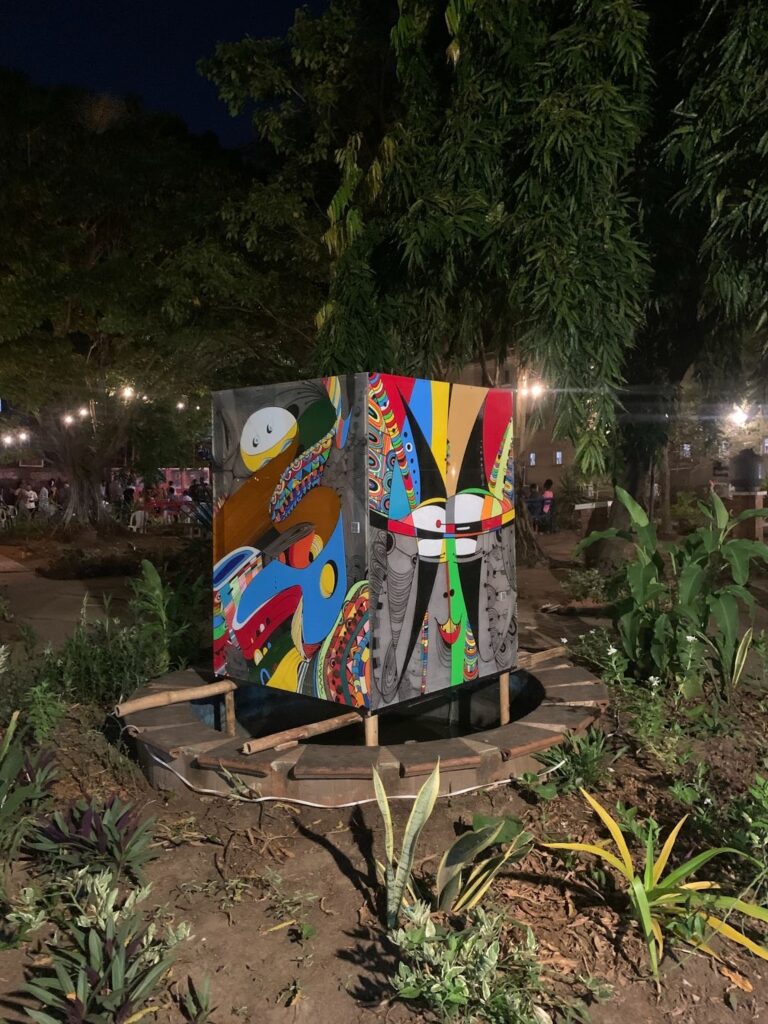
RA: Why was Freedom Park chosen for this exhibition?
UI: Freedom Park was chosen first because of its location and the fact that it’s a park. I was looking forward to exploring its outdoor environment for the works since they are opaque in nature. However, this aspect was not achieved because the exact area of the park I wanted to use was already booked by another organization.
RA: What criteria did you employ while choosing the selected pieces on display for the exhibition?
UI: The choice of works for this exhibition was made largely based on material. Chuma’s last solo exhibition, which I curated, featured works mainly done on wood, and the longevity of the work was a question that kept arising, both in my mind and from some visitors. Considering that he uses a laser machine to work, I advised that he should start using hardwood. Then one day, I visited the workshop and saw a small prototype work done with Plexiglas, which I now own, and I thought, “This works—can it go bigger?” That birthed the works you now see in Red Line over time.
Red Line is Chuma Anagbado’s fourth solo exhibition. The outdoor installations will remain on display on the grounds of Freedom Park, Lagos.