The Ghanaian rap maverick reflects on growth, the creative risks he took on his latest album, and why success is more than just numbers.
M.anifest has always been a masterful storyteller, but on New Road & Guava Trees, his latest full-length project, he reaches a new level of introspection. The album, his first under Mass Appeal, is deeply personal—rooted in themes of growth, resilience, and transformation.
Speaking over a call, he’s as deliberate in conversation as he is in his music. His words are measured but never distant—his mind is clearly tuned into the intricacies of his work, both as an artist and as a thinker. New Road & Guava Trees is about movement—pushing boundaries while staying grounded in where he comes from.
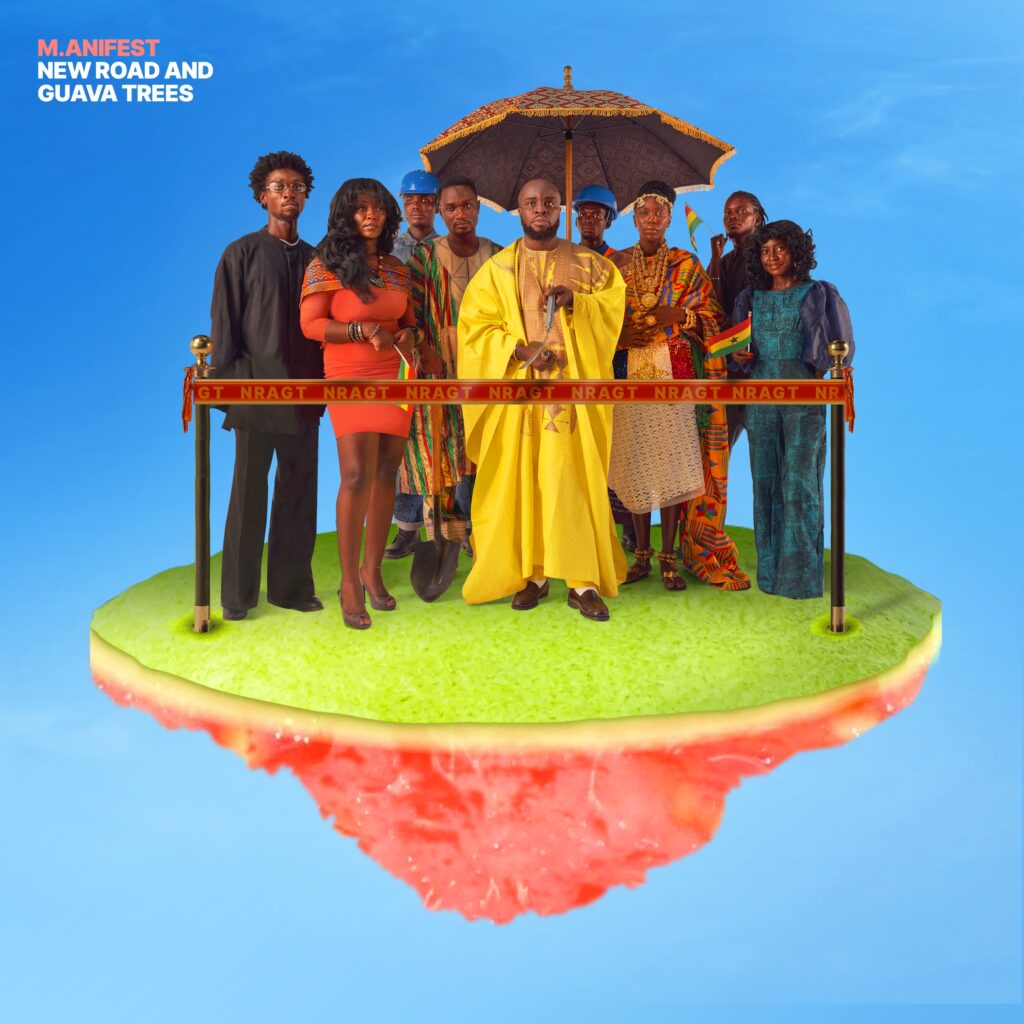
What does New Road & Guava Trees represent for you at this stage in your career?
“I think it represents a point of maturation,” he says, settling into the conversation. “It’s about knowing where to go with my GPS. The idea of taking a new road is the most pressing thing for me now. That’s the only way to keep going—by finding new ways to do things and leveling up.”
The imagery of the guava tree is equally significant. “It’s not just about the fruit—it’s about the process of climbing the tree to get there,” he explains. “I’ve always been obsessed with the process more than the results. Even though it’s New Road, it’s New Road & Guava Trees because to reach the guavas, I have to pay attention to the tree.”
The theme of growth through movement is rooted in both his personal and creative process. The title is a direct reference to his childhood in Madina, Ghana, where he grew up on New Road and often climbed the guava tree in his home. But beyond nostalgia, it’s a reminder that looking back is sometimes necessary to move forward.
How did this mindset shape the album’s creation?
“My process always starts with vision,” he says. “It’s like planning to have a baby. You don’t control exactly how it turns out, but you have intentions from the start. With this album, I knew early on that I wanted to take a new road—both literally and figuratively. And as the process unfolded, the past kept writing itself into the future.”
This sense of self-discovery is something he leans into fully. “Creating is like putting myself in school, but I’m both the professor and the student,” he says. “I remember things from the past, I unpack ideas, and even the small things start feeling significant. It’s the closest thing to therapy.”
Which track on the album feels the most personal to you?
He pauses before answering. “That’s an interesting question.”
He considers the album’s romantic tracks—songs like Hang My Boots and Ease My Mind—which are personal in their own way. But ultimately, he settles on Time Catch, the album’s opening track. “It captures this sense of urgency that I felt throughout the process. But it’s urgency without desperation. That’s an important distinction. It’s about knowing that now is the time to unload a whole bunch of feelings, emotions, and thoughts—but doing it in the grandest way possible.”
Did you take any creative risks on this album?
M.anifest is quick to answer. “That’s almost a given. Innovation is a prerequisite for every project.”
One of the biggest changes was where he recorded. “For the first time, I recorded the majority of an album outside of Africa. Seattle and Los Angeles were the backdrops for what is arguably my most African-inspired album,” he says.
Another shift was his approach to work. “I kept incredibly healthy working hours. I recorded from 10 a.m. to 6 p.m. every day—no stretching myself thin, no burning out. I still had time to go to restaurants, galleries, and live life. That balance kept me inspired, so I never felt exhausted. I don’t remember feeling burnt out, not even once.”
On the sonic side, his long-time collaborator Budo played a crucial role. “He was my co-captain in this process,” M.anifest says. “I hadn’t worked with him since 2011, so it felt fresh. He’s an insider-outsider—familiar with my style but also bringing a different perspective. He’s produced for people like Doja Cat and Macklemore, so he has a wide range. He didn’t come in with any restraints or preconceptions. It was all about pushing the limits.”
You’re very intentional with collaborations. How did you approach them on this album?
“I like working with risky people,” he says with a laugh. “People who don’t think there’s only one way to do things.”
That approach led to standout moments, like My God, which features an opera singer trained in Black classical music. He also had collaborations with artists like The Cavemen, Flea from Red Hot Chili Peppers, and Bien from Sauti Sol, each bringing their own unexpected textures to the album.
He’s very selective about what makes the final cut. He recorded a track with O’Kenneth, a Ghanaian drill artist, but it didn’t make it onto the album. “It’s a banger—I love it. But I started shifting into a new creative space, and it felt like it belonged to what’s coming next rather than this project. Cohesion is always my priority. I’d never sacrifice it just because a song is dope.”
So, will we ever hear it?
“Absolutely,” he says with confidence. “Maybe it’ll come out as it is, or maybe it’ll evolve. But if you’re a betting person, the odds are in your favor.”
Your music often features social commentary. Do you ever feel a responsibility to be ‘the conscious rapper’?
“First of all, what’s the difference between a conscious rapper and a rapper-rapper?” he asks, raising a philosophical point.
He rejects the notion that socially aware music has to be boxed in. “All the greatest artists I grew up on—Nas, Lauryn Hill, Fela—were dope by dope standards. It’s not about being ‘conscious’ or not. Who cares about a message if the music isn’t good? Nobody. That’s my number one responsibility—to make music that’s undeniably good. The rest follows naturally.”
For him, storytelling isn’t an obligation—it’s just how he sees the world. “The things I care about, the things I have conversations about—those are the things that end up in my music. It’s not forced. It’s a logical extension of who I am.”
How do you view Ghana’s music industry and Africa’s music industry as a whole?
“We have this weird idea that there’s only one kind of sound that works in Africa,” he says. “Meanwhile, you’ll see Playboi Carti fans in Accra. You’ll see Kendrick fans in Nairobi. So why do we limit what we can make?”
For M.anifest, the real challenges are infrastructure and economics. “We have to control our own destiny and understand how global capital works. Music in Africa is thriving creatively, but financially, it’s not as rewarding as it should be. Data is expensive. Streaming services aren’t affordable for the average person. The problem isn’t just the music industry—it’s an economic issue.”
Are there any rising artists you’re excited about?
“Absolutely. There’s a musician in Ghana called Notse—he’s incredible. There’s this song he released – Mijo, I hope the world sees him. SuperJazzClub is another top pick for me because they are amazing and different. And there are so many others. Even Arathejay, who is also on the project.
I discover new talent all the time, and I even curate playlists with the underground artists I find.”
Would he ever share those playlists?
“They’re private,” he says with a smirk in his voice. “Gatekeeping? Maybe. Or maybe I’m just keeping the gems to myself.”
Has signing to a label changed your creative process?
“Nope,” he says flatly. “I’ve been independent and entrepreneurial for so long. A label doesn’t make music—you do. The partnership is about taking your vision and amplifying it, not changing it.”
Still, he acknowledges that being backed by a major label like Mass Appeal has opened doors. “I’m seeing firsthand how certain industry mechanisms work when you have a company with gravitas behind you. But ultimately, alignment is key. It doesn’t matter how big the entity is—if there’s no alignment, there’s no growth.”
What does success look like for this album?
“I want it to cluster in spaces I haven’t before—culturally and commercially,” he says. “I want it to open doors, not just for me but for the people coming up behind me.”
But he’s also thinking bigger. “Imagine if this album does a billion streams? That would be a game-changer. Imagine if it leads to an epic run of shows, late-night appearances. That would be incredible.”
For now, he just wants listeners to approach the album with an open mind. “Don’t listen to any trash music before mine,” he jokes. “Clear your palette. This album is meant to serve you—so don’t bring in emotions from something else.”
M.anifest has spoken. Listen accordingly.