At 2 a.m. on Friday, 14 December 1961, a plane carrying 38 Americans landed at Lagos International Airport. Nina Simone was on it. So were Langston Hughes, Lionel Hampton, Odetta, Randy Weston and the drummer Babatunde Olatunji. They came for a two-day festival run by the American Society of African Culture (AMSAC), and on 18 and 19 December they shared stages with Nigerian bandleaders including Bobby Benson and Zeal Onyia.
None of the performers knew who was paying for it. In 1967, investigations in the American press revealed that AMSAC had been secretly funded by the Central Intelligence Agency. Its membership fell away, and by 1969 the organisation no longer existed.
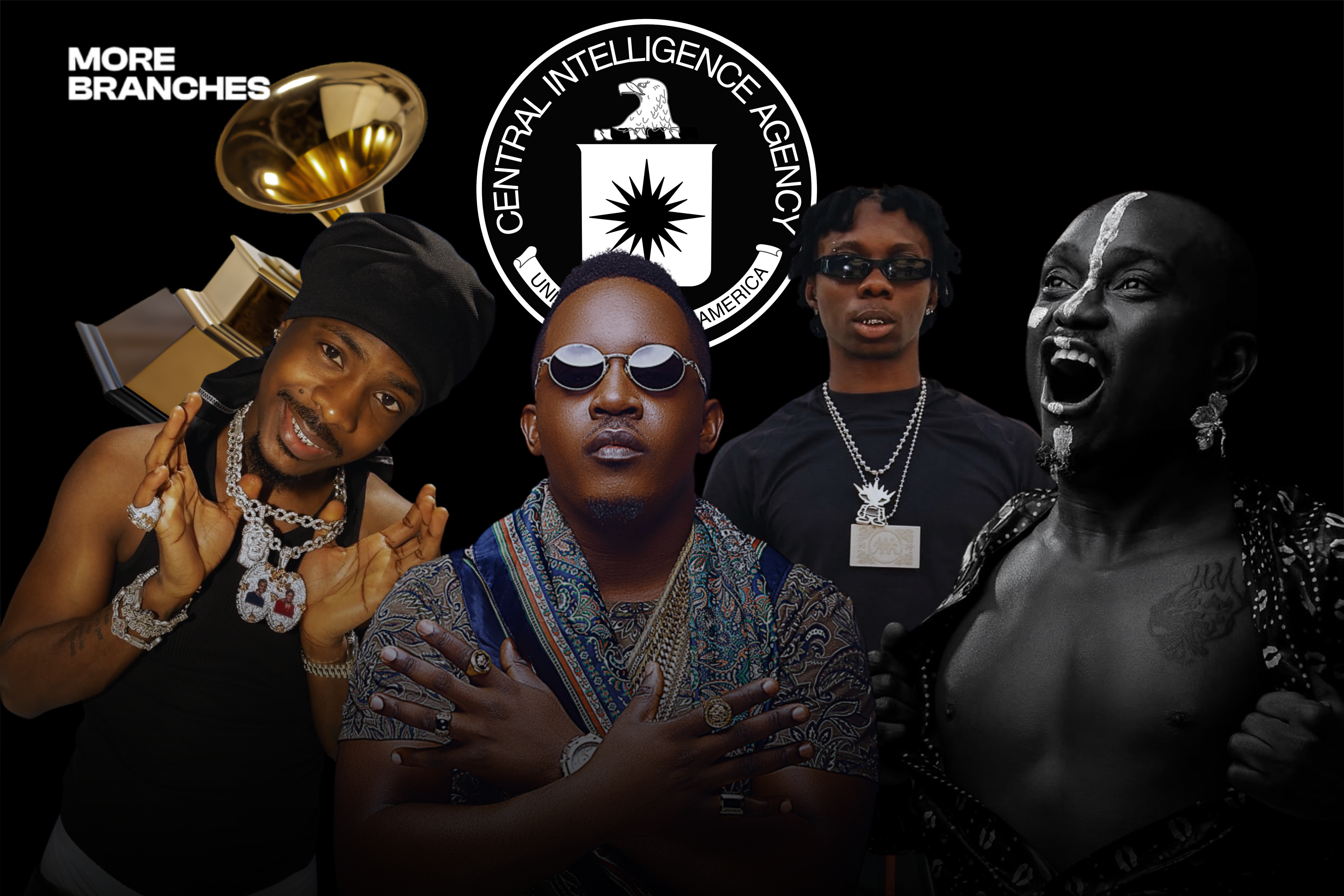
This is real, documented history, and most Nigerians have never heard of it. It is also the strongest argument behind the story that has taken over Nigerian music Twitter for the past two weeks: that the CIA, or US intelligence more broadly, is quietly running Afrobeats.
What is Being Claimed
In mid-September, a video shared by the X account Spearhead Africa alleged that US intelligence interests control or influence leading African musicians. It linked that alleged control to what some commentators describe as Afrobeats’ loss of international momentum. As the video spread, the claims attached to it grew bigger: that Chocolate City is CIA-funded, that Mavin is effectively US-controlled, and that stars including Wizkid, Davido and Burna Boy have “handlers.”
The journalist David Hundeyin pushed the story hard on X. He defended himself and the X user @Big_Mck against critics, and shared a clip from a livestream by the American commentator Mike Benz, posted under the title “Mike Benz On The US Government Program Producing Music Industry Plants.”
To one critic, he replied: “Because you work for Chocolate City and the food in your mouth is threatened.”
On 15 September, Chocolate City issued a statement on X:
So we took Hundeyin’s advice. We read the declassified history, the academic work built on it, the US government’s own announcements and the public record on Nigeria’s biggest labels. Here’s what we found.
The CIA Has Been Here Before
AMSAC wasn’t the only one. In Ibadan, the Mbari Writers and Artists Club, founded in 1961 by Ulli Beier with Wole Soyinka, Christopher Okigbo, J.P. Clark and Es’kia Mphahlele (Chinua Achebe suggested the name), opened its premises in July 1961 with sponsorship from the Congress for Cultural Freedom (CCF). Mbari published Black Orpheus, one of the most important literary journals in post-independence Africa.
The CCF was a CIA front, a fact that came out in 1966 and 1967. In her 2020 book African Literature and the CIA (Cambridge University Press), the British scholar Caroline Davis used CCF archives to show how the agency, through the CCF and a front grant-maker called the Farfield Foundation, funded journals like Black Orpheus and Transition, publishing houses including Mbari, and conferences that put African writers on the world stage. Her chapter on Soyinka caused a storm in Nigerian literary circles.
What stands out is how the money worked. The researcher Asha Rogers has described the CCF’s Africa programme as “non-interventionist.” Nobody told Soyinka or Okigbo what to write. The influence came from deciding who got funded, who got published and who got flown to Kampala, Berlin or Dakar.
This wasn’t only about Africa. In 1950, undercover agents from the CIA’s Office of Policy Coordination bought the film rights to George Orwell’s Animal Farm from his widow. The 1954 animated film was produced through a front company, and its ending was rewritten. The 1956 film of 1984 was also secretly subsidised. By the 1990s, the agency had moved into the open and was advising Hollywood productions directly. “It took us a long time to support projects that portray us in the light we want to be seen in,” CIA officer Chase Brandon told the Guardian in 2001.
So the people saying Washington has used culture to win hearts and minds are right. The real question is whether that is happening to Nigerian music now, and what the evidence shows.
What Washington Does in the Open
Today, most of American cultural influence in Nigeria runs through programmes listed on a government website. In September 2023, then Secretary of State Antony Blinken launched the Global Music Diplomacy Initiative. That same month, four US hip-hop artists came to Lagos for a two-week “Next Level” academy focused on conflict transformation.
In 2024, the State Department and the Recording Academy, the body behind the Grammys, ran the first American Music Mentorship Program (AMMP). It brought 20 mid-level music professionals from Nigeria, Ghana, Kenya, Egypt and Morocco to the Academy’s Los Angeles headquarters for two weeks of workshops, with trips to YouTube, CAA and Apple. US embassies vetted and selected the participants.
The US Mission doesn’t hide what it gets out of this. At a reception for the 17th Headies in April 2025, Ambassador Richard Mills credited “American streaming platforms, record labels, and US Government exchange programs” with playing a vital role in amplifying Nigerian music around the world.
That is soft power, stated plainly by the people using it. But it is a long way from a spy agency secretly bankrolling a record label. AMMP-style programmes pick individuals, build networks and generate goodwill. They are public, and people apply to them.
Follow the Label Money
Nigeria’s major labels do have deep foreign ties, and they are on the record. Chocolate City signed a worldwide distribution deal with Warner Music Group in March 2019, which is why CKay’s “Love Nwantiti” charted in the US as a Chocolate City/Warner release. In February 2024, Universal Music Group bought a majority stake in Don Jazzy’s Mavin Global. YBNL releases through the US-based distributor EMPIRE.
Chocolate City’s other big partner is the Nigerian government. In April 2025, it signed a three-year memorandum of understanding with the Federal Ministry of Arts, Culture, Tourism and the Creative Economy to build small live venues, develop talent and strengthen intellectual property protection. A month later, it partnered with the ministry on plans to rebuild the National Film Institute.
These deals raise real questions about who captures the value in Afrobeats. A 2026 paper from George Mason University’s Antonin Scalia Law School pointed to international industry power, weak local data systems, contested royalty arrangements, and a shortage of African capital to scale music businesses. Foreign money can decide which songs get pushed, which markets get investment and how artists are packaged for the world. None of that needs a spy agency.
On the specific claims, MoreBranches found no contract, budget line, payment trail, court filing or declassified document linking Chocolate City, Mavin, YBNL or any Nigerian artist to the CIA. IBTimes UK, which also examined the claims, reached the same conclusion. The one claim about Chocolate City’s ownership that could be checked, a link to Universal Music Group, is contradicted by the label’s public Warner deal and by its own statement.
Who is Making the Case
Mike Benz is often introduced as a former State Department official. According to The New York Times, his time at the State Department lasted about two months. He was a speechwriter for Ben Carson and Stephen Miller during the first Trump administration and now runs the Foundation for Freedom Online.
He is best known for popularising the claim that USAID worked as a front for US intelligence, an idea Elon Musk seized on in early 2025. Later that year, The Atlantic reported, Benz was brought into USAID itself as a special government employee. In 2023, NBC News reported that he appeared to have run an alt-right online persona that posted racist content.
David Hundeyin is an award-winning investigative journalist whom Chimamanda Ngozi Adichie has called “brilliant.” His reporting has also drawn legal threats, including a 2021 demand for a retraction from Senator Godswill Akpabio.
His critics say his methods skip the verification that traditional journalism requires. Writing in Africa Is a Country this year, Omole Ibukun argued that Hundeyin “takes people’s anger, turns it into dramatic battles… and then profits from the public watching it unfold.”
Neither man’s record settles the question either way. Evidence settles it. So far, neither has published any evidence that names a Nigerian label.
Why So Many People Believe It
Timing is part of it. Afrobeats exploded internationally between roughly 2016 and 2023, and this year the Guardian reported industry figures worrying about weaker global visibility, although the same piece framed the moment as a realignment rather than a collapse.
At home, the numbers are still going up: Spotify says Afrobeats streams in Nigeria have grown 5,022 per cent since it launched here in 2021. When a scene that once looked unstoppable starts to feel stuck, a hidden hand is an easier explanation than market saturation, rising promo costs or amapiano.
History is the other part. In 1961, Nina Simone flew to Lagos without knowing who paid for her ticket. In Ibadan, some of the greatest writers this country has produced built their careers on money whose real source they didn’t know. Nigerians have good reason to ask questions about foreign money in their culture. Asking is fair. Treating the question as the answer is not.
What Would Count as Proof
- A declassified or leaked US government document naming a Nigerian label, artist, or executive
- A contract, invoice, or payment trail from a US agency or known front to a Nigerian music company
- On-record testimony from a named insider, backed by documents
- Company filings showing funding that can’t be explained by known deals
Until something like that appears, the claim that the CIA controls Chocolate City or any Afrobeats star remains unverified.
The Question Worth Asking
There is a better debate buried under this one. Should Nigerian labels, festivals, award shows and media platforms disclose foreign government money, including embassy grants and exchange programmes, the way politicians are supposed to declare assets? The writers of the 1960s took money they couldn’t see. Today most of it is visible to anyone who checks.
The CIA story from 1961 is true. The one going round in 2026 has yet to show its receipts.