The drum held about 200 litres of liquid. It sat in a vehicle at No. 25 Omenazu Street, Aba, next to packaging for Sir Edwards Scotch Whisky and Scottish Hills Whisky and a pile of empty bottles. The man NAFDAC believes ran the place was gone. He left the car behind.
That is how the National Agency for Food and Drug Administration and Control described its latest raid in a statement on Monday, 19 October, Nairametrics reported. Inside, officers found bottle caps, sealing machines, cartons, storage tanks of “unidentified liquid mixtures” and dirty sieves. There were 200-litre drums of ethanol, some with tree bark soaking in them. NAFDAC put the value of the equipment, materials and facility at more than ₦500 million.
It is not the first raid this month. It isn’t even the second. It is at least the third.
A Week of Busts
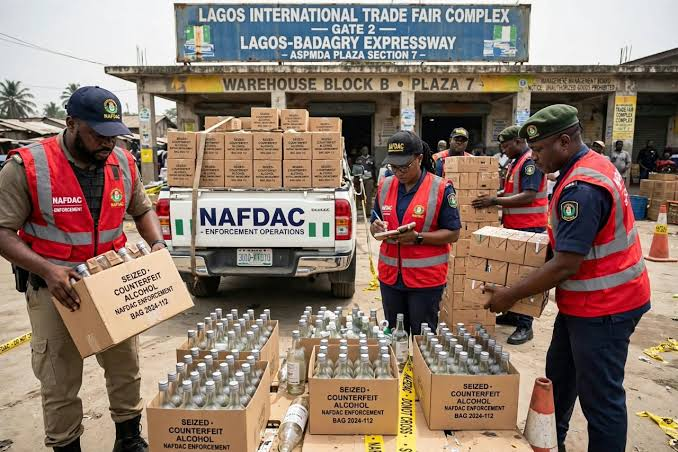
On 13 October, NAFDAC raided Zamfara Plaza inside the Lagos International Trade Fair Complex in Ojo. Officers found more than 20 illegal stores, according to news reports. The agency said suspects were blending and faking popular alcohol brands, changing expiry dates on old drinks and stockpiling banned imports. Goods worth more than ₦2 billion were seized.
Vanguard, which was at the raid, reported fake energy drinks, wine and whisky too. One of the two men arrested told the paper: “I change the bottle of the drink… because the other one is already damaged. So that’s why we are putting it to the next bottle.”
On 15 October, it was reported that NAFDAC had hit five shops at Old Court Road Market in Aba and seized fake labels, corks and packs worth more than ₦200 million. The brand names on them included Jameson, Glenfiddich, Four Cousins, Lord’s Dry Gin, Imperial Blue, Chelsea, Squadron and Seaman’s Aromatic Schnapps. Traders threatened officers, and the shop owners were not there.
Earlier in the month, a raid on Ile-Epo Market in Lagos seized about ₦300 million of alcohol in banned sachets and small PET bottles.
The Numbers Side By Side
Add up the three counterfeit raids between 13 and 19 October (₦2 billion, ₦200 million and ₦500 million, each a “more than” figure) and you get at least ₦2.7 billion in fake drinks, packaging and kit. Put the Ile-Epo seizure on top and October passes ₦3 billion.
Across those three raids, the reported arrest count is two. Both came from the Lagos raid. In Aba, the factory operator escaped, and the shop owners were absent. To be fair to NAFDAC, these are values it assigned itself, and a seizure is not a conviction. But more than ₦700 million of alleged fakery in Aba has so far produced no reported arrests.
Why This Is Not Abstract
The raids land weeks after a deadly alcohol story in Ondo State. In September, 48 deaths from suspected methanol poisoning there. NAFDAC confirmed 182 cases linked to locally prepared alcoholic and herbal concoctions, and said lab tests on 15 samples found high concentrations of methanol and that 15 people had been arrested. Five victims reportedly went fully blind and two partly blind.
No report says the drinks seized in Aba or Lagos contained methanol. NAFDAC found ethanol in Aba. But the wider market is hard to police: the Federal Government has cited a 2024 Euromonitor estimate that about 40% of the spirits and wine drunk in Nigeria are illicit or unrecorded.
Kunle Ojo, an assistant director in NAFDAC’s enforcement unit, told Vanguard the agency stepped up raids ahead of the festive season. His message to the fakers was blunt: “You are killing Nigerians in order to make money.”
How To Spot Fake Products
These checks come from NAFDAC’s own consumer guidance and from tips its Director-General, Prof. Mojisola Adeyeye, issued in December 2023.
- Check the NAFDAC number. NAFDAC tells consumers to insist on a registration number (NRN). No number, don’t buy.
- Read the dates. Look for the production date, expiry date, and a batch or lot number.
- Find the maker. There should be a manufacturer’s name and a physical address, not just an email. Adeyeye said if it is missing, “the alcohol is fake.”
- Inspect the seal. A broken or damaged seal means the contents may have been tampered with.
- Look hard at the label. Poor printing, spelling mistakes, and oddly shaped bottles are warning signs. A label in a foreign language with no English means NAFDAC has not registered it.
- Be suspicious of a bargain. Adeyeye said a bottle selling well below its normal price is “probably fake.”
- Scan the barcode and check it matches the product.
- Smell it. In Adeyeye’s words: “If it smells like paint stripper or nail polish remover, then it probably is!”
To report a suspected fake, call 0800-1-623322 or email reforms@nafdac.gov.ng. You can also text the product name and problem free to 20543 on any network.
What Is Still Owed
NAFDAC says it will trace who financed the Trade Fair operation. It has not named the owner of the Omenazu Street factory, the five Aba shop owners, or where the ₦500 million in kits came from. Until someone stands in court, the raids are a good video and not much else. Party season starts in six weeks.