Nigeria’s headline inflation has fallen for three straight months. The central bank cut its policy rate by 350 basis points in September. The economy grew 3.89% year-on-year in the first quarter. Federal, state and local governments shared a record ₦17.12 trillion in the first eight months of 2026.
And only one in ten Nigerians with a bank account could raise ₦156,000 within a week without difficulty.
That figure comes from Odunayo Eweniyi, co-founder and COO of PiggyVest, speaking at the company’s OpenHouse in Lagos. ₦156,000 is not an arbitrary number. It is ten per cent of Nigeria’s gross national income per head — the standard measure the World Bank uses to test whether a household can absorb a shock. Nine in ten cannot.
Her keynote was titled “A Tale of Two Nigerias.” The numbers behind it are worth setting out properly, because they explain something the macro data cannot.
Saving has collapsed in three years
PiggyVest surveys roughly 30,000 Nigerians a year. The trend line is brutal.
| Year | Share who did not save at all |
|---|---|
| 2023 | 1 in 5 |
| 2024 | 4 in 10 |
| 2025 | More than half |
Of those who stopped, six in ten said plainly that they do not earn enough. Two in ten said they did not care.
Six in ten Nigerians have no emergency fund at all. Among the minority who do, most can cover only one to three months, and just 15% have more than that. One in four could not raise emergency money from anyone — not a bank, not family, not a friend. The Sub-Saharan African average is one in eight. Nigeria is twice as exposed as its neighbours.
Asked how they feel about money, 6% said secure.
The income floor
None of this is a discipline problem, and the income data settles the argument.
58% of Nigerian adults earn under ₦100,000 a month or nothing at all. Among Gen Z it is 77%. Nearly three in four adults now use a bank, wallet or other formal financial service — so this is not about being unbanked. People have accounts. They have nothing to put in them.
The minimum wage tells the same story in a different currency. In 2023 it was ₦30,000, worth about $65. Today it is ₦70,000, worth about $53. The number more than doubled. The value fell by a fifth.
Where the money actually goes
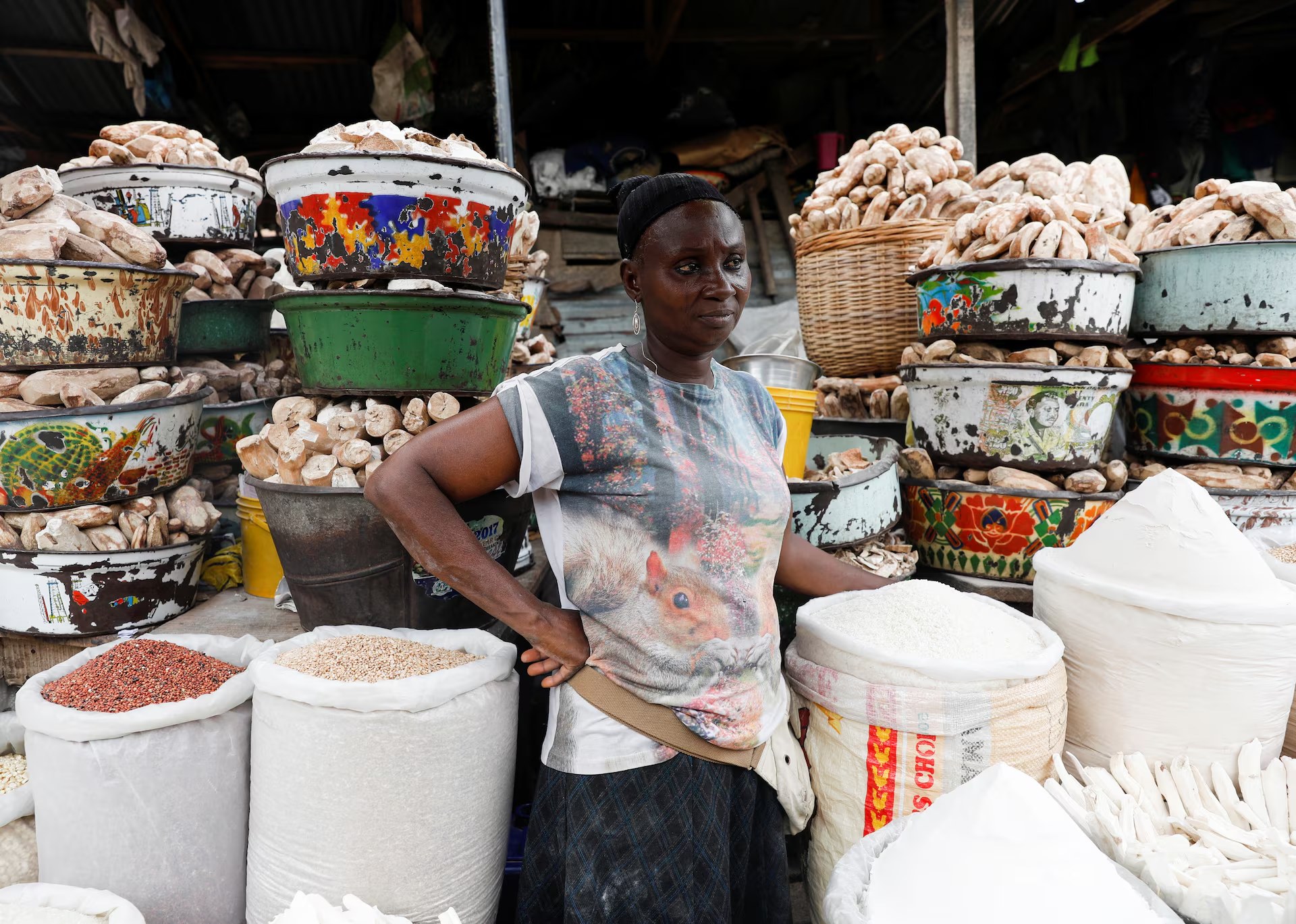
Food takes ₦6 of every ₦10 Nigerian households spend — close to 60% of income. In the United States, food was 12.9% of household expenditure in 2024. That single comparison is the whole cost-of-living story: when six naira in ten is already committed to eating, there is no tenth naira left to save.
SBM Intelligence has tracked the cost of a pot of jollof rice for a family of five across 13 Nigerian markets since July 2016. Over that decade it has risen 624%. In the Southwest, 708%.
Here is where the story gets more interesting than the viral version of it.
In June 2026 the index hit ₦29,578, about 42% of the minimum wage. But in the third quarter it fell — down 11.5% to ₦26,178, the sharpest quarterly drop since SBM began tracking in 2016. Chicken, beef and vegetable oil got cheaper on better harvest supply and cheaper poultry feed.
So food got cheaper, and people still cannot save. At ₦26,178, a single pot still costs 37% of the official minimum wage. And if the unions are right that the wage many actually receive is closer to ₦40,000, that one pot is 65% of a month’s minimum pay.
Relief at the market does not reach a household whose income never recovered.
Two Nigerias, measured
Both sets of numbers are true at the same time, and that is the point.
| The recovery | The household |
|---|---|
| Inflation down from about 35% to around 15% | Food inflation still near 20% |
| Policy rate cut from 26.5% to 23% | More than half of adults did not save in 2025 |
| GDP up 3.89% year-on-year in Q1 2026 | 58% of adults earn under ₦100,000 a month or nothing |
| Record ₦17.12trn shared by the three tiers in eight months | 63% live below the national poverty line — about 140 million people |
| Jollof index down 11.5% in Q3 | A pot still costs 37% of the minimum wage |
Poverty has risen every year since 2023.
What people do instead
Two things give way when income is squeezed, and both show up in the data.
The first is the extended family. The share of earners paying black tax has fallen from over 80% to about two-thirds. That is not people becoming selfish. It is the safety net itself thinning out — which is precisely why one in four can no longer raise emergency money from anyone.
The second is leaving. 56% of Nigerians have considered leaving the country, up from 36% in 2017. But here the carousels circulating this week get it backwards. Japa is not getting easier to fund — it is getting harder. Japa was the top savings goal for more than half of Gen Z in 2023. It halved by 2024. By 2026 it had dropped out of the top savings goals entirely.
More people want to leave. Fewer can afford to. The exit became a luxury good.
The part that doesn’t fit
One number cuts against everything above, and it is the most Nigerian statistic in the set.
65% of Nigerians believe the next generation will be better off. Across 28 countries surveyed, that is the highest figure recorded. The world average is 32%.
A country where six in ten have no emergency fund and 63% live below the poverty line is also the most optimistic country in the survey about its children’s future. Six in ten young Nigerians would rather start a business than take a job.
Whatever is holding this economy together, it is not the savings rate.
What to watch
Three numbers will show whether the two Nigerias converge.
The first is food’s share of household spending. Until ₦6 of every ₦10 becomes ₦4, no amount of headline disinflation reaches anyone’s savings.
The second is whether the Q3 fall in the Jollof Index holds through December, when demand peaks, or reverses.
The third is the share who save anything at all. It fell from eight in ten to under five in ten in two years. That is the clearest single measure of whether recovery has reached the household — and so far it says no.