
Twenty years, four missed deadlines, billions of naira, a Chinese satellite programme that quietly collapsed in rural villages, and one administration that decided to stop building towers. This is a story about why FreeTV might be the first version of this promise that actually sticks, and why that is not yet certain.
There is a particular kind of Nigerian government announcement that arrives with great fanfare, a ministerial press conference, and the quiet certainty that it will become a footnote. The Digital Switch-Over has been that announcement, repeatedly, for the better part of two decades. It was announced in 2006. Then 2012. Then 2015. Then 2017. Each time, the language was almost identical: Nigeria is finally making the transition from analogue to digital broadcasting. Each time, it did not happen.
Today, June 17, 2026, the same date Nigeria signed its original ITU commitment exactly twenty years ago, the federal government launched FreeTV. Over 100 channels, no subscription fees, accessible by satellite, terrestrial signal, and a mobile application. If it works, it is the most significant shift in Nigerian broadcasting since DSTV arrived in the nineties. If it doesn’t, it joins a long list of announcements that were really just announcements. To understand why this one might be different, you have to understand why all the others failed.
The Promise That Kept Getting Made
The journey started on June 17, 2006, when Nigeria signed a regional and international agreement to conclude digital migration by June 17, 2012. In 2008, the Federal Government set up a Presidential Advisory Committee to develop a policy framework. The committee submitted its report the following year. The government kept the recommendations for three years and did nothing with them. Nigeria missed the 2012 deadline.
The target moved to 2015. Nigeria missed that one too, then set June 17, 2017, as the next target, and still could not achieve 95% digital coverage across the country. Between 2017 and 2022, there were more rollout announcements, more ministerial tours of facilities, more renewed efforts — all of which stalled on the same two problems: funding and political will. Only limited pilot phases were ever launched in states like Jos, Abuja, and a few others.
Countries including Mauritius, Rwanda, Tanzania, Kenya, Malawi, Botswana, Namibia, and Côte d’Ivoire have all successfully completed the DSO process. Luxembourg completed its switchover in 2006. Most of Europe followed within a decade. Nigeria, the largest economy on the continent, kept missing its own deadlines. The diagnosis was never really a mystery. Funds, lack of political will, and technicalities are what successive governments cited, always in that order, as though they were separate problems rather than the same problem with different names.
The Chinese Chapter Nobody Wants to Talk About
Buried inside the DSO’s history is a story that gets less attention than it deserves. In 2019, the Chinese government, through StarTimes, a state-linked broadcasting company, launched a satellite TV project for 1,000 Nigerian villages. Each selected village was to receive two solar power projector TVs, a digital TV set, 20 satellite dishes and decoders, providing access to over 100 channels free of charge. The launch was celebrated. Buhari’s government praised it. StarTimes said the project was ongoing.
What actually happened on the ground was different. Research found that most of the satellite TVs in public places in these villages had collapsed, and very few were still in use, yet the Chinese government continued to receive commendation and applause. In one documented case, a beneficiary in FCT said they used the equipment for one year before it stopped working. The monitoring from Nigerian authorities was, by most accounts, nonexistent.
The StarTimes episode is instructive not because it was a scandal, but because it was a preview. A free TV initiative, government backing, Chinese infrastructure, rural communities who were supposed to benefit — and what you got was a launch event followed by silence. The footprint of Chinese government financing in the foundational architecture of Nigeria’s broader broadcast transition cannot be ignored, and anyone serious about scrutinising FreeTV needs to ask what oversight mechanisms exist this time around.
Here is where the Tinubu administration deserves credit for doing something the previous attempts did not: changing the blueprint rather than just the deadline. Every failed DSO attempt was built around the same model: a nationwide network of terrestrial transmission towers that would beam a digital signal to decoder boxes in people’s homes. The NBC Director-General, Charles Ebuebu, has been explicit about why that model was always doomed: “Even if we are able to fund all those towers nationwide, it is not sustainable. We would run into the same issues again.”
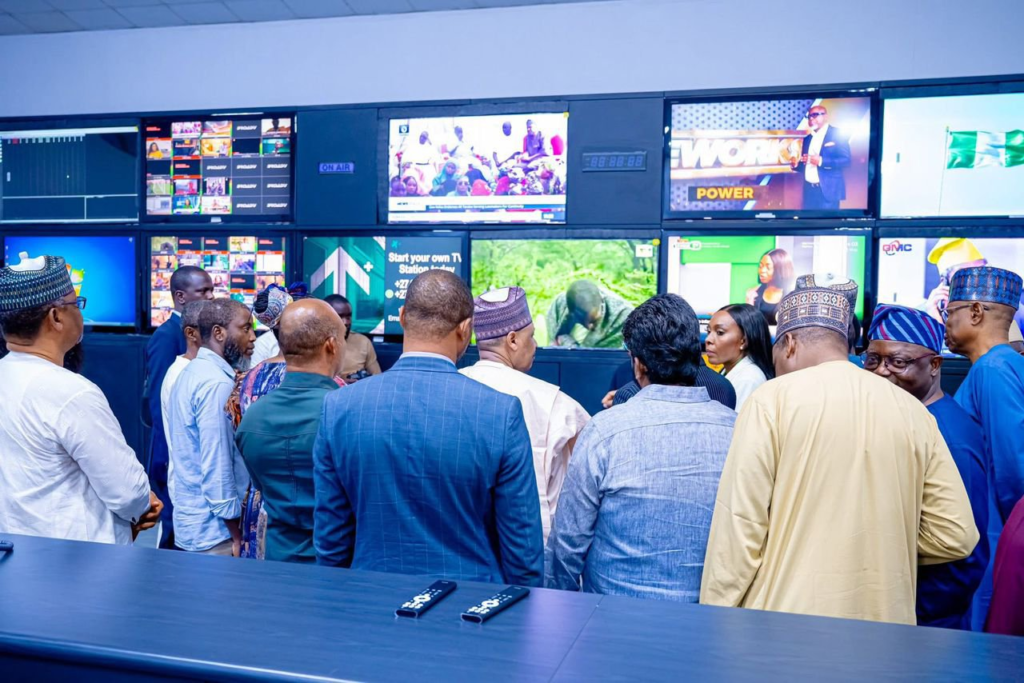
The tower model was expensive to build, more expensive to maintain, and structurally incapable of reaching communities in Nigeria’s geography. The moment funding dried up, which in Nigeria it always does, the signal stopped. FreeTV abandons that model in favour of a hybrid: digital terrestrial television, satellite broadcasting, and internet-based platforms combined into one system. This is not a cosmetic change. It means the platform’s reach is not dependent on any single infrastructure layer surviving. If terrestrial towers in a region fail, satellite covers. If the satellite is patchy, the mobile app picks up the gap. The service is expected to reach major cities, towns, rural communities, and locations that were not covered during earlier phases of Nigeria’s digital migration programme.
The decoder problem has also been addressed more sensibly than before. Existing television sets can work with compatible DVB-T2 or DVB-S2 decoders, and households that already have compatible free-to-air decoders may not need any additional equipment. The mobile app removes the hardware barrier entirely for anyone with a smartphone. This is how you reach people who are not already invested in upgrading their setup.
What’s Actually at Stake
Strip away the Renewed Hope branding, and what FreeTV represents is a direct challenge to the subscription television model that has extracted money from Nigerian households for thirty years. Currently, most Nigerians who access digital TV do so through satellite platforms that charge monthly subscription fees. DSTV has dominated that market so completely that “DSTV” has become a generic noun; people say they’re watching DSTV when they mean they’re watching television.
A free platform with 100+ channels, local content obligations, and mobile accessibility is the first thing to threaten that in any structural way. The question is not whether FreeTV is a good idea, it clearly is, but whether the execution matches the announcement. There are reasons for scepticism that go beyond habit. Online reactions to today’s launch were already split, with Nigerians questioning the government’s priorities amid ongoing economic and security challenges. That reaction is unfair in one sense, digital broadcasting is not a competition with fuel subsidies for government attention, but it points at something real.
Nigerians have learned to treat government infrastructure promises as press releases first and deliverables second. That trust deficit is not irrational. It was earned over twenty years of exactly this kind of announcement. The final analogue television switch-off remains scheduled for December 31, 2028. That is the real deadline, not today’s launch, but the moment the old signal goes dark and FreeTV either holds the weight of being the primary alternative or becomes another expensive footnote.
The Honest Verdict
FreeTV is the most technically credible version of this promise Nigeria has produced. The hybrid infrastructure is smarter. The decoder-agnostic approach is more realistic. The local content mandates and regional production studios, if they materialize, could genuinely reshape how Nigerian stories reach Nigerian audiences.
But the DSO has also been the most technically credible version of this promise at least twice before, and it still didn’t work. What kills Nigerian government infrastructure projects is rarely the concept. It’s the gap between the ribbon-cutting and the maintenance budget three years later, between the announcement and the accountability structure that makes sure someone is monitoring those village satellite dishes before they rust.
The question FreeTV cannot answer today is the one that every previous version of this promise also couldn’t answer: what happens after the launch event?
Nigeria signed its first digital switchover commitment on June 17, 2006. Twenty years later, to the day, FreeTV went live. That symmetry is either a satisfying resolution or an irony so deep it loops back around to being funny. Which one it turns out to be depends entirely on what the government does next, not what it said today.