The Financial Action Task Force (FATF) is a global watchdog that sets international standards for fighting three major financial crimes:
- Money Laundering: Hiding the sources of illegally obtained money.
- Terrorist Financing: Funding illegal or violent activities.
- Proliferation Financing: Supporting the development or spread of weapons.
Over 200 countries around the world follow FATF’s standards, making it one of the most influential global bodies in financial regulation
The FATF reviews countries’ efforts to prevent money laundering and terrorist financing through two FATF public documents issued three times a year. Following their findings, the organisation publishes two public lists:
- Black List: For high-risk countries with serious and ongoing issues (e.g., Iran, Myanmar, North Korea).
- Grey List: For countries that have strategic weaknesses but are working with the FATF to fix them.
Why Was Nigeria Grey-Listed?
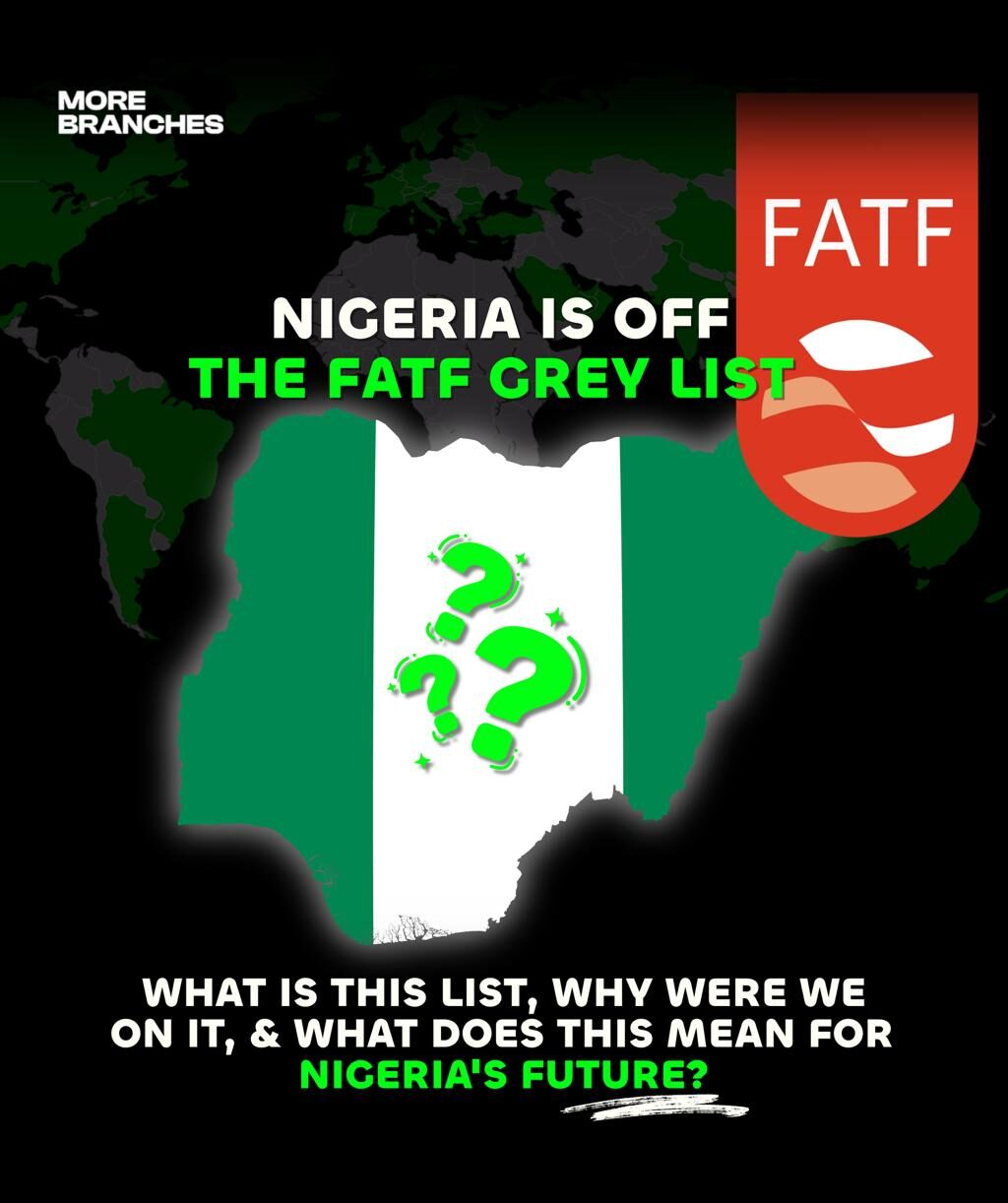
In February 2023, the FATF placed Nigeria on its Grey List, “Jurisdictions under Increased Monitoring.” The FATF identified strategic deficiencies in the country’s Anti-Money Laundering and Counter-Terrorist Financing (AML/CFT) framework, including:
- Weak transparency in company ownership
- Limited supervision of non-bank financial institutions
- Poor coordination between agencies
- Insufficient enforcement and prosecution
Being on the Grey List didn’t mean sanctions, but it did have serious economic consequences:
- Tougher scrutiny from international banks, making cross-border payments harder.
- Investors saw Nigeria as a higher-risk market, leading to reduced foreign investment.
- Nigerian businesses and banks faced increased due diligence requirements and costs for international transactions.
- Limited access to finance, especially from international partners.
How Did Nigeria Get Off The List?
To resolve these issues, Nigeria worked with the FATF to implement a 19-point Action Plan to strengthen its systems and address the identified gaps. To get delisted, Nigeria had to show progress by:
- Creating a Beneficial Ownership Register.
- Strengthen its financial intelligence systems for better monitoring.
- Enforcing anti-money laundering laws.
- Improving inter-agency coordination (EFCC, CBN, NFIU, etc.).
- Increasing prosecution and convictions for financial crimes.
What Does the Delisting Mean For Nigeria?
Now that Nigeria’s off the FATF list, it shows global confidence in the country’s financial system and opens new opportunities for economic growth. It also means:
- Cheaper Transactions: Lower costs for remittances and international payments.
- More foreign investment: Investors now see Nigeria as a lower risk.
- Stronger Naira: Improved trust in the country’s financial stability.
- Better global image: Nigeria may now be seen as transparent and trustworthy.