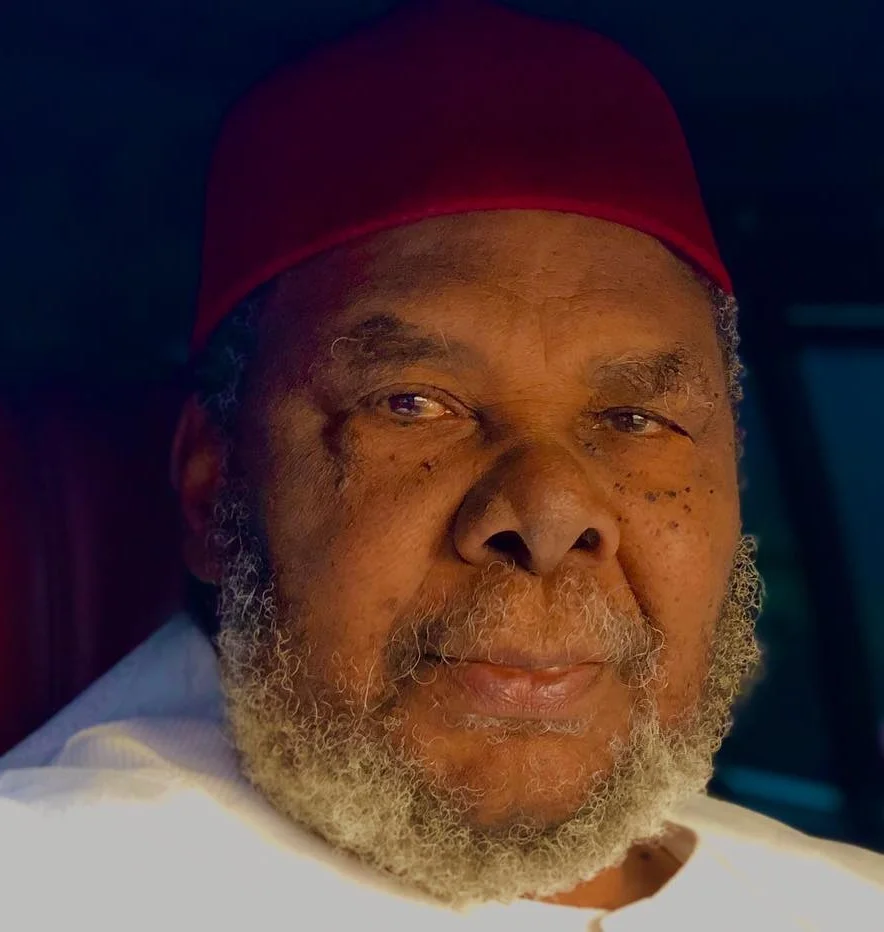
Pete Edochie died at 12:30 this morning in Enugu. He was 79.
His son, Chief Leo Pete Edochie, announced it in a statement on behalf of the family, posted to Instagram and titled “An Iroko Has Fallen.” It confirmed that his father had died after a protracted battle with prostate cancer, and said funeral arrangements would follow in due course.
For a generation of Nigerians, he was the first face that Nigerian literature ever had.
The man who became Okonkwo
When the NTA adapted Chinua Achebe’s Things Fall Apart for television, the part of Okonkwo went to a broadcaster from Anambra with no film career behind him. Edochie had spent his working life in radio and television administration. He did not come up through the theatre.
What he had was the voice, and a stillness that read as authority without ever reaching for it. Okonkwo is a difficult man to play. He is proud, violent, frightened of his own softness, and the novel does not forgive him. Edochie gave him weight rather than sympathy, and the performance fixed itself so firmly that for millions of readers across the continent the character has worn his face ever since.
What he did with the rest of it
He became Nollywood’s patriarch by default and then by demand. Traditional rulers, chiefs, wealthy men at the head of difficult families, the elder whose judgement closes the scene. He played the same register for decades and found more in it than the writing usually offered, largely through delivery and the proverbs he was known for folding into a line.
That typecasting is worth noting honestly. An industry that had one man it trusted with gravitas used him for exactly that and little else. He made it look like a choice.
Born in Zaria in March 1947, he hailed from Akamnato, Ifite Nteje in Anambra State, and was honoured as a Member of the Order of the Niger.
A generation going
Olu Jacobs died in September, aged 84. Edochie follows barely two months later.
These are the actors who were working before Nollywood had a name, when the industry was a few people with cameras and no distribution, and who stayed long enough to see Nigerian film become the second largest industry of its kind in the world. They built the audience that everything since has been sold to.
There is no replacement generation for that, because the conditions that made them are gone. Nobody now comes to screen acting through a career in state broadcasting and a novel on the national curriculum.
In February he had to publicly dismiss rumours of his own death, which is its own grim comedy for a man of his standing. This time the statement came from his son.
An iroko has fallen.