
Sitting on a white wall, a slender black frame enwraps a striking scene: a pale face, stretched taut as though carrying the weight of countless generations, emerges through layers of acrylic. Colors surge across the canvas: green, red, teal, cerulean, orange, and black. Colliding and blending like the aftermath of a volcanic eruption, flecks of white scatter throughout this kaleidoscopic mindscape, shimmering like stars in an iridescent night sky.
Set against a deep black backdrop, the face and its cascade of colors stand in sharp relief, the vivid spectrum glowing all the more fiercely against the surrounding darkness.
This painting calls to my mind the likeness of a young Nigerian adult, navigating the complexities of adulthood in present-day Nigeria, surrounded by much darkness (figuratively and literally), yet with a mind that is alive and vibrant, evolving into shades of colors and light, and like an iridescent sky, creating beauty even amidst heaviness. The piece is named rightly so — Transcendence.
Of this immersive work of art, the self-taught abstract visual artist and mental health advocate, Bella Mfon says, ‘it reflects a period of quiet self-discovery, and a decision to keep moving forward despite fear and uncertainty.’ The artist, who has half a decade of experience with acrylic and textures, took up art as a therapeutic tool while navigating her own mental health challenges. Her work goes beyond mixing and layering colors, but gives language to depths that may otherwise never find expression. Of Transcendence, she said, ‘the textures, colors, and overall composition all carry layers of meaning that go beyond aesthetics; they represent resilience.’
This is a classical example of how the Abuja-based artist uses art as a means of expression, a way to speak about emotions and states of mind that may otherwise never be expressed. ‘Art became my voice,’ she says, “
‘through acrylics and textures, I could pour out what I was feeling: brokenness, loneliness, or the weight of silence.’ Mfon and I are conversing via email, and as I read her responses, there is an earnestness in her words that captivates me, engulfs me even. ‘Over time,’ she says, ‘I realized that what I was creating was not just about me; it reflected a larger reality in society.’
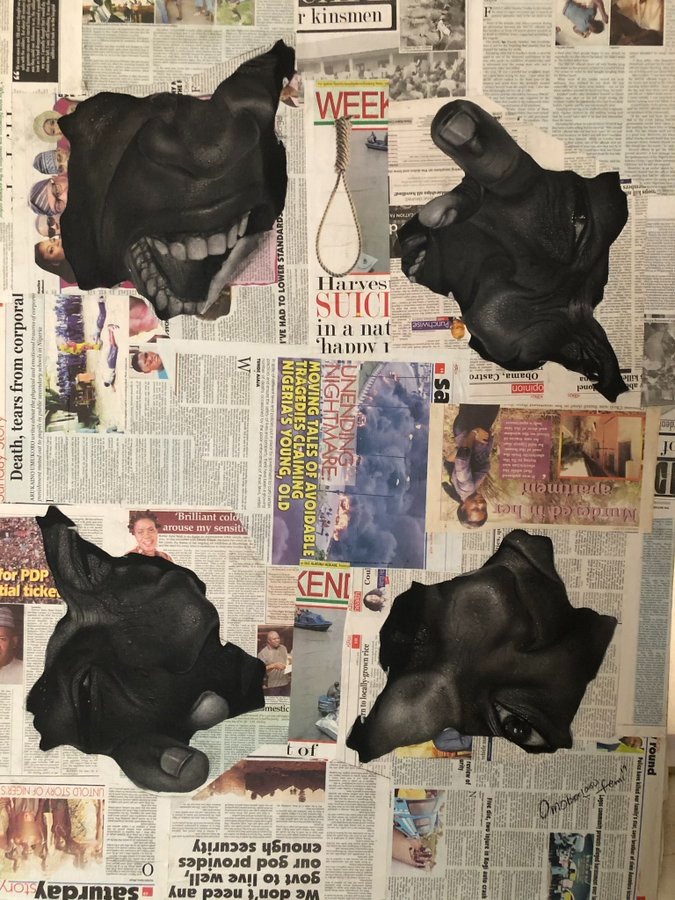
This sentiment is not hers alone. Oluwafemi Omoboriowo, the Nigerian-born, United Kingdom-based hyperrealistic and mixed media artist, created a piece in 2020 named “Angry Nigerians.” The piece features enraged faces of Nigerians matted against a backdrop of cutout newspapers. As if overwhelmed by the overflow of unpleasant news that rolls out at us through various outlets, the faces are squeezed as if in a bitter frown or caught in the middle of an earnest scream.
Of this piece, Omoboriowo says, ‘This piece was born out of observing the collective frustration and disillusionment of Nigerians who live under constant pressure from corruption, insecurity, and economic hardship. It’s about how the system weighs down on people’s minds and emotions.’ This response of his forces me to pause; I stare out of my room window into the vast space.
A myriad of random thoughts fall free through my mind; young Nigerian medical doctors clamoring for their salaries to be paid in time, professors being owed years of remuneration by the federal institutions they’ve served for over 2 decades; violence, kidnappings, deaths unaccounted for, the unruly inflation and resultant palpitating hearts of young parents, as they worry about how to put food on the table for their children. Then there is the Behavioral Sciences ward of the University of Ilorin Teaching Hospital, filled with men and women whose minds have one way or another become “fractured,” battling with one form of mental illness or another.
According to Alliances for Africa, over 60 million Nigerians are suffering from various mental illnesses, making up as much as 30% of the total Nigerian population. Nigeria was recently ranked 15th in the number of suicides per year. Another survey ranked Nigeria the most depressed country in Africa. It goes without saying that Nigeria is facing a mental health crisis; yet, conversations about mental health remain taboo in many Nigerian communities. In many parts of the country, things like depression and schizophrenia are still considered spiritual attacks, punishment from God, or an indication of witchcraft. So while Nigeria has the highest load of depression in Africa, the topic itself is still discussed in hushed tones, as if to speak of it is to be cursed. However, visual art is rising as a channel of expression, helping many Nigerians talk about mental health in powerful, shape-shifting ways.
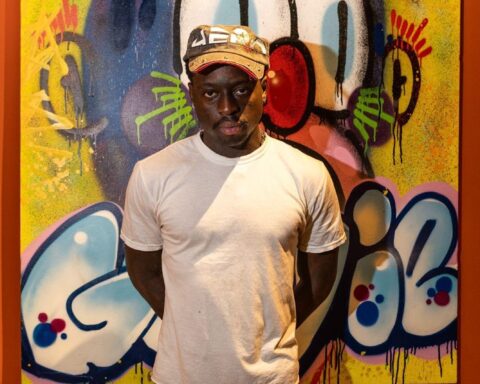
Take Yusuf Seidu Okus, the UK-based experimental artist who grew up in Sapele and studied Painting at Auchi Polytechnic in Edo state. While actively creating art, he worked in the Occupational Therapy Unit of the Federal Neuropsychiatric Hospital in Benin City until 2023. The opportunity to gain such exposure to mental health and work in proximity with people living with mental health challenges prompted a shift in his work. He described his experience in the unit as the ‘turning point’ of his artistic career, spurring him to explore more mental health themes in his work.
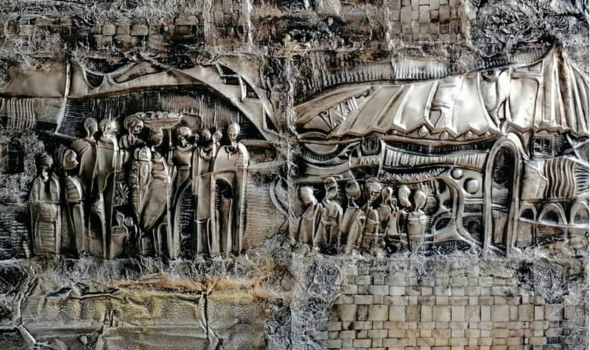
There is also Cherry Aribisala, a Nigerian-born multidisciplinary artist currently based in London, whose works often explore themes like anxiety, perfectionism, and escapism. Through her work, she aims to make intangible concepts tangible. ‘Once a dream, or an anxiety, becomes a painting or a sculpture, it exists in the world,’ she says. ‘It’s no longer just inside me. That transformation is deeply tied to my mental health.”
Adrian Hill is often credited as the founder of art therapy. In the 1920s, Hill came down with tuberculosis, and during that time, he started to draw as a way to cope with the boredom associated with his restrictions. This habit became a vital tool of expression for the scientist and an aid in his recovery journey. ‘I became… a diligent and leisurely composer of precise pencil productions, each of which, in terms of my restricted medium, sought to express my personal reactions to the unreality of my existence’ (Hill, 1954, p.14).
Over time, the use of art as a form of therapy has continued to evolve and expand. In Nigeria, art has always been linked to healing, even before it became formally recognized as a therapeutic tool. Many cultural and religious practices of Nigerian ethnic groups employ artistic traditions for their healing properties.
Today, the use of art as a form of therapy for mental well-being is expanding, with initiatives centered around harnessing art as a tool for mental wellness. It was in the pursuit of the healing effects associated with art that Bella Mfon developed her own passion for visual art. In 2018, she started painting in an art therapy session after struggling with depression for over 10 years. ‘I had moments in my life where I found it difficult to express my emotions verbally, and art became a therapeutic outlet.’
Cherry Aribisala has a similar experience. ‘The first time I think mental health truly featured in my work was during my second year in university, around the start of Covid-19,’ she tells me. ‘Suddenly, I couldn’t make art in the ways that I used to. I felt constrained, reductive, even useless. I didn’t have the language for those feelings, but I knew I had to process them somehow…out of necessity, I began working smaller, experimenting with what was possible in that confined period. To my surprise, I found light in what felt like a dark time.’
If this started as an experiment, it must have been successful, because not only were these artists able to channel their inner chaos and experience the healing they craved, they also found that art was a powerful tool that could help them speak for the people around them. They could express themselves and also become a voice for those in their communities who have no voice or language to articulate their experiences.
‘Many people struggle with their mental health,’ says Mfon. ‘Especially in communities where conversations about it are still stigmatized. My art became both a mirror of my own healing process and a voice for others who couldn’t find the words.’
For Cherry Aribisala, being able to express her own inner turmoil through art gave her the courage to delve deeper and explore other mental health themes that are common in her community. ‘As restrictions lifted,’ she tells me, ‘I carried that part of myself into the studio and felt braver to explore deeper mental health themes like anxiety and perfectionism.’
Oluwafemi Omoboriowo shares this sentiment with Mfon and Aribisala. ‘It wasn’t just about me, but about how the system weighs down on people’s minds.’ Yusuf Seidu Okus is also on the boat with them. ‘I had firsthand experiences all around me and needed to tell these stories,’ he says.
Mental health is a vast theme, and as these artists courageously explore diverse dimensions of it in their works, it continues to reveal itself to them in new depths. Aribisala tells me practicing art has deepened her understanding of mental health.
‘Through my practice, I’ve learned that mental health is not about achieving a perfect balance. It’s about navigating flux and allowing myself bad days without shame, trusting that the act of making will bring me back… Art has given me a space to witness myself, to hold versions of me that I might have otherwise ignored. It has taught me that healing is not a straight line, but a practice.’
‘At first I approached mental health as something I could observe in society, the visible anger, tension, and pressure around me,’ Omoboriowo intimates. ‘But over time, through my practice, my understanding has deepened. I started to see that mental health isn’t only about outward expressions of frustrations; it’s also about the quiet, internal battles, anxiety, displacement, identity struggles, and trauma that people often endure in silence. My later works show this shift. I begin to explore vulnerability and healing, not just anger.’
‘In the beginning, I only saw art as an escape, a safe space to release emotions I couldn’t articulate. But over time, I started to notice patterns in the colours, textures, and forms I created. They became a language of their own, showing me that mental health isn’t just about illness or struggle, it’s also about resilience, balance, and the journey of self-discovery.’ Says Mfon.
Each of these artists explores different sensitive mental health themes in unique ways, with distinctive creative processes. They also work with a wide range of materials and media to give physical form to these abstract themes.
Bella Mfon often explores themes like brokenness, healing, and resilience, which arise from reflections of her own personal experiences and her observations in society. Her process begins with allowing herself to feel deeply. ‘I translate these emotions into color, texture, and layered forms on canvas.’ She goes further, ‘acrylics provide me with the freedom to work quickly and intuitively, while texture helps me capture the weight and complexity of these emotions.’
Omoboriowo is drawn to themes like anger and frustration, displacement, identity crisis, and resilience. ‘My process often begins with an emotional or societal observation, which I translate into portraits, layered with materials like charcoal, graphite, acrylic, fabric, and paper. Though my primary medium is currently charcoal and acrylic.’
Bella Mfon recognizes colors for their emotional significance and is intentional about the colors she uses in her works, depending on the kind of emotion she is trying to translate. ‘For example,’ she says, ‘darker tones such as deep blues, greys, and blacks often represent heaviness, silence, or feelings of isolation. In contrast, brighter hues such as yellows, whites, and golds symbolise hope, light, and the possibility of healing. I also incorporate layered textures to represent the complexity of the mind and how emotions do not exist in isolation; they overlap and intertwine. Cracks, rough edges, and raised surfaces often signify scars or unresolved struggles, while smoother, blended areas reflect moments of calm and balance.’
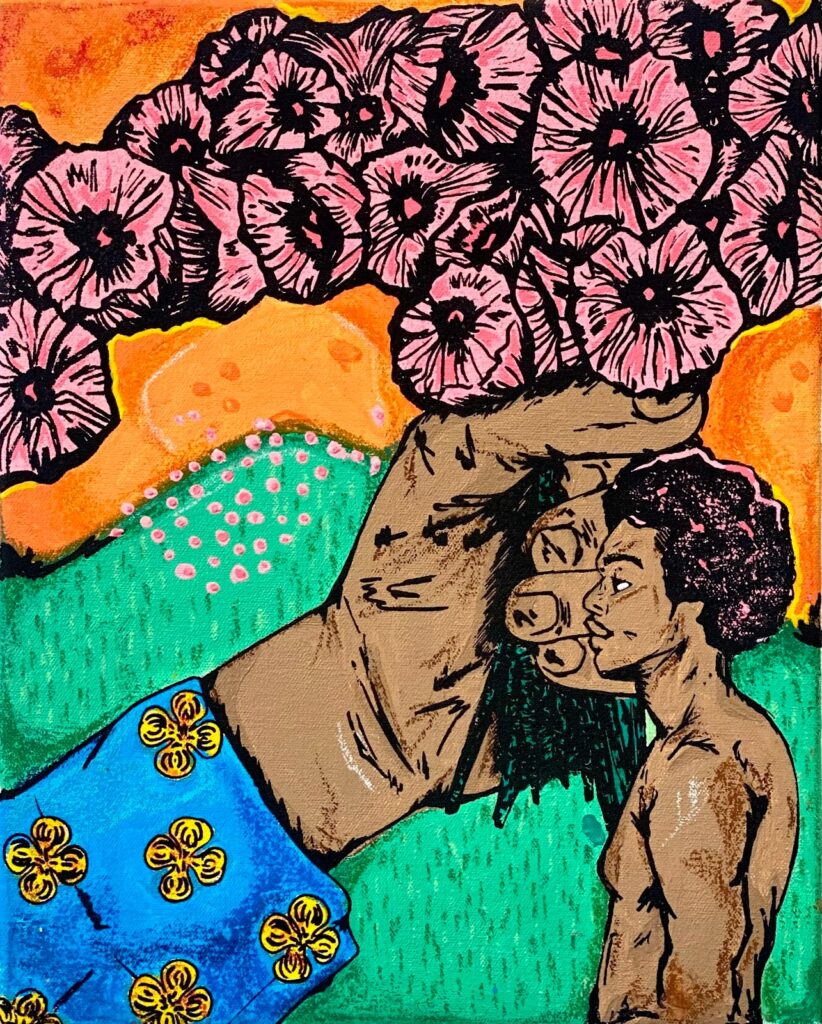
Cherry Aribisala also has a very intimate relationship with colors and how she employs them to tell stories. ‘From a young age, I was fascinated by color theory,’ she says.‘By the way certain hues clash or harmonize, by the emotions they can stir. For me, color is a form of escapism, a way to translate the vibrant intensity of my imagination.’ Her works also often feature lots of flowers.
An example is “In Bloom,” which features a striking profile portrait of a man with flowers integrated into his hair, face, and neck against a bold red background. It is created using acrylic paint and black ink on canvas. The man’s hair is filled with numerous orange-yellow flowers with black centers. They resemble marigolds or black-eyed Susans, which often symbolize warmth, creativity, and optimism. A large, pale yellow flower with soft petals, possibly a lily or hibiscus, is placed around the mouth and cheek area. A red flower with multiple thin petals, resembling a zinnia or daisy, also emerges from the face. There’s a cluster of lavender-colored flowers with elongated petals, which look similar to lilies or irises. Small orange blossoms with delicate petals also appear, resembling tiny wildflowers or buttercups.
‘Flowers often appear in my work because I live with them in my daily life.’ She explains, ‘I tend to my garden the way I tend to my studio, with patience, curiosity, and care. Both spaces are forms of escape for me.’ Speaking further on the significance of flowers in her art, she says, ‘Flowers are fragile, fleeting, yet resilient. They bloom, wither, and return. In that cycle, I see reflections of my own mental health, of vulnerability that can coexist with strength.’
Omoboriowo often works in monochrome, using charcoal and graphite. ‘The black-and-grey tones emphasize raw emotion, intensity, and the depth of psychological tension. I later started using colours (Acrylic) to deepen my conceptual thinking. I also rely on hands and facial expressions to externalize invisible emotions,’ he says.
These artists, among many others, are working hard to fill the existing gap in Nigeria in terms of mental health conversations and the creation of awareness, but no matter how much the towncrier cries, it is up to the town to respond.
‘Reactions can be complicated,’ says Aribisala. ‘Some people approach my work expecting the painting to be purely visual, something “just to look at.” When conversations turn towards mental health, there can be discomfort, even hostility.’ Yet, the positive impact is palpable. ‘What’s been most meaningful is when these same people (who were initially uncomfortable around mental health discourse) return later and admit that the work resonated with them, that it shifted their perspective. Those moments remind me that openness and patience can invite people into a dialogue they might never have considered before.’
Bella Mfon agrees. ‘The response has been deeply encouraging, especially from Nigerian audiences. Many people approach me after seeing my work to say it spoke to feelings they couldn’t express out loud. I’ve had viewers stand in front of a painting and share personal stories of loneliness or resilience. Those moments are powerful because they show me that art is doing its job: creating a safe space for reflection and connection.’
It is safe to say that art truly is as powerful as it has been acclaimed to be, both for the artist and for the consumers of the art. Yet, there remains the elephant in the room — is it affecting change? In a country where over 60million people are suffering from one form of mental illness, with fewer than 200 psychiatrists to cater to their needs, we need more than conversations that yield no outcome.
We need conversations that will effect change, such as the encouragement of more Nigerian medical graduates to pursue specialist training in the field of psychiatry; the rise of passionate individuals who can build and lead initiatives that will help bridge the mental health literacy gap in the country and link people with available care, the government and stakeholders to truly recognize the mental health crisis that Nigeria currently faces, and dedicate funds to sponsor mental health initiatives and the training of psychiatric doctors and other mental health personnel to meet the mental health needs of the Nigerian community. Is art powerful enough to bring about this much-needed shift?
Both Bella Mfon and Cherry Aribisala are positive about this.
‘I believe that art has the power to change cultural perceptions because it speaks to emotions rather than just logic,’ says Mfon. ’In Nigeria, where mental health is still a sensitive and stigmatised topic, art can create entry points for people who may not have been open to discussing it before.’ Aribisala shares this sentiment.
‘I believe that art can change individuals,’ she shares. ’And individuals, over time, shape culture. Culture isn’t static; it evolves because people evolve. Yes, Nigerian culture as a whole may still carry silence or stigma around mental health, but within it, some individuals already see its importance; just as there are individuals who resist it.’
Already, people and organizations are catching this fire and taking up the challenge of bridging the mental health gap in Nigeria. A few notable organizations steadfastly doing the work include Neem Foundation, which provides psychological support, trauma care, counselling, and similar services to individuals affected by conflict or displacement. Mentally Aware Nigeria Initiative (MANI) is a youth-led, youth-focused NGO that uses social media, online campaigns, and “toolkits” to increase awareness of mental health and mental health conditions. They also run mental health first aid and crisis support, including a suicide/distress hotline. Others include She Writes Woman, and the Love, Peace, and Mental Health Foundation (LPM).
‘It’s not a simple divide between cultures that care and cultures that don’t,’ Aribisala says. ‘There are historical traumas, colonial legacies, and generational fears that all shape why mental health is treated the way it is. Those things run deep. But even within these contexts, art has the power to create moments of recognition.’