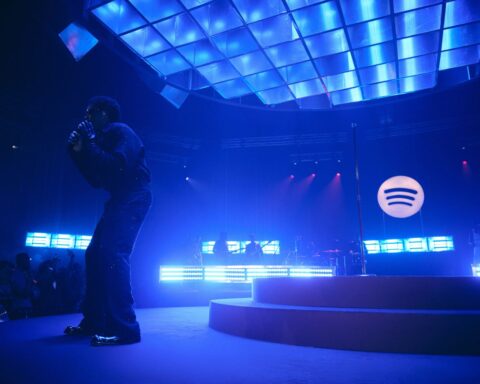

Birmingham’s growing arts scene is producing artists who explore new ways to connect audiences with live performance, sound, and visual storytelling. Among these emerging talents is visual artist and creative director Wuraola Francisca Oduweku, known professionally as Gholldy. Her recent project, Visualising Sound, offered an immersive arts experience focused on the emotional link between music and visual interpretation.
Presented at Zellig in Birmingham, Visualising Sound combined live visual art, projection, music, movement, lighting, and audience interaction in a multidisciplinary performance setting. With the visuals not serving merely as background decorations, they responded dynamically to the atmosphere, rhythm, emotional pacing, and energy of the performance, thereby allowing audiences to experience sound in both spatial and sonic ways.
At the project’s core was Gholldy’s evolving artistic practice, which investigates how emotion, movement, and live music can translate into visual form in real time. Through projection, spatial composition, live artistic responses, and immersive visuals aimed at the audience, she created an environment where visual storytelling became an integral part of the live performance.
The highlights of the project are a growing interest in contemporary combined arts, where visual artists are moving beyond static exhibitions to engage directly with live performance, audience immersion, and collaborative sensory experiences. In Visualising Sound, audiences did not just watch visuals from afar. They became part of a constantly changing visual atmosphere shaped by sound, lighting, movement, and emotional tone.
What sets Gholldy’s work apart is her instinctive response to live performance settings. Her visual direction does not seek to dominate music or performance but reacts to subtle shifts in rhythm, mood, silence, tension, and audience energy. This sensitivity allows the visual component to feel emotionally connected to the performances happening around it.
Based in Birmingham, Gholldy has gradually developed her practice within live music environments, interdisciplinary arts programming, and audience-focused cultural projects. She has contributed visual interpretation and immersive creative direction in collaborative public spaces. Her work has appeared in concerts, live events, and gallery-associated arts programming, where she continues to explore the relationship between sound, visual composition, and audience experience.
Projects like Visualising Sound reflect a broader shift in the UK’s contemporary arts scene. Younger artists are increasingly mixing music, installation, live visuals, spatial storytelling, and collaborative performance formats. Birmingham, in particular, has become a key place for this kind of experimentation, with independent creative spaces supporting emerging artists who work across different disciplines and cultural forms.
For Gholldy, Visualising Sound is more than just a single event. It is part of an ongoing exploration of how audiences emotionally connect with sound and how visual art can enhance that connection in live settings. As immersive and interdisciplinary formats grow in contemporary arts programming, her work indicates a developing practice grounded in collaboration, atmosphere, and sensory storytelling.
While still emerging, Gholldy’s approach reveals a distinct artistic identity shaped by live interpretation, audience engagement, and sound-based visual expression.
Throughout projects like Visualising Sound, she is helping to redefine how visual art fits within music and live performance culture.