

The 2.4% statistic, released in 2023 by the Nigerian Financial Services Market Report (NFSMR), exposes the decline in Nigeria’s economy.
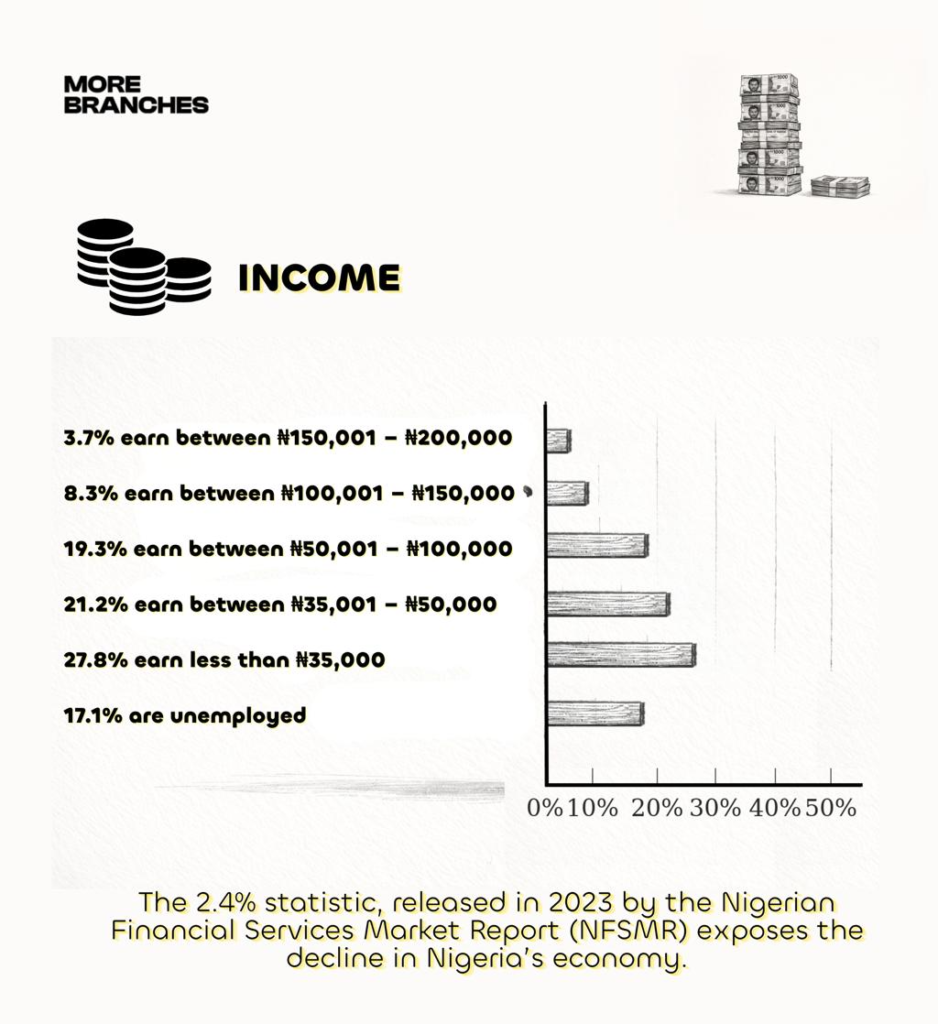
Low- and middle-income earners bear the brunt. Workers in the informal sector (petty traders, artisans, commercial drivers, smallholder farmers, and casual laborers) earn below ₦200,000. Young people and early-career workers earning between ₦50,000 and ₦150,000 are also affected. Rural Nigerians, especially farmers and agricultural workers, have even lower, seasonal incomes.
Nigeria is facing economic pressure, making income levels more critical than ever. The 2.4% statistic is a clearer picture of how current policies fail ordinary Nigerians.
When over 97% of people earn below ₦200,000, even basic expenses (such as food, transport, and rent) consume most or all of their income. Policy makers often assume income capacities that most people don’t have, highlighting the gap between policy design and reality.
₦200,000 is not rich, it’s barely stable.
Following 2024 & 2025 realities, let’s assume ₦200,000 covers:
- Rent savings: ₦40,000 – ₦60,000
- Food: ₦60,000 – ₦80,000
- Transport: ₦20,000 – ₦30,000
- Electricity, data, cooking gas: ₦15,000 – ₦25,000
- Healthcare, emergencies, family support: ₦15,000 – ₦30,000
Total: ₦150,000 – ₦225,000 (leaving little to no savings).
Earning ₦200,000 means:
• You can survive without daily panic
• You are one emergency away from crisis
• You are among the top few percent of earners in Nigeria
Why So Few Nigerians Earn ₦200,000
Nigeria’s economy is dominated by informal trade, low-productivity agriculture, and small-scale services. These sectors employ the majority but cannot sustainably pay high wages.
Over 80% of Nigerians work in the informal sector. Nigeria produces graduates faster than the economy produces skilled jobs. Degree holders earn between ₦80,000 and ₦150,000. Education raises expectations, but not wages. Even rising salaries are undermined by the naira’s declining value.
Employers resist wage increases because revenues are unstable, costs are predictable, and foreign exchange risk is high.
Economic reforms hit the low-income majority hardest. With 97% earning below ₦200,000, households cannot absorb shocks or save. This explains youth frustration, japa syndrome, and distrust in government. Until Nigeria fixes how income is generated, not just how it is spent or taxed, this statistic will remain unchanged.
With rents rising sharply in 2026, many low-income families may struggle to keep up. This represents real human lives at risk of homelessness.
If the trend of low earnings continues, Nigeria risks deepening economic inequality. Millions may remain trapped below the ₦200,000 threshold, limiting their ability to save, invest, or support dependents.
Solutions
• Individuals: Upskill in high-demand sectors, diversify income streams, and seek formal employment.
• Businesses: Invest in employee development, adopt productivity tools, and price goods/services to remain accessible yet profitable.
• Policy makers: Strengthen social safety nets, promote formal employment, and align wages with inflation to prevent widening inequality.
2.4%, a number too small, yet it represents a world of difference in opportunity, security, and influence. What changes when the focus shifts from the few to the many?