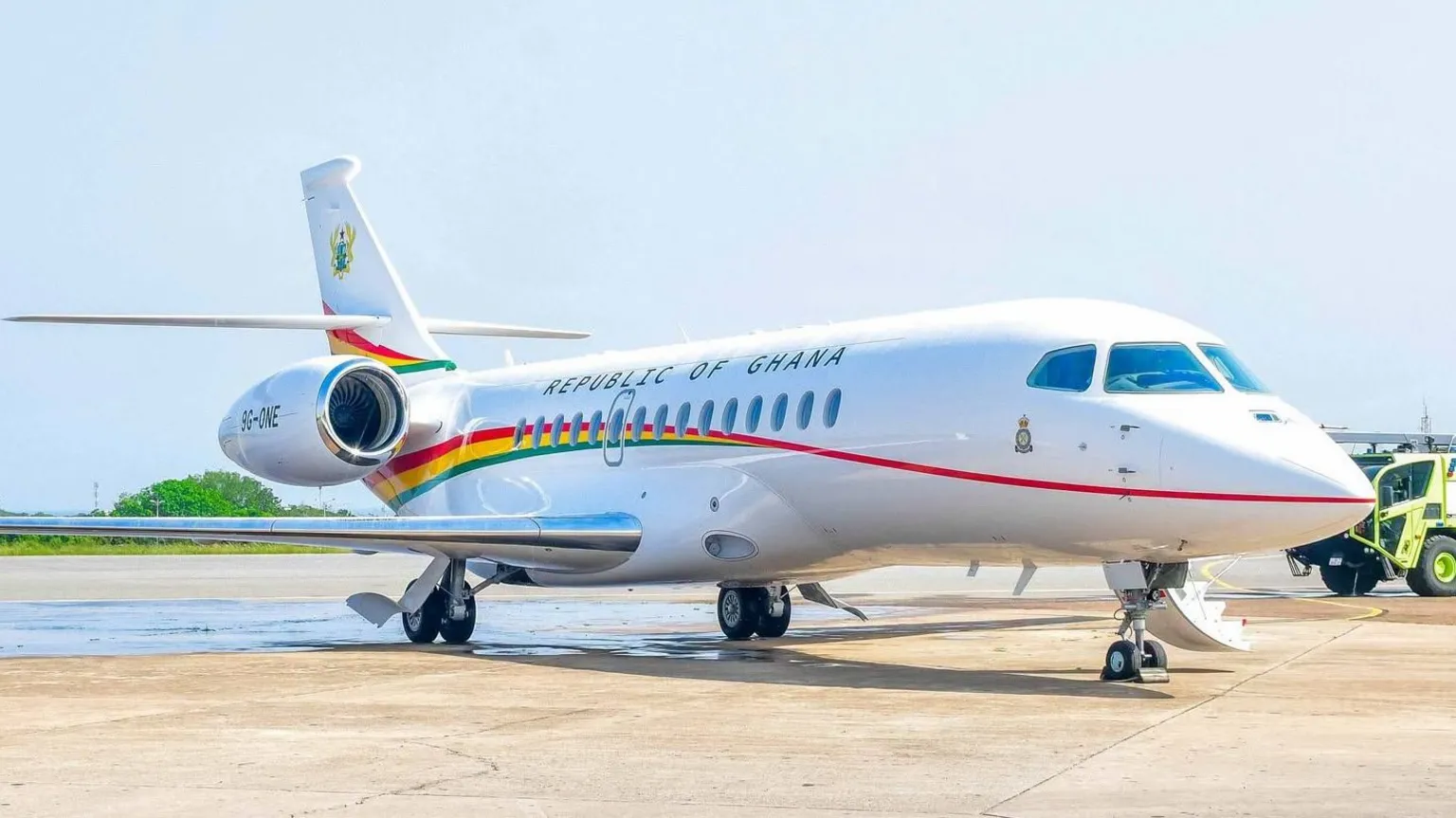
On Monday 16 November, a brand new Dassault Falcon 6X touched down at Kotoka International Airport in Accra and was met with a water salute. Painted in the national colours, tail number 9G-ONE, the words REPUBLIC OF GHANA along the fuselage. The Ghana Air Force had taken delivery of its new presidential jet under a contract worth 60.68 million dollars.
Ghana welcomes new executive jet. The Ghana Airforce has taken delivery of a Falcon 6X manufactured by Dassault Aviation of France. The purchase of the aircraft was approved by Parliament on 4th December 2025. The new jet is intended to replace the ageing Falcon 900EX which is currently 16 years old and has been suffering maintenance problems. The new jet has a longer range and therefore eliminates the need for frequent refuelling stops.
— Felix Kwakye Ofosu (@FelixKwakyeOfo1) November 16, 2026
Within a day the aircraft had become the most argued over object in Ghanaian politics, and not because anyone disputes that it is a good plane.
What they said before
For four years the loudest voice against buying a new presidential jet belonged to Samuel Okudzeto Ablakwa, then the opposition MP for North Tongu. In August 2021 he described Ghana’s existing Falcon 900EX as being in “pristine condition” and said it could fly non-stop to Europe. A new aircraft, he argued, was needless. He pointed to other countries getting by with far older jets, including Namibia’s thirty-year-old aircraft.
John Mahama held the same line from the opposition. He argued it was not prudent to spend public money on a presidential jet while Ghanaians were struggling.
Ablakwa is now Foreign Affairs Minister. Mahama is President. The jet has arrived, and the video of Ablakwa opposing exactly this purchase has been circulating since Monday.
The pattern is older than this government. In 2008 the NDC attacked the Kufuor administration over its plan to buy a Falcon 900EX. In September 2010 the NDC took delivery of that same aircraft, at a cost of about 37 million dollars, and John Mahama commissioned it as Vice President the following month.
What they say now
Felix Kwakye Ofosu, Minister for Government Communications, announced the delivery and has defended it since. The argument is that Ghana’s economic circumstances have changed enough to make the aircraft affordable, and that the old jet needed replacing.
Peter Lanchene Toobu, who chairs Parliament’s defence committee, put it more precisely. The party never opposed buying a presidential jet in principle, he said. The objection was to the timing, back when the economy was in severe difficulty.
Parliament approved the purchase last December as part of a wider programme to modernise military aviation, which also covers four Airbus helicopters. The President’s executive secretary, Callistus Mahama, had written in March that additional aircraft including one for presidential travel were expected by November.
Samuel Abu Jinapor, the Damongo MP and Ranking Member on Foreign Affairs, is not accepting the distinction. He has demanded full disclosure and asked the government to account for every dollar committed.
The arithmetic people are doing
The reason this landed the way it did is that 60.68 million dollars is a legible number. People can convert it.
“This money can employ over 100,000 nurses and 200,000 teachers,” one user posted, and that framing has travelled further than any of the official statements.
This is President Mahama’s new sky mansion. The Dassault Falcon 6X. Price ranges from $60m-$65m but Ghana’s new presidential jet could cross up to $70m with regards to security configuration to meet a jet suitable for a President. https://t.co/5vSgoaaPun
— DAMOAH (@realansudamoah) November 16, 2026
The context sharpens it. Ghana went to the IMF after years of financial difficulty, and this administration has spent its first year trying to demonstrate a recovery. A jet with a cabin wide enough to be called a sky mansion is a difficult object to place inside that story, whatever the state of the old Falcon.
Nigeria has already had this argument
None of this will read as unfamiliar from Lagos.
In 2024 Nigeria acquired an Airbus A330 for the Presidential Air Fleet at a reported cost of around 150 billion naira, after President Tinubu and Vice President Shettima both had aircraft trouble on official trips. The fleet already held roughly ten aircraft, among them two Falcon 7X jets, two Falcon 900s, a Gulfstream G550 and a Boeing 737. The opposition to that purchase was loud and it changed nothing.
The Ghanaian version is cleaner only because the reversal is so well documented. The same people, on camera, arguing both sides of the same purchase four years apart.
What happens next
The Minority wants the full contract disclosed. The government says the matter was settled when Parliament approved the budget line last December.
The jet is already in the country, which is the part that tends to end these arguments. Ghana’s last presidential jet arrived the same way, under the same objections, from a party that had spent two years opposing it.