A stool does not usually carry an argument. This one does.
Nifemi Marcus-Bello has spent years asking what happens to a material after the world decides it is finished with it. His answer this time was built out of shredded trainers.
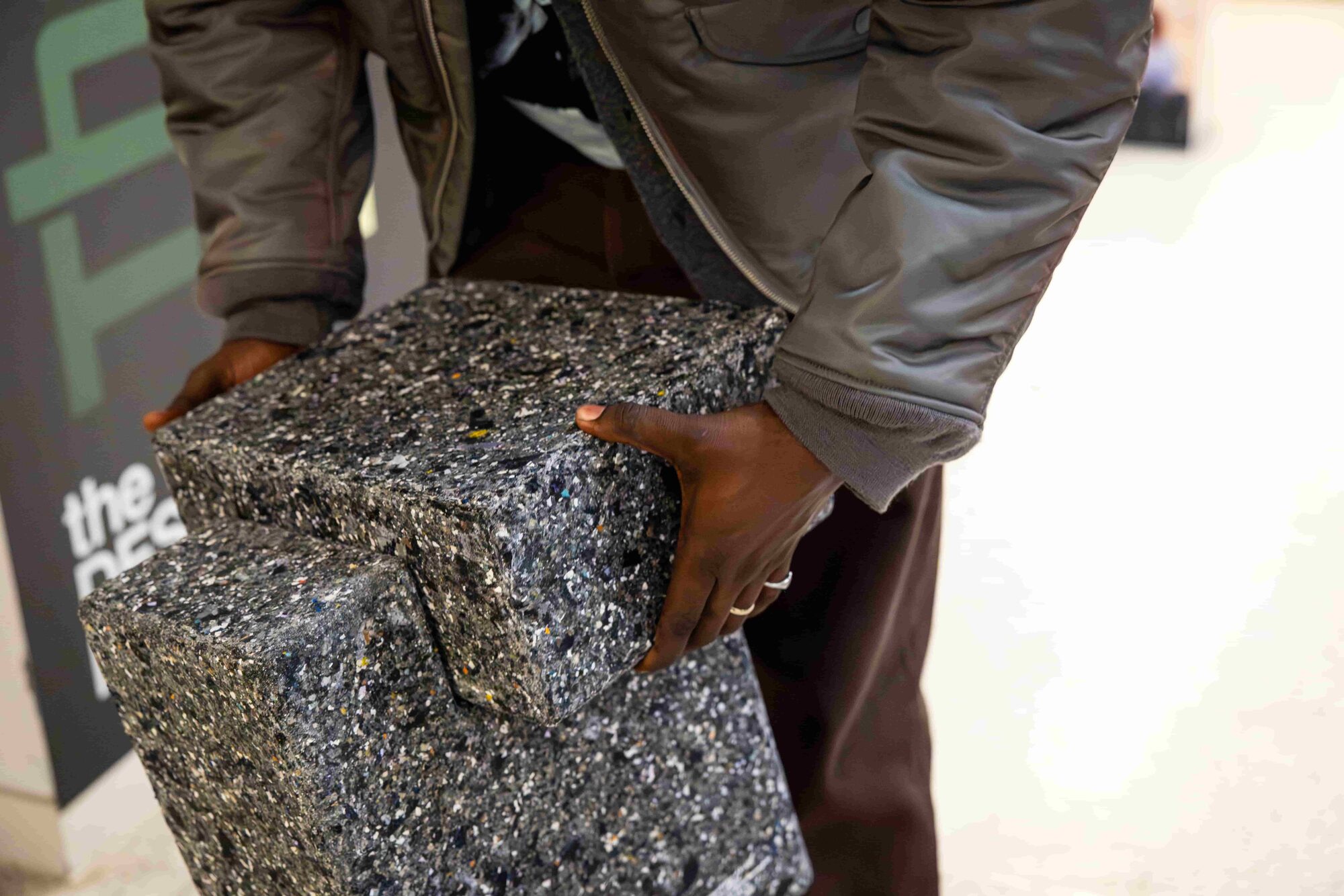
The Lagos designer has unveiled The Weight of What Remains, his first collaboration with Nike, made entirely from Nike Grind. That is the company’s recycling programme, running since 1994, which turns factory scrap, unsellable footwear and worn-out sneakers into usable material. The stool is on view in The Nue Black Aesthetic at the Design Museum in London, where it is not behind rope. Visitors sit on it.
The material is the point
Marcus-Bello’s practice has long treated materials as carriers of history rather than neutral inputs. Working with Nike Grind gave that idea an unusually blunt test, because the raw material is the leftover output of the global footwear industry itself.
“Every material carries a history, of where it came from, who handled it, and why it was thrown away,” he said. “Working with Nike Grind let me ask those questions at the scale of global manufacturing. I didn’t want to hide where this material came from. I wanted the form to be simple enough that you see the material first, and start to question the line we draw between what is valuable and what is disposable.”
The form is deliberately monolithic, almost architectural, with no ornament to look at instead of the material. Nothing about the stool disguises what it used to be.
Consumption in the North, reuse in the South
The question underneath the work is older than this collaboration. Marcus-Bello has returned repeatedly to the relationship between what gets consumed in the Global North and what becomes available for reuse in the Global South, which is the logic that governs everything from second-hand clothing markets to auto parts.
His Oríkì series, shown in full for the first time at Tiwani Contemporary in Lagos last year, worked through that question metal by metal. He cast bronze with Benin bronze casters, sand-cast aluminium sourced from the Lagos second-hand auto-parts trade, and worked copper informed by the years he spent in Zambia, a country shaped by raw material extraction. Each Act took a single metal and traced where it had been.
Nike Grind extends the line, but it moves the scale. The Lagos auto-parts market is a local economy. Nike is one of the largest manufacturers on earth. Putting the same question to both is the move.
What it proposes
Beyond the object, the stool argues that the future of design may have less to do with inventing new materials than with recognising what is already present in what has been made, consumed and discarded. It is a quieter claim than most sustainability messaging, and a harder one, because it asks the industry to look at its own waste stream rather than its next innovation.
Marcus-Bello’s work sits in the permanent collections of MoMA, the Brooklyn Museum, LACMA, the Art Institute of Chicago, SFMOMA, the Detroit Institute of Arts and the Design Museum London. Wallpaper* named him Life-Enhancer of the Year and shortlisted him for Designer of the Year this year. He has a Special Mention for the Loewe Craft Prize, the Hublot LVMH Design Prize and a Graham Foundation Grant.
The Nue Black Aesthetic brings together more than 100 works by 16 designers and runs at the Design Museum until 8 August 2027.