
We sat down with Oroma Cookey-Gam, co-founder of ThisIsUs, to talk about the deeper story behind one of Nigeria’s most intentional design brands, one that weaves culture, craft, and community into every thread. Founded in 2016 by Oroma Cookey-Gam and Osione Itegboje, ThisIsUs is a sustainable brand making fashion items for stylish, environmentally conscious people.
From discovering Funtua cotton to collaborating with artisans at the historic Kofar Mata indigo dye pits, Oroma takes us through the journey of transforming raw materials into pieces that celebrate Nigerian craftsmanship and everyday heritage.
In this conversation, she reflects on creativity, sustainability, and the power of telling our stories through fabric, not just as fashion, but as a living archive of who we are.

Let’s start at the beginning. What sparked your curiosity about making locally and eventually led to discovering Funtua cotton?
I studied law in uni, and throughout my course, I was always drawing sketches, doing collages, but I never had any way of bringing anything to life because I couldn’t technically. And the way England is set up, you can’t just go to your tailor and like show them your sketch and bring anything to life.
So as soon as I finished my course and I moved back to Nigeria, the first thing I did was find a tailor to start bringing my ideas to life. That was the beginning of my fashion journey, and making things locally. After I started my first brand, Alali, I ran into a lot of problems because people always wanted to order things, and I was never able to meet the demand because I was using dead stock fabric from the market.
Dead stock fabric is like sample fabric from the market, or from places like China, Italy, or Switzerland. When I stopped Alali and I wanted to start this as well, the first thing that I decided that I was gonna try and figure out was a sustainable source of fabric that I could get locally.
I wanted to find a way to make all my fabric locally, fabric and textile that felt like me; that was inspired by my environment, was Nigerian, and that was the beginning of me making locally.
Looking back to 2016, did you imagine the Funtua project would grow into what it is today?
Back in 2016, when we started the Funtua project, we kind of saw the vision and the path to get to the vision. We saw where we are now, but it’s just taking a lot longer than we thought. It’s great to see things play out as we envisioned, and it’s very reassuring to know that we’re on track.

How do the artisans and communities you work with also benefit and grow from these collaborations?
When we first started working with the pits, the main resist method that they used was the tie and dye. They also used a lot of stitching. We wanted to do other patterns, so we introduced the paraffin wax that is used in modern dye methods in 2018.
The pits actually died after a couple of days. And one thing that we went back and did was research about organic ways to dye in a dye pit, using organic materials that can go in a dye vat and not kill, because the wax was not organic. We’ve now started working with cassava in the dye pits, and it’s very interesting because one of the dyers that we work with mentioned how their family back in the day used to work with cassava, but it’s not something that they practice anymore.
So it’s very encouraging to have access to being able to do research. When we first visited the dye pits in 2016, there were three active pits, and we were very skeptical about whether any of it worked. It just seemed like a folk tale, a story. They told us about a time in Nigeria when all 144 pits were active and were being used, and it just seemed unrealistic.
Fast forward to 2022, there were 15 pits being used. Today, there are 45 pits being used. So in real time, we can kind of see the dye pits, the families, and the communities around the dye pits grow. And that is very reassuring in the work that we’re doing. This is their family business, and these are livelihoods that are being created and sustained.

We also try to work within the boundaries of their system and come up with new innovative ways to achieve new designs. And what’s one really exciting thing is just seeing how the dye community uses all of the new methods that we introduce and that we play around with, and we see them using it in their practice.
We’ve recently started working with a group of women in our design processes. We have different satellite groups of women, and one thing that we’ve noticed is that the way that their social structures are set up, they have these community spaces where they work together and they do things together, so it just works seamlessly with this. With the way that their spaces are designed, they can work in big groups, they can design in big groups, and that’s always really nice to see.
Can you walk us through the journey of the cotton, from farm to fabric to finished piece?
Our clothes are made from 100% cotton, farmed and processed locally in a town called Funtua in Katsina state. It is farmed by men and harvested and picked by women. It’s then taken to a factory, where it is cleaned, separated, and processed into cotton wool first, and then into cotton yarn, and then into the cotton textile or fabric as we know it.
It is then taken from Katsina to Kano, where it is hand-dyed in indigo dye at the renowned Kofar Mata dye pits. We work with a group of artisans to dye our textiles into plain indigo cloth or into prints. Typically the women will do the design and the prints, and the men will dye it in the pits.
After that, it’s taken to Lagos, where it is then soon constructed and designed. Then it’s sent out to you.

What makes indigo dyeing at the Kofar Mata pits so unique compared to modern dyeing methods? How do you ensure consistency when every piece is handmade and naturally dyed?
We’ve worked with the indigo dyeing community in Kofar Mata since inception. The dye pits have existed since 1498. So inherently, when we arrived there, we knew that it had to be sustainable for it to have lasted this long.
The practice in Kofar Mata is a wholly natural process. All the inputs involved in the process are completely natural and done with utmost care and reliance on nature. The indigo used in the pits is found locally in Kano state. The ash is made from reused ash from previous pits, and the potash is a mineral that can be found locally as well.

These ingredients are mixed in the pits with water, and typically, when a pit is made, it lasts about six months. What’s really special about this process, though, is the fact that there’s no wastage involved in the process after the pits are dead, meaning it’s no longer producing any more color from the indigo leaves.
The solution in the pits is bottled and sold to pregnant women because, apparently, it helps with labor pains. I find that really interesting, by the way, but the rest of the ingredients at the bottom of the pits are then molded and left to dry, and then burned and used to make the new pit.
With this, you start to really understand the legacy that these dye pits have for sustainable fashion globally. The downside, but also the beauty, about what we do is that no two dyes are the same, which means that no two garments can ever be the same, because the indigo is a living substance.
At first was something very difficult to deal with. We were always trying to get the same thing. Over time, working with the dye artisans, we have kind of adopted a more accommodating approach to the beauty of the differences that we achieve.
What’s one product you’ve made that feels like the purest expression of your ethos?
The product that feels like the purest expression of our ethos is the danshiki crop from our latest collection, Local Champion. I like it because it’s an equal part design and craft. It is minimal, elaborate, and traditional, but also modern. My favorite part about it is the embroidered neckline, but I also really love the loose boxy drape.
It’s quite typical of the traditional clothes in our culture that just feel like ease. The patches are fun. But also, when they’re unadorned without the patches, it’s also quite uniform. So this is my favorite. This is a thing that really feels like us.
When someone wears or uses one of your pieces, what feeling or story do you hope stays with them?
The feeling of comfort and pride. Above everything, I think that there’s a confidence that comes from wearing clothes that feel comfortable and feel like they hold stories about you. We want people to feel like they’re part of something great by wearing clothes with a mission.
Can you tell us about your latest collection – what inspired it, and what story does it tell? Which of your recent pieces feels most personal to you, and why?
Our most recent collection is called Local Champion. It’s inspired by local champions, people like you and me who wake up every day and push the needle for our local communities and for people around us. We always design from the perspective of how we present ourselves on the global stage, always assuming that our clothes speak for us. So we want the clothes to speak for themselves, telling a story of local pride and power.

You’ve done pop-ups instead of having a permanent retail store. Why take that approach?
When you start your brand with an online store, you have loads of people from around the world buying your clothes, but you don’t know the people who are buying your clothes. So we started doing pop-ups because we wanted to connect with all the customers from around the world, even customers in Nigeria.
We wanted to be able to connect with people and get to know them. And so our pop-ups have really helped us do that. We’ve connected with our community in Amsterdam, in New York, and in London, and it allows us to just be flexible in that way.
What’s next for the brand? Any upcoming projects, collections, or material experiments?
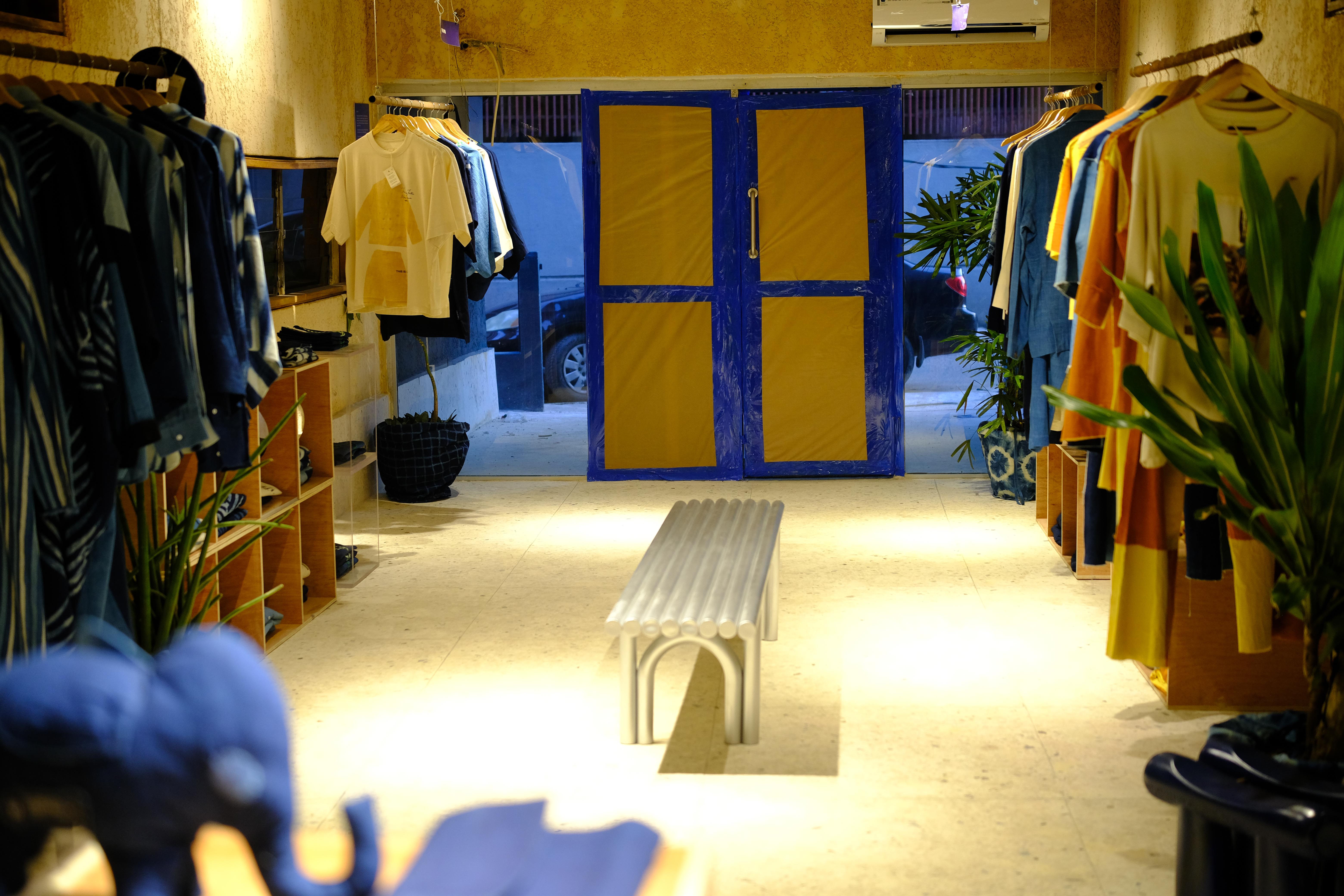
We’re finally opening our flagship store. We’re really excited about having a space for community. We’re excited about having a space that can house all of our ideas, that can be home to us and to our community of friends and creators. We have two new collaborations at the end of the year that are gonna be banging. So look out, watch this space.