Nigerian music has a new tier of superstar, and they are not singers. They are DJs, and this year they became the acts people buy tickets to see.
The DJ used to be infrastructure. She played before the artist arrived, filled the gaps between sets and kept the room alive after he left. Her name went on the flyer in small type, if it went on at all. In 2026 the name went to the top of the flyer and the room sold out anyway.
Group Therapy keeps selling out in Lagos and sold out its London debut at Colour Factory. Klub Aniko sold out before December started. Dance Èkó’s Friends of Èkó tier is gone with a month still to run. Not one of those nights has a singer headlining.
That reads like a claim. It is a calendar.
| When | What |
|---|---|
| Apr 2025 | Group Therapy hosts Boiler Room in Lagos with AMÉMÉ, Aniko and Yosa b2b WeAreAllChemicals |
| Nov 2025 | “OGBA” arrives from Shallythechampion, the first Nigerian Afro House anthem of its size |
| Feb 2026 | The Associated Press files a story from a Group Therapy rave in Lekki |
| Apr 2026 | Group Therapy lands in Nairobi. “Bani Kudi” is released on Café Riddim |
| Jun 2026 | Blak Dave runs a three-day convoy from Lagos to Cotonou. Lojay’s label releases “Tenner (Aniko Remix)” |
| Oct 2026 | Fireboy DML releases “IMALI”, a 3-step Afro House record |
| Nov 2026 | Dance Èkó runs a 5km community run with an after-party |
| Dec 2026 | 38 of Lagos’s 107 December events are DJ-led |
First they made their own records
A scene gets taken seriously when it stops borrowing. For years a Lagos rave ran on South African imports: amapiano from Johannesburg, Afro House from Durban, gqom from everywhere. The DJ was a conduit for other people’s songs.
“OGBA” broke that in November 2025. Shallythechampion made it, DJ Spinall, Heavy K and DJ Consequence pushed it, and “ogba” is street slang for someone exceptionally good at what they do. It became the soundtrack of Nigerian rave culture and it was Nigerian.
“Bani Kudi” followed in April, credited to Naija House Mafia with Calix, Jamie Black and Sigag Lauren. Note the shape of that credit. A collective, not a frontman.
It came out on Café Riddim. Café Riddim is also a party, running on 23 December as part of Litmas 2.0. The same name is on the record and on the door, which is the whole model in one detail.
Then the mainstream came to them
The part that matters most is not a DJ breaking into pop. It is pop arriving at the DJ’s door, on the DJ’s terms.
On 30 June, Koratori Music released “Tenner (Aniko Remix)” as an official Lojay single. A major Afrobeats artist’s own label put out a Lagos DJ’s reworking of his song as a release in its own right, and it became a Beatport Afro House staff pick. Aniko took the original from 118 BPM to 147.
Four months later Fireboy DML released “IMALI” with JAZZWRLD and Thukuthela, a 3-step Afro House single. Fireboy sold out Eko Hotel and most listeners still attach him to “Peru”. He did not guest on a house record as a favour. He made one.
Our own interview with Yosa last month put the mechanism plainly: labels and A&Rs are now looking at the scene and asking how to tap into an audience a DJ already owns.
The audience moved first. The industry followed it.
Who they actually are
The people who built this mostly had other careers, and several still do. That is not colour. It is the explanation for why the scene was built the way it was.
| DJ | Known for | The other life |
|---|---|---|
| Aniko (Aderinsola Ogala) | Founder of Group Therapy | Cardiologist |
| Blak Dave (David Olubaji) | Co-founder of Monochroma, Blak Dave and Friends | Former frontend engineer |
| Proton | Co-founder of Monochroma, created Deep Haus and helped build Sonic Radio | Software engineer |
| We Are All Chemicals (Blessings Ewona) | Oroko Radio resident, hosts Chemical Resonance | Skater |
| Axara (Ugochi Silas) | Runs the Dance Dance Dance pop-up, plays Insert Nights and Obi’s House | Works in music administration |
| Abiodun | Founder of Ilé Ijó, electronic and Fuji DJ | Cultural curator |
A cardiologist, two engineers and a skater built Nigeria’s rave economy. People with day jobs do not wait to be signed. They book the room themselves, price it themselves and keep the door money, which is how this scene grew without a label anywhere near it.
Naija House Mafia shows what that produces. Jamie Black, Sigag Lauren and Calix each built solo careers before forming the trio around 2023, working across Afro house, gqom, 3-step and tech house. They made “Bani Kudi”. Sigag Lauren plays Ardour. Jamie Black is on the “OGBA” remix. The same handful of names recur across the records, the remixes and the lineups, which is what a scene looks like shortly before it becomes an industry.
Axara and We Are All Chemicals are both residents at Oroko Radio, the not-for-profit station in Accra that carries 18 Lagos residents across DJ shows, talk and curation. Yosa plays Group Therapy, Element House and Boiler Room Lagos, and has taken sets to London, France and Uganda. A rave scene with its own radio station and its own export route is not a trend.
Group Therapy removed the tables
Lagos nightlife ran on table culture for decades. You bought a table, you bought bottles, and the status of your night was priced in advance. The dance floor was whatever space was left over.
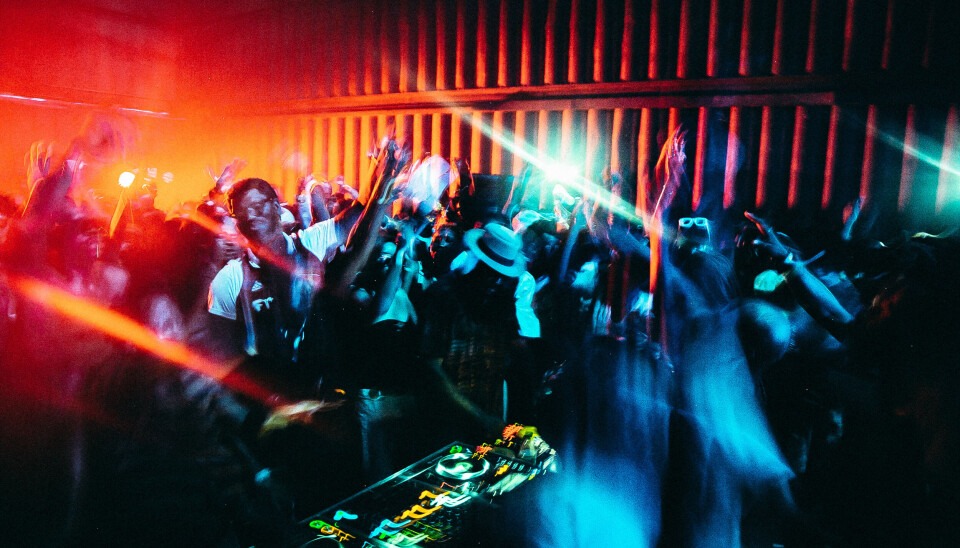
Aniko built the opposite room. At Group Therapy there are no tables, no VIP and no bottle service. The decks sit in the middle and the room is all floor.
She has described dreading the calls before each edition, from powerful people asking for a table that does not exist. Her answer is the entire thesis: everyone is standing, and whether you are the biggest person in the room or the smallest, you are standing.
In February the Associated Press sent a reporter to a Group Therapy night in Lekki and wrote it up as a rave rewriting the rules of Lagos nightlife, drawing young Nigerians priced out of club culture. One small bar, drinks well below club rates, no seats.
Then it left. Group Therapy toured London, Accra, Nairobi, Abuja and Ibadan. The London debut at Colour Factory sold out. Nairobi landed in April with Funky QLA, Foozak, SHI, WeAreAllChemicals, Ghedi, Sounds of Ace, Lemi and Dylan-S. The Ibadan edition was rebuilt as Green Light Fashion Room with the local outfit Red Light Fashion Room rather than imported wholesale. Mixmag named Aniko among its breakthrough DJs of 2025, and she played ADE in Amsterdam, Ghana, and Nyege Nyege in Uganda.
By May, stage access tickets for Group Therapy Lagos were moving through phases at ₦50,000, ₦60,000 and ₦70,000, and the scene argued publicly about what that money does to a culture built on standing room. That argument only happens to something that has already won.
It is not one party
The mistake would be reading this as one woman’s success. The scene has a full price ladder and a different room for every kind of night.
| Night | What it is | Entry |
|---|---|---|
| 303 Garage | Tech, deep and Afro house on the mainland, run as numbered experiments | ₦1,000 to ₦10,000 |
| Upstairs | Afro House, Afrobeats and amapiano, Victoria Island | ₦5,500 |
| Sunday Service | Day rave, Lekki, sunset into the night | ₦6,000 |
| Ardour | Melodic house and underground electronic, Lekki | ₦16,000 |
| Dance Èkó | Two-day festival, Orange Island | From ₦21,500 |
| Group Therapy | Stage access tier | Up to ₦70,000 |
303 Garage proves the depth. It runs in Yaba, Jibowu and Oworonshoki rather than Lekki, bills its nights as numbered experiments, the eighth being drum and techno, and at ₦1,000 on some nights it is the cheapest serious room in the city.
Sunday Service changed what a rave is for. Founded by DJ Déjì, it runs on Sundays from the afternoon, at Lighthouse Bar in Lekki and on the beach in August, closer to a seaside sermon than a club night. Some editions have run on pay-what-you-think-is-fair entry, which is a tithe by another name. A Sunday afternoon party is a different business from a nightclub: it serves people with jobs and sells a slot nobody else was selling. It has since worked across borders with Open House Accra.
Ardour works the other end, melodic house at Royal Oaks Centre with Sigag Lauren, Proton, Blak Dave and Brave on one July bill. Element House, powered by Spektrum Entertainment at Livespot’s warehouse, is the elder of the Lagos house scene and still running, with a December edition on the 26th. Ilé Ijó, Yoruba for dance house, fuses Afrohouse with indigenous Nigerian music.
Sunday afternoon, the warehouse, the mainland and the purists. Four different audiences, four different prices, one sound.
They built companies, not parties
This is why the year holds rather than fading in January.
Monochroma is a rave. Monochroma also curates Dance Èkó, the two-day festival at Orange Island on 19 and 20 December. A party that programmes a festival and books other DJs is a promoter.
Dance Èkó ran campus popups in Ilorin, Lagos and Ogun with ticket giveaways and state discount codes, plus two editions of a 5km community run ending in an after-party. Artists do not build running clubs for their fans.
In June, Blak Dave and Soft Days ran a three-day trip from Lagos to Cotonou: a convoy out of the city, a welcome party over the ocean, a deliberately slow second day, a wine tasting and listening session. A DJ selling a cross-border weekend is not taking a booking. He is running a travel product.
Control the record, the room, the lineup and the mailing list, and you are no longer talent. You are the business.
December is the receipt
We keep a verified database of Detty December events in Lagos. It currently holds 107.
| Lagos, December 2026 | Events |
|---|---|
| Parties, raves and dance-music events | 38 |
| Concerts | 37 |
| Everything else | 32 |
More nights in Lagos this December are built around a selector than around a singer.
There is still a ceiling. No Nigerian DJ is headlining a room the size of Eko Convention Centre on their own name, with no singer on the bill. The floor has risen much faster than the roof.
But Black Coffee returns on 19 December for a twelve-hour set with Rampa, Ape Drums and Caiiro. Two years ago that booking would have been the ceiling of the Lagos rave year. This December it reads as a visit, because the city runs its own version every weekend.