In the last couple of weeks, the #EndSARS peaceful protests spread globally, transcending the country’s borders and extending to foreign soils. Both home and abroad, Nigerians marched in solidarity with a unified demand: an end to the years of unbridled violence imposed on citizens by the Nigerian Police Force – particularly from members of the Special Anti-Robbery Squad (SARS), a now-defunct unit. In a matter of days, we witnessed history unfold.
Uprisings of this sort are not new in Nigeria. Back in 2012, the social media-driven #OccupyNigeria protests erupted across the country as citizens took to the streets, outraged at the president’s announcement of a sudden spike in fuel prices due to the overnight removal of the fuel subsidy.
History will also recall the ‘Enough is Enough’ protests back in 2010, as the then youth gathered en masse in a display of public anger over issues ranging from infrastructure failings, fuel shortages, and power blackouts while clamouring for the resignation of the then-ailing president.
#OccupyNigeria in 2012 lasted just 15 days . Same initial ginger from the beginning ,same vibes et al. Accountability is a huge part of a successful revolution. It took us 8 years to wake up from our sleep, we can’t afford to mess this up. #EndSars
The common denominator between these two timestamps in Nigerian history and the #EndSARS protests is the youth’s undeniable presence at the forefront. In all instances, the youth’s collective antipathy towards the bodies in power enabled them to lead the charge and demand tangible change.
But there was something very different about 2020’s #EndSARS protests.
For one, social media was employed as a fierce tool to fight oppression in a way like never before. Thanks to its ease of access and widespread reach, news of the protests was circulated in a matter of seconds, with updates spreading as quickly as they occured. Social media gave the movement the amplification needed to rally advocates from far and wide.
For Rume, a fervent online protester, this was her first time being actively involved in a revolt of this sort. “A lot of the times when people rise up against the government, a lot of people usually get left out,” she told me. “This time, we’re all in the loop. We’re sending broadcasts on Whatsapp, and people are compelled to listen, and as they do, they realize they have something to share as well. Our goal is to spread, and it’s spreading fast.”
A gaping hole in Nigerian history is the lack of proper documentation of sporadic moments like this. Where traditional media failed to record the uprisings in real-time aptly and chose instead to fuel harmful propaganda and false narratives, this time around, new-age digital media publications like Zikoko, Stears Business, Native Magazine, and More Branches as well as media houses like Arise News, rose to the occasion to document the lived experiences of the youth. In addition, young people built archives like endsars.com, creating outlets for people to share their experiences with police brutality and to ensure such incidents aren’t erased from our history.
The #EndSARS protest was a decentralized one, with no official leaders, figureheads, or representatives in place. Taking a page out of the year-old Hong Kong protesters’ book, it was a moment created for the people, by the people. This new generation of Nigerian youth has demonstrated that they have learned from the mistakes of the generation before them.
History has shown that leaders are easily susceptible to compromise, as integrity and commitment to a cause is often traded for a seat at the table. Hence, the #EndSARS protests took on a faceless form, with pockets of unofficial coordinators being formed all over the nation, bound by the sense of shared responsibility to reform the country.
We have no leader, we have no followers, we believe in the movement to end bad governance, we have one voice, where your strength ends ours is just beginning, we have frustration as a fuel to motivate us, we have time on our hands and we will not back down #EndSARS
Thanks to social media, the youth were able to create an organised ecosystem with helplines to respond to the youth’s needs at the frontlines of the #EndSARS protests. Collectives like Feminist Coalition, a two-week-old organisation of feminists, have served as distribution hubs for protests across the country, raising funds and granting access to any and everything from food to medical and legal aid.
Everyone was more focused on playing their part and less interested in being spotlighted, and that’s why the protests were so seamless, as Onyema, an online protester, told me. “The beautiful cooperation amongst the youths and supporters of the protest is what’s so different this time,” he remarked.
The growing momentum of the #EndSARS protests was brought to a screeching halt at noon on Tuesday, October 20th. Following Governor Babajide Sanwo Olu’s orders, a 24-hour curfew beginning at 4 pm was declared in all of Lagos State, setting the entire city into a chaotic flurry as commuters hurried to get home in time. Despite this, a brave multitude of protesters peacefully stood their ground at the Lekki Toll Gate.
What followed when night fell is the single most inhumane act in the country this year. The tollgate lights were covertly switched off, and peaceful protesters waving the Nigerian flag and singing the National Anthem, were shot by Nigerian soldiers. In a matter of seconds, the Lekki toll gate was turned into a memorial ground of the merciless bloodshed that night.
The government and authorities of power, in their callous response, have vehemently denied any participation in the massacre on Tuesday night, frantically pointing the finger of blame at each other while giving no definite answer to the burning question: who ordered the attacks? They have resorted to manipulative tactics in a bid to wipe this inhumane moment from history: gaslighting, accusing local and foreign media of disseminating “fake news” irrespective of the concrete video evidence. But we know what we saw. We saw them shoot. We heard those screams. And no matter how much they try to erase it from existence, no matter how many allegations they deny, no matter how many lies they tell, the fact remains that we know what happened. And we will never forget.
Yesterday evening, after nearly 48 hours of complete silence, President Muhammadu Buhari addressed the nation. During the ‘live’ speech, the president completely failed to acknowledge the Lekki massacre and the lives lost, focusing instead on the police officers killed in the pandemonium that followed after, while subtly threatening protesters and warning foreign media to stay away. Scrolling through my timeline after the 12-minute speech, I could sense the general feeling of despair in the air. How could this be it? All those lives lost? All that time, money and energy spent? Just to give up now? It was a painful moment of realization for all that the victory we so passionately seek, won’t be handed to us on a platter of gold.
Buhari broke us. He really did. Last week we felt alive and full of hope, now idk. I really don’t know.
For me, last night was an awakening. After spending time laughing at the memes and jokes floating around social media, I realised this was a relief and not the end. It can’t be. It’s up to us to re-strategise and play the long game, and the first item on the agenda is tackling the 2023 elections and ensuring none of these old heads get the chance to hoard the seats of power again. We need to map out plans to educate the masses on the power of their votes to ensure they don’t sell it for a 2kg bag of rice come 2023. Electoral reforms and constitutional amendments should be our next focus.
The fight against police brutality is far from over. The #EndSARS protest instilled a new sense of commitment to our community in many of us, and while going out to physically protest may not be the best option at the moment, it’s up to us to keep the conversation alive. Social media has proven to be a benefitting tool on our side, so we shouldn’t stop using it.
If there’s one this that this protests have shown me, it’s that we need to study history well to be ready for the 2023 elections.
We need to understand the tactics that have been employed by those who wish to hold on to power, and why they were able to do so.
I urge everyone to hold their heads high, because we fought a good fight, we are still fighting a good fight. In what has been prevalently termed as the biggest nationwide protest ever, the #EndSARS movement is nothing short of revolutionary. Religious and ethnic differences were shunned as we all collectively marched towards a new Nigeria. There was a strong unity across the board, with the consensus being “No one is left behind.”
In his essay, The Trouble with Nigeria, Chinua Achebe stated, “The problem with Nigeria is simply and squarely a failure of leadership. There is nothing basically wrong with the Nigerian character. The Nigerian problem is the unwillingness or inability of its leaders to rise to the responsibility.” Through the #EndSARS protest, we have seen exemplary leadership and we know this was only achievable because we put our differences and came together. We are stronger together than apart. Let us never forget that.
Even with the uncertainty of what the future holds, things still feel more promising than they ever have, this time. And irrespective of the government’s callous attempts to discredit and demoralise us, we the Nigerian youth are determined to ensure our intersectional demands are met, to create a healthy society for the next generation. It would be devastating if they had to fight the same fight.
In the summer of 2017, Amaarae’s ear-snagging vocals first hypnotized listeners as she sauntered down the corridors of genre-fusing R&B. Three years down the line and the ever-evolving multi-hyphenate has taken her place as a pivotal figure in the Alté scene.
This is how a young girl went from writing amateur songs in a classroom to becoming a disruptive female voice in an androcentric industry.
“I look more androgynous or masculine, but I have this really feminine voice, and I say some really nasty shit sometimes, but people love it.”
Amaarae is a walking paradox. Clad in oversized, glossy leather jackets and pants, futuristic glasses, edgy metallic jewelry, and a colorful buzzcut that has taken the form of everything from pastel colors to red and yellow stripes, the Ghanaian singer-songwriter, producer and engineer’s style oozes alluring androgyny. But when she opens her mouth, all stereotype expectations are thrown out the window as we’re greeted with soft, honey-dipped, featherlight vocals, laced with earworm melodies you just can’t shake off. The polarizing combination of Amaarae’s epicene outward appearance and her small yet seductive vocals is what makes the 26-year-old so intriguing to listen to. Yet, one cannot help but fall prey to the fierce expression of lust, pain, and lost love in her music.
Amaarae is no taller than 5 foot 3 inches, but when I am graced with her undeniable star presence, her quiet composure shines through. Leaning in towards her phone as she settles in for our afternoon Zoom call from her family home in Ghana, all the glitz and glamour are evidently out of sight. She’s in her most natural state, casually dressed in a comfy tank top and bottoms, regular glasses on, and her usually varicolored, close-cropped cut is replaced with a head full of jet black finger twists. Yet, even with less glamorous adornments, her commanding aura is inescapable. “People see me and expect me to be a rapper with this deep voice, but they end up like ‘she sounds like a baby and looks like a thug, how do you connect those two dots?’, but it works,” she tells me, flashing a toothy grin.
Debuting back in the Soundcloud-halled days of 2017, Amaarae’s delicate vocals on the piercing ‘The Obsolete Truth’ instantly swooned us and left us yearning more from this new, talented artist. Her experimental take on R&B with clear influences from highlife and hip hop kept us interested as she further explored the depths of genre-bending. Tracks like AYLØ’s ‘whoa’, on which she gave a sweet, sultry tribute to lost love, cleared the path for the warmly welcomed release of her debut EP, Passionfruit Summers. While running just under 20 minutes, the 6-tracker is long enough to aptly illustrate her immersive writing and composition and concise enough to leave the listener intrigued for more.
Since then, Amaarae’s sonic exploits have firmly placed her in the center of neo-R&B conversations in Africa. Her releases may be few and far between, but they’re well worth the wait. Her eclectic sound, coupled with her inimitable vocals, has made her an essential voice in the Alté sound – Africa’s burgeoning sub-genre. Unafraid to be authentically herself, this young maverick is redefining power and identity for the 21st-century black woman. In a single breath, she’s bold; she’s sexy; she’s vulnerable, and always talking her shit. And as the sounds grow beyond the continent, Amaarae’s impact in shaping the future for women in Africa cannot be ignored.
Born Ama Serwah Genfi to Ghanaian parents, Amaarae took her first breaths in a hospital in Bronx, New York. Carted back to Ghana to continue her childhood, she grew up in a family with eclectic music taste, that would later have an integral effect on her artistry. “My mum was a jazz fan, so I listened to a lot of jazz through my mum, and my dad was into R&B and soul, so I picked that up from him. One of my uncles was into alternative rock, so I picked that up from him as well,’’ she tells me.
Her 8th birthday was followed by a move to the storied city of Atlanta, Georgia – hip hop’s center of gravity – where she became a rap-head almost by default. Southern rap had just begun to gain serious momentum, so her move seemed almost fated. Atlanta in ‘03 saw the rise of the trap era with pioneers like Young Jeezy, Gucci Mane, and Dem Franchize Boyz leading the charge, rapping in pockets as opposed to on time, and embellishing their flow with cryptic writing. Fascinated by these new sounds, Amaarae found inspiration in the early movement of the dirty south.
Age 11 saw a move to Mount Olive, New Jersey, a town almost the polar opposite of Atlanta. ‘It’s like 98% white people’, she says with a laugh. It was here she got exposed to the DIY sounds of indie rock and indie pop. “All those kids used to listen to Fall Out Boy, and you know, really interesting shit, like Metro Station.” Unknown to her, she had already begun collecting the threads that would later be woven into the sonic blanket that defines her genre-swirling sound, one city at a time.
Moving back to Ghana at 14 to live with her grandparents, she continued her secondary education and further explored her creative abilities. Settling into high school back home, she had dreams of being a neurosurgeon as she was a stellar science student. But all that went down the drain when she discovered a whole new group of peers expressing their love for music through experimentation. She would watch kids at the backroom in the computer lab making beats and recording songs and this inspired her to get to work. After writing her first song at 13 (an amateur remake of Usher & R Kelly’s ‘Same Girl’), Amaarae released her first mixtape at 17, while in high school. The tape – titled Splendid Isolation – saw her take full creative control, writing, producing, and performing all the songs as well as handling the art direction and design of the cover.
From an early age, Amaarae knew she was a perfectionist, and this has translated into her creative process even to this day. ‘It’s the gift and the curse,’ she told Harmattan Rain. “I thrive for perfection so much I will ruin a good thing. I make everything myself, from the beat to writing my content and choosing the people who will work on my songs. I will go here to work with the best drummer, and there to work with the best voice coach and come back here to write my music.’’
Her level of perfectionism granted her a knack for sonic refinement and moving back to Atlanta at 19 allowed her to develop that further. Enrolled at college in Decatur, she landed a summer internship in a studio where she learned the technical aspects of sound engineering. This new knowledge motivated her to push the sonic boundaries of her music. “My voice is the last thing I think about when making music. I care mostabout the production. The first thing I think about is: how can I make these beats or instrumentals super immersive?” she revealed in a 2019 interview. After graduating from college four years later, she decided to move back to Ghana to pursue her musical career, bridging her global influences with her African roots.
2017 was a pivotal year for music globally. Helmed by Cardi B’s ‘Bodak Yellow’ and Migos’ ‘Bad and Boujee,’ hip hop saw a rise to the top of the Billboard charts and has been recorded as the most consumed genre of music in America since then. And with the colossal success of the Justin Beiber assisted remix to Luis Fonsi and Daddy Yankee’s flirty reggaeton bop, ‘Despacito’, Latin music cracked the Hot 100 and has gradually been integrated into the mainstream host of power pop numbers.
Here in Africa, a paradigm shift was unfolding as well. A new sub-genre was emerging in Nigeria, transcending the Soundcloud halls to becoming a cultural movement of its own accord. Spearheaded by frontrunners, Odunsi [the Engine], Cruel Santino, and Lady Donli, the burgeoning Alté scene was united by the artists’ mutual desire to experiment with genres and strong visual storytelling. Their music is a cocktail of various sounds, ranging from R&B, soul, and rap to Afrobeats and indie guitar music. It’s an amalgam of global influences and their own transcontinental experiences while placing individuality and authenticity firmly at its center.
Around the same time frame that this emancipated pop scene was seeing its rise, Amaarae was making her move back home in Ghana to begin laying the groundwork for her career. There, she began releasing music as a rapper in a group known as Crooked Straight. But the Ghanaian audience’s reception wasn’t as welcoming as she’d hoped. “I wonder if Ghanaians like me at all, I don’t even think they like me. I think they want me to get the entire fuck out of there,’’ she laughs, gazing at the ceiling as if searching for the possible answer. “And that’s totally fine with me. Go where you’re loved,” she finally shrugs.
The reception in Nigeria, however, is a different story. A quick scroll to the bottom of Amaarae’s (reasonably sparse) Soundcloud page and you’d find the very first track she ever put out for streaming purposes, ‘ANthem4deezhoes’ – a sultry, sex-positive number with a message reminiscent of the infamous third verse on Missy Elliot’s ‘Work It’. But it was the tranquil ‘The Obsolete Truth’, that opened her sound to the Nigerian audience.
It was love at first listen; her delicate drawls gently placed against the experiential production yielded many eargasms. Mesmerized by this fresh, feathery voice that’s equal parts piercing as it is tender, Nigerian artists and listeners alike became intrigued by her essence. And almost immediately, Amaarae was welcomed into the (then growing) Alté community.
The crossover was so seamless that, to this day, a sizeable crop of Nigerian Amaarae fans aren’t aware of her Ghanaian roots. Building on the traction gained from ‘The Obsolete Truth’, Amaarae’s first guest appearance on the Alté scene was on AYLØ’s ‘whoa’. Her airy vocals melded perfectly with his baritone melodies and completely transformed the track. And then subsequent collaborations began pouring in. “Nigerian artists have really embraced me and my music and embraced collaborating. The crossover wasn’t forced, it really just started with one person, and the next person was like ‘hey, let’s do this.’ It’s given me the opportunity to express my fearlessness because they give me the avenue and the platform to do that”, she tells me.
Since then, she’s acquired quite the reputation of lending her voice to different artists, creating magical collaborations you wouldn’t get with anyone else. Her honey-dipped, ethereal vocals are one of a kind, and everyone wanted a piece. “What would you say is your standout quality that makes artists from different genres want to work with you?’’ I curiously ask. ‘I really wonder what it is, whether it’s because I have an interesting voice or if it’s the fact that I’m experimental, but I still try to be me,’ she modestly replies. “Maybe I should start asking people..’’, she trails off. The synergy exuded with each artist she works with is unique, different with each one, but authentic nevertheless.
Her versatility knows no bounds. Irrespective of the genre, if Amaarae hops on it, you know it’s bound to be straight fire. It’s why she can go from lacing sweet melodies in Cruel Santino’s mosh-starting cult classic ‘Rapid Fire’, to adding her magical touch on Zamir’s bouncy number ‘Munchies’, to talking her raw and grimey shit on Odunsi’s female-led anthem, ‘body count’.
It’s this effortless chemistry she evokes with collaborators that has allowed her to immerse herself in different music scenes. In addition to Nigeria and her homeland Ghana, so far, she’s tapped into the UK music scene as well as the Jamaican scene, collaborating with artists like Kojey Radical and Friday Night Crew, respectively. “Every artist has a certain vibe, and you have to be able to tap into it. The fun part for me is being able to tap into another artist’s energy but still maintain my individuality”, she tells me when I ask how each experience has differed. “My favorite collab has to be Kojey because we were at a writing camp, writing specifically for his album. I really enjoyed having to put myself in his shoes and write things from his perspective.”
And in some ways, her crossover to the Nigerian scene opened up the doorway for other alternative Ghanaian acts, like La Même Gang and Kwesi Arthur, proving yet again just how influential a figure she is in the Alté scene.
“Androgyny has become a big thing in music videos now, and that’s helping to broaden people’s perspectives. You see more people start to become flexible in the way that they present themselves,” Amaarae remarked in a SowetanLive interview.
The term ‘androgynous’ and Amaarae may very well be synonymous with one another. Famous for her eccentric fashion taste, the singer is most likely to be caught in oversized masculine-looking clothes, chunky jewelry, and a bleached buzzcut that has probably seen every color combination under the sun. “I like the fact that I look the total opposite of how I sound, and I don’t do that on purpose,” she tells me with conviction. “Music is a medium through which I express myself, and clothing is another medium.”
In some ways, she’s as androgynous in her music expression as she is with her taste in clothes. Her emotive writing is dotted with raw & grimey references expressing carnal desire. She sings like she’s making rap, filling her songs with a host of double entendres and hidden messages. And she’s spitting real shit too. “I stopped lying in my raps when I was 10,” she cheekily tweeted once. It’s as deep as it is sensual, with a delivery that’s every bit as masculine as it is effeminate.
Amaarae has never been one to shy away from exploring the sonic boundaries of her music. It’s part of what makes her so unique. Her 2017 debut release, Passionfruit Summers EP, was an experimental ode to heartbreak and compromise in relationships. “I think that project was really about self-discovery and growth. I started working on that project in my junior year in college, and I had just experienced my first major relationship break-up. So heartbreak was a big part of that, but more so, the self-discovery that came out of that,” she admits.
A fuse of atmospheric R&B and lush bubblegum pop, her honest, romantic woes instantly catapults the listener to a place of pure serenity and joyous pain. But it’s the icy, electronic production that ties it all together. Heavily involved in the production and post-production process of her music, Amaarae takes her time to painstakingly source out the best of the best people to work with.
She’s just as experimental with the accompanying visuals to her songs. The video for her single, ‘Fluid’, is an aesthetic masterpiece of simple, stark artistry & creativity. A definite unorthodox concept, the video sees Amaarae’s head floating in milky water in a bathtub filled with brightly colored flowers, as she sings with emotive facial expressions. In the psychedelic video for ‘Like It’, she explores the unknown, brought to life in the form of an eccentric motel depicted as ‘The Lost Motel’. Filled with a variety of off-kilter characters, the video elucidates what may seem like a fever dream. And for the animated visuals of her recent single, ‘Leave Me Alone’, she revels in a dystopian dimension brought to life by Gianluigi Carella.
Coming up with the concepts for such boundary-pushing work is no easy feat.
“How do you usually draw inspiration for your work?” I ask her.
“I draw inspiration from a lot of things. It varies, and anything can happen at any time, and that could inspire me,” she says. “But one of my most interesting experiences with inspiration is, I was with a friend and we were going up into the mountains. We were on a wave, and on our way back down the mountains, he started playing ‘Joro’ by Wizkid. I had played ‘Joro’ and I was like ‘oh, it’s a cool song’, but I don’t know, at that moment that song took over my spirit. Two or three days later, I was working on a song, and I was like, ‘yo, I would like to write this song from Wizkid’s perspective. How would Wizkid approach this?’. I tried that, and it was an interesting approach, and it became one of my favorite songs on my new album.”
It’s no news that in recent times, there’s been an evident global scramble for African music and culture, with Afro-pop as a genre receiving the majority of the attention. Our sounds have begun transcending the borders of the motherland, making its way to foreign spaces, and New Age African talents like Amaarae are at the helm of that. She saw this happening earlier than most. Through a couple of project opportunities with a PR agency back in college in Atlanta, she gained some insight into the industry. She saw the tide was changing for Afrobeats, and it was quickly becoming a more coveted genre. She then realized that her R&B fusion would seem more interesting if it was made from Ghana, so after graduation, she hastily returned home.
Nevertheless, while this current western interest could mean a lot for Afropop, the importance of taking ownership of our narrative and controlling how our sounds and stories are shared, is not lost on anyone – certainly not Amaarae. “I think as Africans, we have to claim full and total ownership of African music in order for it not only to thrive but to have longevity. And that’s my fear: how do we claim our space on the global scene while keeping our music purely as our music? People shouldn’t be able to just hop on our wave”, she says intently. “And in a wider sense, the way our industry works in terms of publishing, royalties, the way contracts are signed and the overall structure; people being able to make money in music apart from just being artists. There’s a space for producers, songwriters, managers, tour managers, A&Rs, label execs. I think if we’re able to get the infrastructure right, Afrobeats would be unstoppable. We also have to document our history right, and that’s why there are people like you.”
In many ways, Amaarae is a leading light for the New Age African woman. With this recent global interest, many African artists have begun fusing their sounds with Western influences to satiate foreign audiences. Female artists, however, haven’t been granted as much freedom to experiment as their male counterparts. In fact, female African artists have been dealt the short end of the stick on all fronts. From being placed in genre-rigid boxes to constantly being policed on the content in their music, women can’t seem to catch a break. Everything Amaarae stands for is the polar opposite of that.
Earlier in the year, Odunsi rallied Amaarae, Gigi Atlantis, and DETO Black to deliver ‘body count’, a body & sex-positive number challenging the purity culture African women have been expected to conform to. Peaking at #7 on the Apple Music Nigeria charts, ‘body count’ was a considerably big moment for African women, especially in a country as conservative as ours. “You’re helping them understand that their freedom, sexuality, and sensuality is 100% theirs, and they have autonomy over themselves and their decisions”, she explains. “And outside of ‘body count’, the way I present my music is all about autonomy and being able to take responsibility for my decisions, and sexuality and sensuality is just a fraction of that. I like that in the Afro space, I get to represent that.”
From her dress sense to the content of her music, Amaarae embodies the new generation of progressive African women. The new age African woman is confident. The new age African woman is fiery. She’s daring. She’s never silent. She shows up and shows out for women everywhere.
In an interview with Unorthodox Reviews, Amaare was asked her opinion on an artist’s role in being a force for societal change. “A musician, essentially, is supposed to use their platform to create dialogue and social awareness with intelligence, thoughtfulness, and finesse”, she replied. Amaarae indeed leads by example, as she displayed back in June when women took to social media to name and shame their abusers. She used her Twitter platform to speak out, posting a 7-tweet thread categorically calling out different classes of people involved in sexual assault and harassment and letting them know that they’re ‘part of the problem.’
If you are complicit to the actions of your sexually abusive/harasser friends, you are a part of the problem.
If you have compromised a woman’s integrity by lying about being intimate with her, you are a part of the problem.
She’s an inspiration to many and the textbook definition of owning and living your truth.
“I think the same way an artist like Asa helped me to see that it’s possible to be alternative and make music, is the same way I hope that I’m opening the floodgates for women to say ‘I can talk my shit and no one is gonna stop it’. And that’s really all that matters.”
Life is coming full circle for Amaarae. Having a childhood characterized primarily by constant familial uprooting, she took all those different experiences, cultures, and lessons gathered along the way and put it in her music. “It’s allowed me to be versatile because I’m able to look at things through a different lens/perspective, so my perspective isn’t singular,” she says. Her current sound didn’t emanate from thin air; it’s an amalgamation of all the influences she’s garnered from every city she’s called home.
Somehow rap was always destined to be in the books for her. Being born in the Bronx – hip hop’s birthplace – and raised in Atlanta – the current home of hip hop – rap’s influence on her was inevitable. “Living in Atlanta taught me how to think about music in a very fluid way. I, as a singer, write and think more like a rapper, and I sing what I happen to write. It’s always finding ways around and finding pockets that I can fall in,” she explains in a 2019 interview.
Every time you think you have this bright-haired princess figured out, she switches it up and leaves you wondering. Her latest single, ‘Leave Me Alone’, is nothing like anything she’s made before. The first offering off her debut album The Angel You Don’t Know, scheduled for release in September, ‘Leave Me Alone’ is a bright and bouncy number on which she conveys her air of awareness in a different way than we’re used to. She’s putting all her acquired influences to the test. “You’ll hear a certain style with the singles, but it’s different when you get to the actual album. The intro has me singing a punk rock song for like 20 seconds and people won’t really expect me to do that. I have these really alt-pop records and records that are very Afrobeats adjacent. It’s a melting pot of different moods I was in,’’ she instantly gushes when I ask her for details on her new music. “It’s a lot more ballsy, much more expressive, much more fun record. There’s a lot of shit-talking, higher tempos, and there are sad moments too. It all comes full circle very nicely.”
‘How would you describe your journey so far as an artist?’
“My journey so far as an artist has been tasking but rewarding. You get to those points when you’re like ‘God when? When am I going to blow?’ but there are also moments where you make a really great song and great things happen.”
Regardless of any obstacles, Amaarae has had some rewarding moments in her career. In April 2018, she was named one of Apple Music Africa’s Favourite New Artists and later that year became an Apple Music Beats 1 featured artist. Her striking style earned her a mention in Vogue’s Top 100 Style Influencers of 2018 and a nomination as Artist of the Year at the Glitz Style Awards in Ghana in the same year. But this moving train is far from making her final stop. “I still don’t think I’m good enough. I want to push myself to try new things but also make music people can relate to wholly and entirely,” she reveals candidly.
Based on her steady incline over the past couple of years, it’s evident that Amaarae is simultaneously learning and playing the game – she’s mapping out her own rules and seizing control of her trajectory. She’s gone from a newcomer in the Nigerian industry to being a household name and a defining voice in the Alté community. With her music, she’s consistently striving to create a feeling that transcends the listening experience. It’s reinventing herself, over and over again.
“How does this all make sense for you in the end?” I ask, closing my notes, ready to wrap up our conversation. “I don’t think I’ll ever be satisfied, but I think a really happy moment for me would be to write and score an animated movie. I really enjoy cartoons, and it’ll be a crowning moment for me,” she says, flashing that toothy grin one last time.
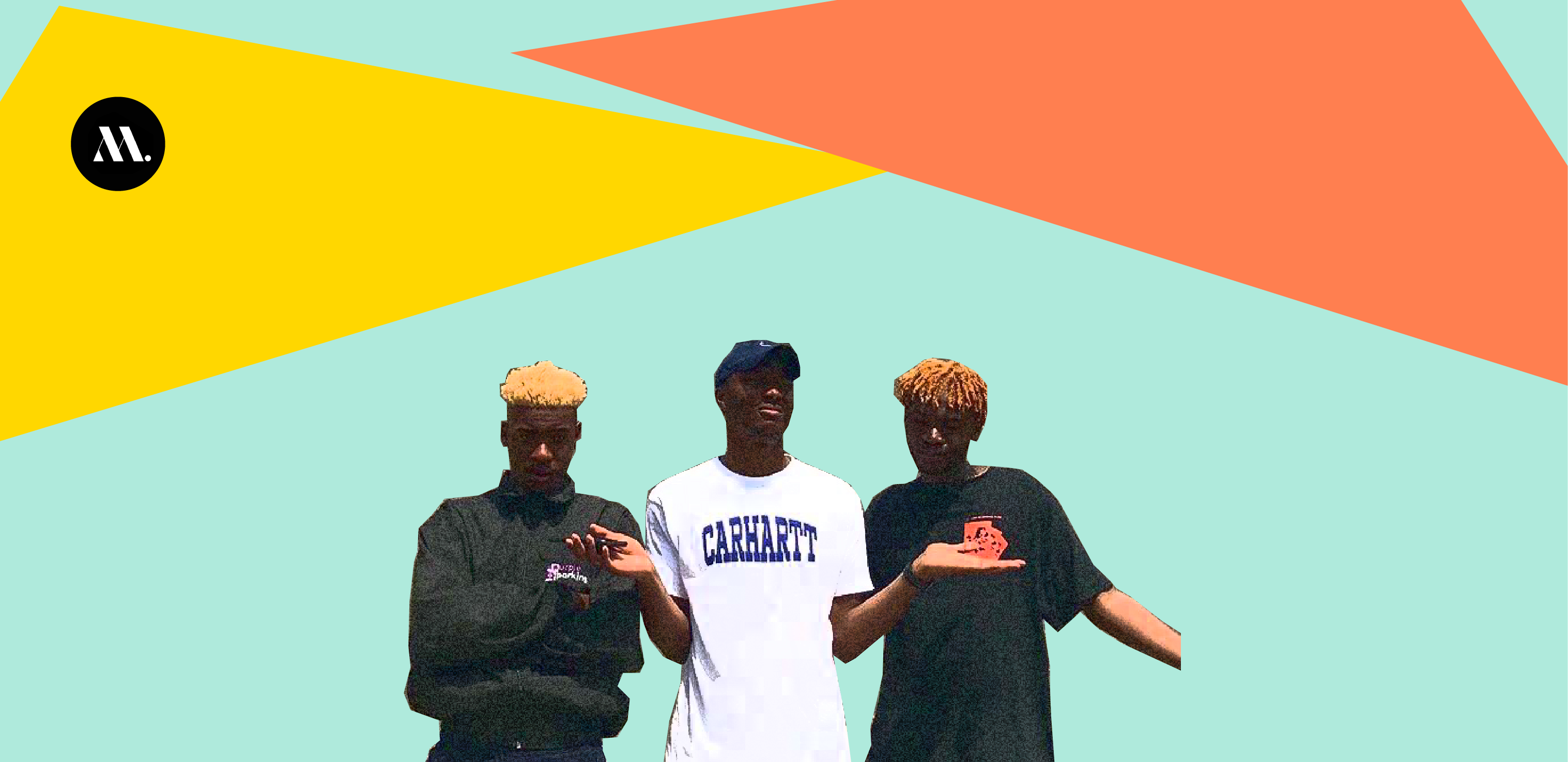
Forevatired is the name on everyone’s lips at the moment. Last week, the eccentric 11-man collective shared the hazy ‘Devil Fruit,’ the lead single off their next full-length project, and premiered its accompanying trippy visuals via The Fader. Since then, the burning questions have flown around: ‘Who is Forevatired?’ ‘Where did they come from?’ ‘Are they 3 or 50 ?’. In the short space of a week, the boys have gained a sizable amount of traction leading up to the release of their latest project. But anyone who’s been paying attention would know that this has been a long time coming.
this is a very nice change of pace. where does kimani find these artists? 👁👁 https://t.co/HuphUJB9f6
In the summer of 2018, the band released its debut demo titled at the end of summer, a fresh, acoustic take on soul-infused hip hop. The project served as the perfect introduction to the BROCKHAMPTON-like alternative front’s unique sound. Late 2019 saw the boys release the Before You Kill Us All, as they further explored the depths of genre-swirling hip-hop, which created a buzz as more people caught on to the group.
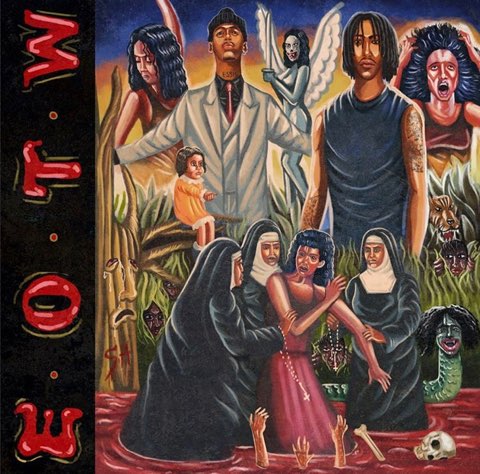
Seven months down the line, and we’ve been blessed with their sophomore full-length tape, THOSE KIDS NEXT DOOR, a project that just might be their ticket to the mainstream.Their steady incline has made their music hard to ignore, and this has been solidified with the favorable reception of the release; the boys are finally getting their flowers, and it’s about damn time.
THOSE KIDS NEXT DOOR is a quarantine-themed compilation, put together by the band while observing social distancing during the pandemic. While initially based in Abuja, the boys have, surprisingly, never all been in the same place at once. But earlier in the year, ¾ of the members found themselves in a new home, and with the government-enforced lockdown in place, they decided to utilize this rare time together to make music.
‘The idea for the mixtape had been in the works even before our members moved to Lagos with a plan to finish a different project, our debut EP (still TBA),’ they tell me via email. The result is THOSE KIDS NEXT DOOR (or TKND), a sprawling 10-tracker brimming with experimental versatility and pushing the borders of modern hip-hop to blurry edges.
The project opens up with the ethereal ‘WEST’, and Golddrummachine’s delicate vocals and dreamy production immediately welcome us as he pens an ode to a lover. ‘If she kills me with her thighs/Tell the jury I don’t mind/It’s a privilege of mine/I was lost, but now I’m found’, his synth-shrouded, layered vocals echo tenderly. Effortlessly switching from an airy falsetto to digitally enhanced baritone vocals, he illustrates the intimacy of their relationship, likening the bond to that of River Phoenix and Keanu Reeves and Joey Bada$$ and Capital Steez (RIP). And on ‘ALONE’, Golddrummachine is seen receding into his all too familiar cave of self-searching.
Much like now separated hip hop collective, Odd Future, Forevatired pride themselves in their non-conformist ways. Their aesthetic is all shades of self-assuring notoriety; one glance at their Instagram, and you’re greeted with a handful of trippy, unconventional artwork and visuals, highlighting their anarchic core. This brand of reckless adolescence is conveyed further on ‘STEW’, a synth-heavy trap cut. Etienne and Runateam up on the moshpit-inducing number and trade bars on relishing in their youth and focusing on making a mark, void of distractions. The chaotic, accompanying teaser video sees the pair (along with another band member) wilding out on an uproarious car ride as Runa raps ‘She don’t care about boys/She just want the racks/Yeah, we making noise/Now that bitch want me back’.
If there’s one thing you should avoid thinking about Forevatired, it’s assuming that their ‘wild youth’ trope voids their music of refinement. One listen to this tape, and it’s quickly proven that this is not the case. Their pen game is elite. The boys have a way of putting a unique spin on relatable subjects while simultaneously exploring immersive soundscapes. A gummy, amalgamation of trap and guitar-led indie rock sounds, ‘BROKEN’ is an emotive rendition that perfectly captures the depressive episodes many young adults today can relate to.
‘I’m broken/I’m weak/I cry to sleep/Alone/I’m sad/Alone in my sheets/The darkness is creeping/I see it in my dreams’, Faith cries out, later joined by Runa and Etienne for this introspective cut. On ‘BLUE’, Rookie SBKtaps in rapper Mafeni for an eccentric Afro-pop number encapsulating their attempts to woo a love interest. Elsewhere on the reflective project outro, ‘WASTED’, Brum3hchannels his soulful melancholia into penning a somber love song in the key of intoxication. ‘Oh, this Henny on your lips is what I live for/Cocaina, that’s your hips, I think I want more’, his delicate vocals croon softly, oozing with love-drunk melancholia.
There’s something rather freeing about not making music to anyone’s expectations. It relieves you of the anxiety and stress of trying to please everyone (which of course has been proven impossible) and instead allows you to focus on putting out content that’s true to you. Rockimonsta’s 30-second monologue on ‘MAGIC’ touches on this. ‘You mean to tell me that I’ll be making shit/And that it all comes down to what people think ?/Nah, nigga/I don’t enjoy making music/ Until, like, those moments come’, he confesses. Without a doubt, TKND is the perfect embodiment of what making music to no one’s expectations sounds like.
I mean, you’d literally never hear a song like ‘BABY JESUS’ anywhere else. On this intense number, Etienne and Pharoah voice their thoughts on the ongoing hysteria stemming from the global pandemic and racial-based uprisings. ‘Good evening citizens, world on drugs/Government talking, I just switched off/Girlfriend calling, four missed calls/These drugs I feel my pores lift off/Whole world gone loco’, Pharoah raps, highlighting the coping mechanisms they turned to as the world sinks to an inevitable dystopia.
Lead single ‘DEVIL FRUIT’ sees Rockimonsta render an expressive conversational monologue, sparked from a hazy introspective session. The meld of the pipey synths, rippling basslines and dreamy acoustics, paired with Rockiemonsta’s immersive writing, all make for the most unexpected, yet enjoyable, ode to the struggle as a young artist. And on the hypnotic ‘FILM TRICK’, Etienne and Pharoah tap in SOLIS to deliver an ode to a love interest, inspired by old Nollywood flicks.
Forevatired is a pretty sizeable collective. Their large number has made them rather self-sufficient, for the most part, rarely venturing out-of-house for vocal, art direction, and production needs. But what’s most intriguing about the posse is the balance they bring to their musical compositions, despite featuring an array of artists. The collaborations are well thought out; each vocal delivery is distinct, complementing the next and never gets cluttered, portraying the intentional thought behind every track.
As a whole, TKND scans the breadth of the band’s exuberant poster, exhibiting their genre-fluid sonic palette and experimenting with modern hip hop techniques. The camaraderie that binds the group is apparent. With 3/11 of the boys in different states, and one abroad, TKND is proof that their evident synergy exceeds the physical; separated but never really apart. It’s a project for everyone. No matter your taste, you’re bound to find something that resonates with you. And with each listen, you’re certain to find a new fave. Back in March, we told you that Forevatired isn’t your everyday alternative band, and now with the release of TKND, the gospel isn’t up for debate. If you’re late to the party, it’s fine but welcome. This is only the beginning.
Over the years, it’s become less outlandish for producers to step into the booth, attempting a shot at a solo career. From veteran beatsmiths like Dr. Dre, Pharrell & Kanye West to more recent names like Pi’erre Bourne & Travis Scott, many producers have since proven they can be self-sufficient. 21-year old producer Tochi Bedford has been one to watch this year, and now he’s following in the footsteps of the aforementioned greats.
The 44dbcollective founder kickstarted his solo career back in 2017, collaborating with rapper Abstrakt on the bar-heavy number, ‘Feel It’. Since then he’s rolled out a string of releases as a solo act, in between feeding impressive beats to artists like Traplanta and Odunsi [The Engine]. Now ready to step into the limelight as a full-fledged artist, he offers up his debut project, Eternal Mob –– a scintillating seven-track extended play filled with snappy raps oozing with braggadocio and bravado, and hard-hitting production.
The project opens up with ‘Bros’, a Malik Bawa produced solo cut which finds Tochi rapping about the multitude of fake people in his life posing as friends. ‘Need a rinse, need a cleanse, niggas tryna be my friends/No one knows/Why they pose/While they tryna steal my soul’, he croons in a raspy half-whisper over Malik Bawa’s signature keys, as he vows to weed out the ‘friends’ with disingenuous intentions and ride out for the real ones.
One of Tochi’s most defining and endearing traits as a producer is his ability to somewhat unearth a different dimension of each artist he works with. The intricacy and distinctiveness of his production seemingly ignite a new kind of fire in these artists, allowing them to elicit a different side to their artistry. Whenever you hear the tag, ‘Yo Tochi keep mobbing’, you know it’s bound to be fire. This is perfectly exemplified with his work on Traplanta’s most recent release, ‘Goin 2’. The bouncy number’s thumping 808s, hard-hitting drums, and eerie piano keys served as the perfect backdrop for rappers KA$H and OBA to deliver arguably their best performances in a while. And with Odunsi’s ‘nu finesse’ and ‘airplane mode’, Tochi’s psychedelic production helps evoke equal parts love-drunk melancholy and cynical machismo – a far cry from the mood set on Odunsi’s rare.
Young Tochi really came into the game like Metro boomin. Hottest out streets, SOLID first project, & fire features. More grease & more mobbing @TochiBedford ✨💎
Eternal Mob is no different as Tochi gives ample room for his guest lineup to put their best feet forward. Pre-released single, ‘Disintegrate’ draws out a side of Cruel Santino we haven’t seen in a while; his easy-going, mid-tempo flow melds nicely against the spacey production of the laidback trap cut, showing us a menacing side of Santi we’d love to see more of. ‘Notice Me//Posted Up’ sees dndsection deliver admittedly ‘one of his realest verses yet’. Against the hi-hat heavy production, the Atlanta-based rapper spits bars portraying his present-day success as a result of overcoming unfavorable circumstances: ‘And I still got zero losses like I’m undefeated/And I got chains around my neck but they already freed/Used to be broke but now we shopping Neiman’s’. The song switches up with a slowed-down transition – a certified fan-favorite – as Tochi chimes in with a snappy verse of his own.
On ‘Machine’, he taps in $B andflowerboydave to deliver a melodic trap number, peppered with soft drums and a looped epiano riffs. Elsewhere on ‘Busy’, AYLØ and Begho shine through. Against the thudding drums, heavily syncopated piano keys and a looped flute sample, the trio trade verses recounting the hard work they put in as they chase their dreams. ‘Busy right through the weekend/Gotta restart on Monday…That’s why I’m busy out in these streets/Why I’m always on these beats/Why I’m only giving out heat’, Tochi croons, depicting his daily grind. Further down the line, Begho reinforces that the hard work is non-stop as he raps ‘Probably gonna sleep when I’m dead’.
Producer and fellow 44dbcollective member KD delivers one of his first-ever vocal performances on the highly braggadocios ‘Killer’, and a stellar one too. Close friends and collaborators, their camaraderie is apparent as they trade self-assured bars on their undeniable talent while sending a clear message to the competition. ‘No one next to my niggas/Make my money quick shawty thinks I’m a killer’, Tochi raps, alluding to the unmatched talent of the 44dbcollective. KD is as menacing and cut-throat as ever, jumping in down the line as he snarls about ‘Putting the game up in a headlock’.
The project is wound down to a calming close with the woozy, reflective trap ballad ‘No More’. The Seki SuperVillain assisted set sees a more introspective side of the two artists. While Seki’s melodic vocals meld perfectly against the arpeggiated guitar strums, Tochi’s performance steals the show. Taking off the self-assured and braggadocious mask for a bit, he pens a pensive confession on all the not-so-pleasants he’s witnessed in the game. ‘I sex, I drink, I ball/I seen real shit pop when I was 12/I seen bitches switch sides for some change/Seen a real one bow before a lame’, he intones.
As a whole, Eternal Mob is a solid premier attempt at a solo career; the intent behind the curation is glaring and aids in the cohesion of the project. Running at just under 20 minutes, the 7-tracker is lengthy enough to pass across the message and succinct enough to leave you wanting more. The production is as eccentric and authentic as ever; you certainly can’t find this sound anywhere else (mostly because Tochi designs his own sounds). There’s a quiet buoyancy to his production – it bounces along rather than ratchets up tension for colossal drops. It’s equal parts elementary and equal parts intricate – highly reminiscent of Pi’erre Bourne.
Amidst some of the best new age artists in the game, Tochi holds his own as a solo act; matching each of his guests bar for bar and spinning out an impressive production while he’s at it too! Needless to say, with acts like Tochi Bedford, the future of new age hip-hop in Nigeria is in great hands.
The world has been getting crazier with each new day in the last few months, and while staying updated is crucial, it’s also important to remember to take care of yourself and unplug from the seemingly endless awful news if you need to. Music is one of the few things that have kept our spirits up and sustained our sense of community.
In spite of the current state of affairs around the world, artists have continued to put out new music to help us process everything better, or simply take our mind off things. It’s also completely understandable if you haven’t been able to keep up with the new releases, given everything that’s been going on in the last few weeks.
So to help out a bit, we’ve compiled a list of the new music released over the last week that you might have missed. Enjoy.
Loti & KD – Sins & Scenes EP
The scintillating duo consisting of R&B artist Loti and 44dbcollective producer KD, have finally released their long-awaited EP, Sins & Scenes. The infectious 5-tracker is a nostalgic ode to the Lagos nightlife. Drafting in artists like Hyphen, Buju, and Fasina, the project tells stories of youthful exuberance certain to reignite your teenage fantasies.
Listen to the project below.
Tochi Bedford – Eternal Mob
44dbcollective producer is certainly one to watch. Earlier in the year, he dished out hits to artists like Odunsi. Now focused on his career as a solo artist, he has finally released his heavily anticipated EP, Eternal Mob. The 7 track project hosts a stellar class of guest features ranging from fellow 44db producer KD, to dndsection, AYLØ, and Cruel Santino.
Listen to the project below.
Aussie Maze ft Loti & Shaun Mbah – ‘Hands in the Sky’
Following his earlier release in the year, ‘Aria’, Aussie Maze has teamed up with Loti & Shaun Mbah to serve up this relaxing, mid-tempo number, ‘Hands in the Sky’. The track finds the trio trading melodic verses on pleasant times with a love interest. ‘Shawty spend time with me/We got what we need/Won’t you lay with me/Feel the summer breeze’, they sing, depicting a romantic summery day with a lover.
Listen to the song below.
Lemyang – Goosebumps
UK-based singer, Lemyang began the year with a string of releases including songs like ‘Fight’, ‘Compose’, and ‘Body’ which featured Terry Apala. For his latest offering, he serves up ‘Goosebumps’, a dance-inducing Afrobeat number on which he plays on the familiar trope of the honeymoon stage in a relationship. ‘Goosebumps that’s how I feel/Body dey do me … baby all for you’, he confesses, filled with deep-seated admiration for his love interest as he promises to go above and beyond to prove his love.
Listen to the track below.
MTG 9boy – ‘L.O.L (Life on the Line)’
In light of the recent uprising stemmed from the racial based violence across the pond, Black people everywhere have taken to different media to express their activism. LA-based Nigerian fashion influencer MTG has decided to play his part with the release of a politically-charged number, ‘L.O.L (Life on the Line)’. The upbeat track finds him penning an ode to the Black man as he recounts tales of hardship he’s faced based on the color of his skin. ‘Black man, Black man, what you gonna do?/Black man, Black man, they wanna see you lose’, he sings, urging Black people everywhere to step up to the plate and put their best foot forward, despite any opposition against them.
The world has certainly had a dark cloud hanging in the air in the last few months. From an economic crisis – thanks to the ongoing global pandemic – to a series of racial, sexual, and gender-based violence, the horrible news seems endless.
Music has, however, proven time and time again to be a channel to our healing, and many people have turned to music as a means to get through these difficult times. Santi clearly knows this, as just after a long and heavy day of women virtually protesting against the abusive and manipulative methods D’banj stooped to following the rape allegations against him, Santi sanitized our minds with an aptly titled new single, ‘End of The Wicked’.
Santi (now known as Cruel Santino) has been teasing new music for a while. Since his last musical offering, Mandy and the Jungle, the visionary artist has confessed his next musical journey will explore new sonic directions. ‘I’m actually really excited about my new music’, he gushed on an Instagram Live session back in April. While fans yearned for a new release, he satiated them with an episode of a new show he’d been working on, in which he previewed an unreleased track. After weeks of endless teasing with snippets of ‘End of the Wicked’, the Octavian assisted number is finally here.
The upbeat record sees Santi and Octavian trading fast-paced verses over a GMK and Genio-produced beat while sending out a warning to be wary of jilting lovers. ‘Never put your trust in a woman who told you they love you/They still end up leaving/I see the truth in your eyes/You did what you must to survive’, a scorned Santi croons over the percussion-heavy production. Octavian follows with a verse about stunting on a former flame: ‘Walk around like you not seeing me/Bitch, please/I’m a G and you better believe’.
The dance-inducing number is a warmly welcomed breath of fresh air, amidst the cycle of awful news thrown at us over the last few weeks. As we continue to seek justice for Seyitan, Tina, Uwa, and Jennifer while waging war against gender-based violence, we can also unwind and get lost in the eccentric sounds on this bouncy number.
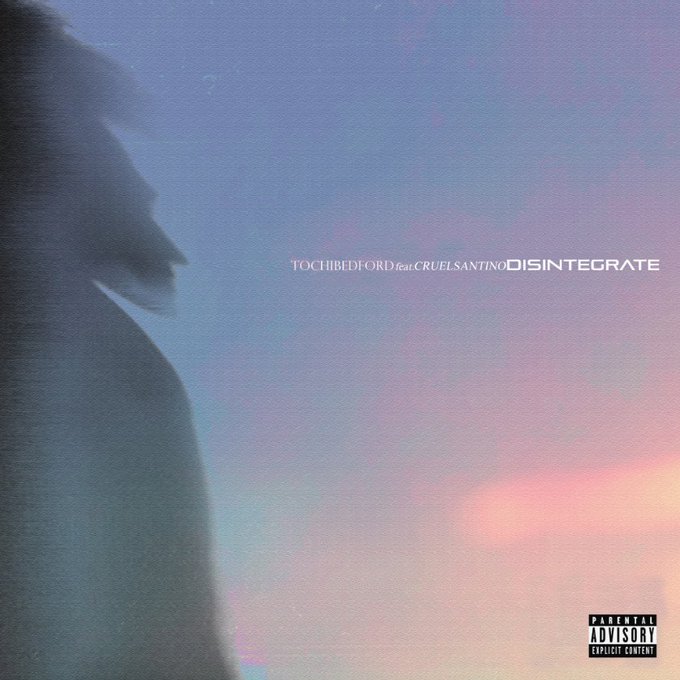
Producer and founder of 44dbcollective Tochi Bedford has spent most of the year feeding hits to artists like Odunsi [The Engine] and Bianco. Now stepping out of the shadows and shifting his attention to his solo career, he taps in Cruel Santino to serve us a laidback trap number, ‘Disintegrate’.
Tochi has been in his trap bag lately and this is evident in his recent work with Uglymoss and Odunsi on ‘Creep’ and ‘nü finesse’ respectively. Following suit in this manner, ‘Disintegrate’ is a spacey, relaxed trap cut, peppered with head-bopping percussions, fluttering hi-hats and a looped epiano sample. This meld of sounds provides the perfect backdrop for Tochi and Santi’s playful & easy-going, mid-tempo flows.
Speaking to Tochi on the creation of the record, he tells me,
”I recorded the song back in November and sent it over to Higo and he told me Santi would work out nicely on the second verse. So I sent it to Santi and we worked on it together”
Self-produced and co-mixed by GMK, ‘Disintegrate’ is the first single off Tochi’s upcoming debut EP, Eternal Mob, scheduled for release later this year.
Over the years, the Nigerian music scene has greatly benefitted from an ample crop of renowned women who have come in and out of the spotlight and lent a hand in granting Afro-pop its current domineering and profitable presence. It’s no news that in recent times, there’s been an evident global scramble for African music and culture, with Afro-pop as a genre receiving majority of the attention – and finally, the men aren’t the sole focus.
This was certainly not always the case. Women have always been dealt the short end of the stick by the industry. Back then, female artists not only had to deal with simultaneously fighting for visibility in the industry as well as the one seat at the men’s table ‘graciously’ allotted to them but also had to grapple with pigeonholed stereotypes and being policed on the content of their music. Thankfully things are much different these days; attitudes towards women have changed – for the most part – and we’ve begun to take command of our own narratives. Thanks to digital advancements and social media, women now gain visibility on their own, doing away with the need for a seat at the men’s table to be seen. And yet, amidst such positive progress, women are still being placed in boxes with little to no room for personal innovation.
Male artists are often granted more freedom to explore different soundscapes and genre combinations, with artists like Rema, Santi, and Odunsi [The Engine] receiving praise for their genre-meshing music. Their female counterparts aren’t so lucky. Usually, as a woman in mainstream media, if your music isn’t similar to the cookie-cutter Afrobeat sound signature to the likes of Tiwa Savage, Yemi Alade and Teni, your chances at seeing any real success are rather slim.
Women are also constantly policed on the content of their music. Female sexuality is a mainstay in Afro-pop and yet it’s an area women often tend to shy away from. Male artists write a million and one songs centering women and the female anatomy as sexual objects, yet when women attempt to take back the power and reclaim autonomy over their bodies; it’s often met with an uproar from the media and the masses, forcing them to suppress their own sexuality to gratify the audience.
In 2014, Afrobeat superstar songstress Tiwa Savage released the controversial video for her single ‘Wanted’ which portrayed her singing raunchy lyrics and seductively dancing in a nude bodysuit. This release, of course, accrued hostile and demeaning attention from the media and masses, cumulatively giving their unsolicited opinions on how a (newly) married woman like herself should behave in the public eye. And while we all know such conversations surrounding a woman’s autonomy over her own sexuality are tired and quite frankly, very obsolete, the rest of the society seemingly haven’t followed suit.
What we also know is that things are changing for sure. We exist in a time where the top 2 spots on the highly coveted Billboard Hot 100 chart are occupied by four (black!) women talking their shit, spitting explicit rhymes, and expressing carnal desire. This age of progressiveness has also found its way to homeland shores with Nigerian female artists feeding into the phenomenon and taking complete control of how their sexuality is perceived. Just recently, Odunsi enlisted Ghanaian pop princess Amaarae, style icon DETO BLACK, and singer Gigi Atlantis on his body and sex-positive number, ‘body count’.
The cut saw the female trio challenging the purity culture African women have been expected to conform to with expressively lewd lyrics, spurring women around the world to let loose and live freely. And this was rewarded with a well-deserved number one spot on the Nigerian Apple Music charts on release day, proving that going against the grain to speak your truth isn’t as much of a taboo as many make it out to be – people are listening.
Maybe I’d rather be me, than be who you think I should be.
In this light and in a bid to champion empowerment and liberation for women in music amongst other sectors, we’ve highlighted 5 young female artists on the rise breaking set barriers, removing themselves from the boxes the industry has placed them in and sticking a middle finger up to the androcentric industry and it’s misogynistic standards. Get to know these badass queens!
SGaWD
‘’ I do whatever the fuck I want cause I can. “Boxed in’’ doesn’t exist in my world. I’ll always pull a new trick like ‘’oh I didn’t know she could do that too’’ – SGaWD
22-year-old sultry vocalist Seddy – known more popularly by her moniker SGaWD – has sparked quite a level of interest on the scene. A graduate of Law and Marine Biology, the tenacious singer’s musical journey began when she moved back home in Nigeria, where her previously discovered passion for songwriting and music creation was ignited. Struggles with being overweight and acne in her early teenage years took a toll on her self-confidence and inherently served as the reason for positive self-affirmations being her mandate, as is well reflected in her music.
Influenced by Hip-Hop/R&B greats like Foxy Brown, Lauryn Hill, Jill Scott and Lil Kim, SGaWD’s vibrantly eclectic sound portrays her as anything but one-dimensional. ‘I can be sultry, sweet, dominant, assertive, full of love and faith, sexual – I can be so many things. The world hates to see and believe that women can be many things – multifaceted – it’s sad but that doesn’t change shit’, she tells me. Her music sees her spitting fire bars on songs like ‘Are You Dumb?’, bringing the energy over boom-bap beats on songs like ‘Came Back For You’ and delivering sultry verses and expressing her carnal desire on R&B tunes like ‘No One Minute Man”. Whatever sonic intention the singer/rapper takes, she’s determined to talk her shit.
With carnality as a running theme in her music, it’s easy to see how society might want to police her content, but she has no care for that. ‘Now women are speaking up, now women are owning themselves in their entirety. There is a different community where there is no shame for being sexual and being open about it. Eliminating the shame in the music is a huge step, bigger than people understand’, she states. Her ever-changing sound might mark her as a wildcard to industry powers so she adamantly refuses to be tamed by a label. Instead, she plans to spend more time building her discography, sharing more music, performing live, and getting to know her fans better. Taking it one step at a time, she’s determined to make the world recognize the name, and she’s doing it on her own terms.
Pocketsizedria
‘’I guess the importance of a sound like mine is just – to bring a different perspective, a new perspective. And sometimes it’s not going to be the most profound but it’s nice to just vibe to a song about wanting bagels y’know?’’ – ria
We are witnessing a new renaissance of female rappers globally, with enigmatic characters like Tierra Whack, Rico Nasty, and Noname who have maintained their authenticity as opposed to embracing the femme fatale persona often associated with women in the Hip-Hop stratosphere. Enter Rami, now known as Pocketsizedria, a 20-year-old Leicester based rapper, and producer, whose sounds draw parallels with the aforementioned iconic women. Born Miriam Iman Said, she began making music as a child, writing amateur songs with her friends back in primary school, and only got into production back in 2015.
‘I don’t know what to describe my sound as though really, maybe I’d say ‘bubble-gum video-game day rap’ ?’’ she tells me, alluding to the plethora of game boy samples littered in her music. Self-produced, her music often finds her spitting eccentric flows over quirky, unorthodox beats. As carefree and goofy as her sound presents itself, she certainly puts in a lot of work and is very intentional with its creative process. ‘I work in bursts, so I usually just sit down and spend half the day making a beat and then right after will try to write to it and lay down vocals and that. [That] will usually take me into the wee hours of the night’, she explains. Such dedication may stem from being a full-time film student while simultaneously juggling a budding music career.
Her latest offering, Nice Kill!, a 3-track pack, is a 6 minute whirlwind of self-assuring, goofy lyrics and unconventional beats – an untapped niche in the African music space. Her music, inexplicable as it may seem, finds the young artist confessing feelings for a love interest, admitting her insecurities, and just talking her shit. ‘I just make things and hope people like it you know? I’m not inventing the wheel, I’m just…existing. If I didn’t make music, I would probably be a very bitter, angry person’, she admits. Grounded in her authenticity and speaking her truth, this young woman’s trajectory is certain to only go up from here.
Rindss
‘I’d like to think I’m versatile so i wouldn’t wanna be put in a box, not now not ever.’ – Rindss
Dorinda Amara, otherwise known as Rindss, officially began making music back in 2018 with the release of her debut single, ‘Money’. Since then, the 21-year-old singer has gone on to release music tackling an array of sonic intentions.
‘I get inspired by the tiniest of things you know. I’m very observant and I pay a whole lot of attention to details. So when I’m writing songs, I like to stay close to what inspired me, take the theme and dance some atilogu around it!’ she reveals to me. Her latest release, ‘2 AM MUSIC’, is a sultry Trap&B number picturing the artist graphically narrating her sexual intentions to a man on her radar. Such explicit themes are peppered throughout her discography, coupled with sex-positive lyrics depicting her stance on the sexual liberation for women in the industry. Irrespective of any pushback, Rindss is determined to speak her truth.
‘As a woman in the industry they expect you to come with the whole package or nothing, your voice is never enough. Your artistry is never enough. You have to be sexy and daring it’s honestly so demanding of us. Being reduced to sex symbols that are,’ she tells me, alluding to the ridiculously obscene standards the music industry often demands of women. The industry is majorly centered on female sexuality but doesn’t offer room for women to occupy it themselves – they’d just have to make do with being sex objects. Well, Rindss begs to differ. She’s dead set on breaking down set notions our deeply conservative society holds, through her music.
Merry-Lynn
‘The Nigerian industry is begging for something new. We all need the diversity’ – Merry-Lynn
21-year-old rising soul singer-songwriter Merry-Lynn began her career professionally back in 2015 when she met producer brothers, Veen and Kiienka. Since then she’s gone on to release resonating music, incorporating her alluring vocal textures and vivid lyricism to grant the listener a one of a kind experience.
Drawing inspiration from Soul legends like the late Amy Winehouse, Erykah Badu, and Lana Del Rey, Merry-Lynn’s soundscape – a delicious blend of Afro-jazz, Blues and Reggae – is certainly unorthodox in these parts. And she’s perfectly fine with that. ‘I’ve never thought about switching my sound to appeal to the mainstream masses, but I’ve had people I work with suggest that to me’, she reveals to me, adamant on standing her ground and sticking to what’s most authentic to her.
Her latest release, Petrichor EP, is a delectable meld of Reggae, Neo-Soul, and R&B with a modern twist. The 6-tracker served as a form of catharsis for the Abuja based songstress. ‘Making this project was a downpour of all the emotions I was holding on to after so long, and when I was done I just felt the weight leave. The atmosphere was breathable again, it was loving and calm afterward. That is why I called it ‘Petrichor’’’, she unveiled in a recent Okay Africa interview.
‘I’d love to see more collabs between talented women. Honestly, I wish the few female artists we have up there could help out other women on the come up so we don’t always have to entertain disrespect from men [who function as the industrial gatekeepers]’, she tells me, speaking on the state of the Nigerian music industry. ‘I know for sure that a time will come when I’d have to prove myself twice [as hard] or have people critique my choices because of my gender’, she further admits. Amidst this painful realization, she’s still determined to stick to her roots and keep speaking her truth. ‘If you keep talking, eventually someone will listen’, she positively asserts.
Adanna Duru
‘I’m very 10-dimensional when it comes to genre; I try so many different things’ – Adanna Duru
Indie recording artist, Adanna Duru has literally been singing since she popped out of the womb. Thanks to her supportive parents, her early years were filled with auditions for singing competitions which landed her top spots on Season 3 of ‘The Voice’ and Season 14 of ‘American Idol’ respectively. Since then, the LA-based artist has gone on to record music taking on a vast range of sonic directions, from Alternative Pop to EDM. ‘I’ll say my sound can be best described as artistic and honest pop music’, she tells me; ‘ABBA and Michael Jackson are huge influences on my sound’.
Her latest addition to her prolific discography, ‘Acid’ is a fiercely hazy record oozing with self-assuring lyrics while she sends a message to naysayers that she’s not one to be played with. While her songs usually take on different genres, the common denominator lies in the fact that her music constantly harbours themes of self-confidence and undeniable power, even when she’s being delicate. ‘I find that Black girls everywhere, we aren’t really given that much space to express ourselves genuinely. We’re pressured to make a certain kind of music,’’ she tells me. ‘I love my music because I feel sonically; I represent all the different ways a Black woman can feel’. Comfortably switching between the ‘Manic Pixie Dream Girl’ (like on her critically acclaimed EP), ‘Depressive Gargoyle Goth Girl’ and the ‘Bad Bitch Persona’ tropes, Adanna embodies all the various ways a black woman can self-express.
‘Instead of focusing on what I think other black girls wanna listen to, I’m more fixated on being as authentic to myself as I can.’
The music industry, amongst many other things, is deeply flawed when affording creators their well-deserved flowers. When a song is made, usually the vocal artists have the spotlight majorly shone on them, leaving producers on the back burner. Audio engineers, however, who serve as the lubricating oil charged with ensuring the moving parts are properly melded together to deliver music of satisfactory quality, are not even given a spot on the stove. And in an industry almost entirely focused on men, it’s just that much harder for their female counterparts to gain any recognition.
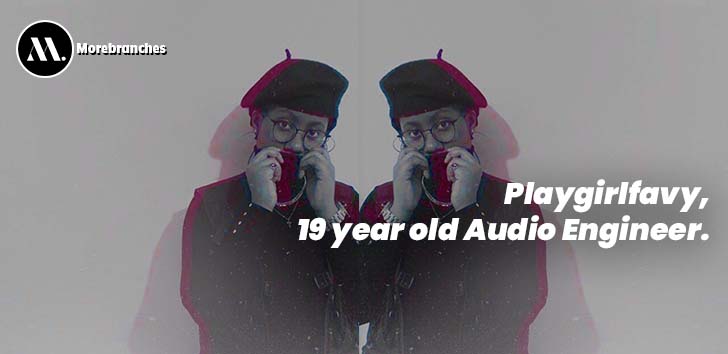
Based on the prevalence of current female chart-topping superstars, like Simi, Tiwa Savage, Tems and Lady Donli, you’d think that the music industry — traditionally the domain of men — is increasingly being shaped by powerful women. But behind the scenes it’s a different story. Female producers, mixers and engineers, are few and far between, and the ones who do exist are consistently overlooked and discounted. For 19-year old Nigerian audio engineer, Favour-Irene Henshaw – known more popularly by her moniker ‘Playgirlfavy’ – the end goal is to create a levelled playing field for women on the other side of the mixing desk to create and receive their merited accolades.
We caught up with the young songwriter/producer/audio engineer to discuss her craft, her thoughts on the future for women in production and more.
More Branches: How/when did you get into music production?
Playgirlfavy: I got into it in I’d say 2017 but didn’t really do anything practically. I was still in boarding school at the time so I was just watching a lot of YouTube videos about it and learning how to work my way around FL Studio in theory. Then in 2018 as soon as I came to uni, I got my equipment and I’ve been pushing since then.
Is that also when you learned sound engineering?
Playgirlfavy: Oh no, I picked up engineering in January 2019.
What encouraged that decision?
Playgirlfavy: I feel like engineering was always something that fascinated me, even before I knew for sure that I wanted to do music. I’d hear certain songs and just wonder how and why the vocals would sound a certain way or why they were moving between my ears. So that January my friend called me and told me about a sale that Waves was having for a particular bundle and I just knew it was then or never, copped it and just experimented a lot until I knew what to do.
Do you think sound engineering is something you have to go to school for? Or one can learn on the job?
Playgirlfavy: I feel both ways about it to be honest. Because if you really put your mind to it, you can learn on your own and just grow from there but going to school for it would also be a different learning curve. Being able to have people who know the ins and outs of small things you’re trying to grasp guide you goes a really long way. At the end of the day though, everyone’s different so whatever floats your boat I guess.
Do you think there’s usually a difference between the quality of work of a self-taught engineer and a trained one?
Playgirlfavy: Not really, there probably would be very little differences between both but I’d say it all comes down to taste. It’s the same concepts both would be working around but the application or technique is what may be different. Some self-taught engineers are even better than those who went to school for it so there’s that.
Walk me through the basic technicalities involved in taking a newly recorded piece to a full-fledged song, in terms of audio engineering.
Playgirlfavy: Okay. So how I approach it is the first thing I do when I get stems or files is I sit down and organise everything, I label and colour code so that it’s easier for me to find what when I need it. Then once that’s done, I level everything and just listen to it over and over again. I take notes on my phone about what I want to do with what part and how to approach the vocal depending on what I’m hearing. Then I deal with everything technically speaking, I’ll EQ, compress, De-ess and just make the vocals sound good on their own before I go in and do anything creatively speaking such as reverb, delay or pitch shifting. My creative effects majorly depend on the type of track it is. After all this I’ll listen and tweak as I go then just leave it if I feel it’s good enough. If I’m also mastering then I won’t touch the file until maybe 3 days later or so just so I can go back to it with fresh ears and also so I don’t get bored of it.
What’s the difference between mixing and mastering?
Playgirlfavy: Mixing is more in-depth I’d say. You’re addressing everything from the ground up and essentially give the song its basis, a good mix makes or breaks the song. Mastering is more like adding finishing touches and enhancing the dynamics (which have been created in the mix) of the track.
What software do you usually use?
Playgirlfavy: I do everything on FL Studio. I am faithful.
As a producer/engineer, what are some of your proudest achievements so far?
Playgirlfavy: Production wise, ‘Hush’ with Katya although I’ve got other songs in the vault that I’m super-duper proud of and cannot wait to be dropped but ‘Hush’ was just something that made me know, yeah you can actually do this. Engineering wise, ‘CRZY’ with Lectrik and Elemen3. That song means the absolute most to me right now.
As a female producer/engineer, what’s the biggest obstacle you’ve faced based on your gender?
Playgirlfavy: People always doubting that I can do this or not believing me when I say oh I mixed or produced this. I’ve had people belittle my efforts just based on the fact that I’m a woman.
It’s no news producers are often placed on the back burner in the industry, but even more so engineers. What’s your take on that?
Playgirlfavy: It’s sad to be honest. At the end of the day it is a team effort and everyone should be credited equally for the contributions they brought to the table. I do feel it’s better than before, maybe not where it needs to be but the improvement is there. Value your producers, value your songwriters and value your engineers. Your track wouldn’t be anything without them.
Where do you see the Nigerian industry in the future in regards to women in production?
Playgirlfavy: I see a levelled playing field. There’s strength in numbers and there’s a lot of us for sure. Our generation is more open minded and is learning a lot from the lapses of the industry currently, so hopefully there’d be more opportunities for women to shine.
Since Kanye West’s game changing 2008 album, 808s and Heartbreak, emotional lyrical content has gradually become a mainstay in hip-hop. A direct contrast to the hyper-masculine hip-hop of the late 1990s and early 2000s, rappers today are often seen speaking openly about their vulnerabilities: loneliness, heartbreak, anxiety, drug abuse. As far back as 10-12 years ago, rappers like Kanye, Kid Cudi and Lil Wayne went against the grain and created a space where it was acceptable to infuse deeply introspective lyrics covering personal subjects other than girls, guns and money in their songs – and this paved the way for a new class of hip hop heroes like Drake and Lil Uzi Vert to take a markedly different approach to lyricism than the icons of decades past.
This age of vulnerability in rap has found its way to homeland shores, with the youth embracing it and telling their distinctly Nigerian stories fused with Western influences. Enter, Femi Shitta-Bey, known more popularly by his moniker – and initials – FSB, a member of British-Nigerian lifestyle collective, Family and Friends. Adopting the ‘sad boy rap’ style heavily associated with Drake, the 23-year old has delivered expressive rap cuts like ‘Misbehave’, ‘Feelings’ and ‘Get it Fast’ over the past year and a half. In a bid to give us a real glimpse into his mind, he offers up his debut project, First Impression – a 14-track tape highlighting the emotional rollercoaster his life seemed to be on at the time. ‘I was kinda overwhelmed by all aspects of life, fairly depressed to be honest. I’ll say this has been the most sensitive & personal period of my life, so First Impression is just to reveal where I’m at’, he tells me.
The project opens up with ‘Confessions’, a deeply pensive soliloquy – as the title suggests – which finds FSB recounting tales of failed friendships and relationships with people who switched up on him. ‘When you stab my back I see it as a term of murder/Niggas tryna talk to me and I would not discuss further’, he assertively declares, letting his ex-acquaintances know forgiveness is not on the table. On ‘Paid My Debt’, he lets us know he’s earned the right to what’s in store for him because he’s worked hard. Over rising synths and scatting hi-hats and snares courtesy of $hadow, he raps, ‘No regrets/I can’t break a sweat/I done paid my debt’.
In true ‘sad boy’ fashion, lovelorn themes are littered throughout the project. ‘Lydia’s Interlude (Girls These days)’ sees an emotionally drained FSB glumly unfolding his feelings to a love interest who toys with his emotions. ‘When you gonna let me know/That you’re trying to take it slow/Cos I’ve been down the same road/We’ve been doing this for long’, he morosely intones, questioning her why on she keeps leading him on. On ‘Feelings’, he taps in fellow collective member, Dimss, for another one-sided dialogue, narrating how he got played by a former flame. Elsewhere on ‘Take Your Time’ (a personal favourite), FSB is found telling tales of – yet another – past love interest who up and left him. ‘How you gonna leave me here I’m feeling blue/ Baby girl don’t do me like that’, his auto-tune heavy voice wails out to his lover for a second chance. Hopefully, we can’t relate.
Taking a break from the downtrodden and broken-hearted themes, FSB stops pining long enough to reveal his more savage side. For ‘2 Bitches’, he taps in Traplanta frontrunner KA$h, and the pair trade bar-heavy verses on their hedonistic, polygamous lifestyle. Drafting in rapper $odaman, he flexes his menacing persona on ‘Push’. ‘Keep it pushing/I done took your girl I swear I wasn’t looking’, he candidly raps, letting his opp know it’s best to swallow this L and move on. The game is the game, baby.
As a whole, First Impression gives us an initial look into FSB’s mind, showing the inner workings of a young male dealing with his emotions in his own way. ‘You know, some things my pride won’t let me admit in person, but imma put it in this music’, he states at the intro of ‘Yea I Still Do’; a 4-minute confession of the unhealthy coping mechanisms – ‘Pop a xanny when I don’t know what to think’ – he adopted to deal with his trauma over the years. Music serves a myriad of purposes to different people. For FSB, it’s a means of carthasis – a way to channel all the negative energy as he unpacks the entire trauma from futile relationships and friendships. Just like Drake, Kid Cudi and others before him, FSB’s goal is for the forlorn introspection in his music to dually serve as a form of self-treatment as well as an escape for others. He’s trying to sing his way to his complete emotional healing, and maybe yours too.
Nigerian R&B/Soul singer-songwriter Dami Oniru has come a long way since her 2017 debut. Last year, she released her second body of work, Bri’s Lounge, which showed remarkable growth in her artistry with her incredible vocal strength, melody and soothing lyrics and earned her a well-deserved spot on our 10 Artists To Watch In 2020 list. Earlier in the year, she released the graphic visuals for ‘5 Shades of Bri’ and gave the audience a deeper look into the mind and life of ‘Bri’.
Now back with her first official release of the year, she offers up ‘Nowhere to Run’. The 3-minute track showcases her lyrical prowess as she delivers an important message about hope in a time of travesty. Speaking to More Branches about the inspiration behind the song, she said, “It’s a story about forgetting who you are and rediscovering your true power through self-reflection and realisation and growth.’’ Over a looped flute sample and vivid drums – courtesy of Remy Baggins – Dami’s honey-dipped vocals echo powerfully as she chants ‘I’m struggling to find myself/Have to find the missing piece’, rendering an all-too-familiar state of confliction on the journey to self-discovery.
With keen listening, you will notice the song sounds like a soundtrack for a movie, this is because it was a demo she wrote for Beyoncé’s Lion King: The Gift album. Speaking on the creation process Dami revealed, ‘I was very frustrated because I was given guidelines and topics/themes to write about but the lyrics for the song weren’t coming when Remy and I decided the beat was ready. So I had a mini pep talk with myself to be honest and just speak from the heart and this is the finished product.’ While the track didn’t make the final cut for the album, it bears a potent message and in these unfortunate corona times, it’s necessary to spread as much positivity as possible.
Quarantining with her mom and sister in Atlanta has forced the soul songstress to a place of deep introspection and she believes it’s the perfect time for self-reflection. ‘Nowhere to Run’ is certainly the perfect soundtrack to our self-analysis. She implores everyone to ‘stay home, stay safe and stay sane by being productive and focusing on maintaining a positive mind-set even though it may seem hard right now’.
The music industry has, more often than not, been guilty of solely shining the spotlight on the creators at the forefront – the artists. It’s no news that music is often purely viewed as a whole, finished product and rarely for the various, crucial parts it’s creation process comprises. Needless to say, production is probably the most integral stage of the entire process. Producers bear the brunt of the work; creating and polishing the sound behind the scenes, while receiving little to no recognition.
The reality of the journey to stardom for most producers is predominantly independent; it’s much easier for artists to secure funding/backing from record labels and talent management companies, and in an entertainment industry as fickle as Nigeria’s, it’s just that much harder for producers to do the same. While artists may be granted the ‘luxury’ of getting signed earlier on in their careers, producers have to sweat, toil and hustle longer before reaping the benefits of their hard work.
The recent iconic Instagram Live battle between renowned producers Sarz and Shizzi was certainly an eye-opener. As entertaining and monumental as the clash was, one thing was made clear – these men have been in the game as far back as 2007 but their prominence was only cemented a few years ago. And yet, in the presence of the well deserved critical-acclaim and reverence, the recognition bestowed upon them is still nothing compared to some of their artist counterparts whose journeys commenced at the same time or long after theirs did.
The struggle is that much harder for younger producers on the come up, and the constant downplay of their value further worsens the situation. For the average producer still in early years of his/her career, such belittlement coupled with the absence of adequate support can be pretty discouraging, to say the least. Nevertheless, amidst such setbacks and unfavorable circumstances, this present generation of innovative creators have prevailed.
Producers, don’t allow artists and labels treat you anyhow. YOU ARE THE FOUNDATION. No good music without you.
Over time, the new generation of creators have proven to be profoundly resourceful; independently acquiring skills and tools necessary for their crafts and forging ahead in spite of the odds placed against them. In a time where there isn’t much backing from older heads in the industry, the younger generation have had to look to themselves and raise each other up, creating a mutually beneficial ecosystem where they learn and grow off one another. Such ideals birthed the foundation of the 44dbcollective, the producer collective established by 20 year old producer, Tochi Bedford.
The idea for the collective was first planted in Tochi’s mind back in 2018. Initially planning an event, he enlisted a few of his fellow producer friends to help out and created a group chat for more efficient communication. Over time, as they grew closer and the membership grew in size, he decided to put a hold on the event and shifted his focus to nurturing the relationship conceived between them. Eventually, it was decided to make the membership official and establish a collective of producers, hence the birth of 44db.
“Everyone in the group basically controls a certain niche, even as upcoming guys. So we’re basically together to prove ‘strength in numbers’. Over time, we’ve learned so much from each other and shared a lot with each other,” Tochi tells me. In his years of producing, this was the first time he had been opportuned to interact with other like-minded producers and for him, it was like striking gold. And what made it even more exhilarating is the fact that each member is as diverse as it gets, bringing something different to the table. From audio engineer extraordinaires to Afro-trap and EDM specialists, the boys all certainly have something distinct to offer. The aim of the collective as a whole is to create an avenue for shared opportunities among the members. “The way we work is, one person’s plug is the family’s plug. If I work with someone today, I leave the door open for anyone else that wants to work with the same person and so on,” Tochi explains.
Two years removed from its institution, the collective boasts of a healthy 13-man crew of talented producers who sometimes also double as artists. In addition to founder Tochi Bedford, the members include Trill Xoe, KD, Malik Bawa, Saint Austiin, Johnson IP, Dëra, Tobi Fads, Veen, Haris, Lex Jnr, Woodpile and the media rep – Coby. Each member pulls his weight in mapping out the day-to-day business of the team. As tenacious as they are currently, the 13 man posse is a product of the combined vision of 6 young men back in 2018; the core members whose early foresight led to the formation of the 44dbcollective we know today.
Trill Xoe
Babalola Awe, known more popularly by his moniker Trill Xoe, is a multi genre producer with focus on Afrobeat and Hip Hop. The 20 year old first got into production as far back as 2014/2015 during his high school days, and he has only continued to grow since then. Drawing inspiration from a wide range of influences from RZA to Mike Dean to Sarz, has enabled him to work with artists in different genres including Barelyanyhook, Psycho YP and Nessa. Since joining forces with the other 44db members, he has sharpened his production skills and this has landed him covetous opportunities like DJ-ing at two international gigs with Falz and Davido last year.
KD
Derek Okorie also known as KD is a budding producer on the rise. The 21 year old’s steady incline over the years has yielded noteworthy works with artists like Somadina, SOLIS, and Kida Kudz. Over time, he has proven to be a man of many talents and this earned him a spot on our Voices in Music list.
Malik Bawa
Abdulmalik Bawa is a 21 year old multigenre producer and audio engineer. Since his introduction to production back in 2014, he’s honed his craft, collaborating with a plethora of artists over a vast array of genres from Zarion Uti to PsychoYP to Nessa. Spurred by monte booker and Krs’s delicate manipulation of sounds, Malik has drawn inspiration from their extraordinary abilities and this is well reflected in his current work.
Veen
Veen is an artist carving a path for himself. Born Johnson Kelvin, the 21 year old self-taught producer, audio engineer, artist and songwriter is a one man army; producing, writing, performing and engineering every track in his catalogue. ‘I don’t like to box myself in, because i love music in general’, he tells me, ‘I make any and every kind of music’. Working closely with various artists, including his brother, Kiienka, Veen has fed off their influence and expanded his versatility.
Johnson IP
20 year old Johnson Itunuoluwa is a multi-genre producer with focus on Hip Hop and Afro Trap. Since commencing his journey in 2016, Johnson has certainly evolved his artistry, bagging himself some notable features along the way. Upon meeting Tochi, he played a huge role in the formative stages of the 44dbcollective. Along with Xoe, Johnson was very instrumental in sourcing out like-minded creatives to join the crew.
‘We’re not trying to make this just another collective,’ Tochi tells me. It’s evidently much deeper than that. ‘Family,’ Xoe recounts, describing the relationship between the boys. ‘We understand each other – our strengths, weaknesses. Help each other grow. Feed off each other’s energies. These are people I can trust and easily collaborate with. Being surrounded by creative people like this is crazy. We’re a family.’ The bond between the boys runs deeper than just making music together; the aim is simply to see everyone of the members succeed. As a result, a lot of their individual work is in actuality, a collaborative effort. ‘Sometimes I could make half a beat and send out to 44(dbcollective) boys. The beat could end up being touched by 3/4 people until it’s right. Sometimes when you’re having a (creative) block, another person’s perspective is good,’ Johnson IP reveals.
In an arguably short span of two years as a collective, the 44db members have flourished in their craft and have gone on to achieve commendable feats, and whether this was a group effort or a product of their individual sonical sojourns doesn’t erase the credibility of their accomplishments. Xoe has been granted international opportunities to work with Falz and Davido, while Johnson has been the man behind some noteworthy cuts, including STRAFFITTI’s star-studded hip hop number, ‘Kuronbe’. But the member with perhaps the most illustrious catalogue is Dëra, the producer behind Joeboy’s smash hit single, ‘Baby’. His work with the Afropop star garnered the attention of emPawa Africa boss, Mr. Eazi and granted him the opportunity to work with him at the initiative. Dëra has since then gone on to produce other prominent cuts, including Joeboy’s current chart-topping single, ‘Call’.
While the members have all gone on to enjoy, in their own ways, moments of success, they certainly also face their fair share of adversities. ‘So we realised that no matter how good we get, some people we work with will still try to move slick sometimes,’ Tochi admits, illustrating the all-too-familiar plight of attempted exploitation upcoming producers often face. However, they’ve adopted a way to curb this. ‘We’ve dealt with this by having meetings and setting minimum prices for everything’, he assures me. Malik Bawa was charged with the duty of drafting all the documents used for split sheets and business agreements, to avoid any further mishaps in the future. Such level of organisation and dedication is what makes these young men particularly ones to watch.
Over the years, the overall reception to producers and audio engineers behind the scenes has gradually improved. Digital advancements in music technology have enabled listeners to find all credited creators on any body of work with ease. ‘We’re advocating for strength for the average producer. At the time most of us started , we felt producers weren’t getting respected and appreciated enough. Not only by artists, but by fans too. But slowly, things are changing’, Tochi tells me, explaining the ideals the collective was founded on. Things are changing for sure, but there’s still much more ground to be covered. As intricate and meticulous as production is as an art, it’s obscene to think that producers/engineers are almost completely disregarded and have to fight tooth and nail for an ounce of recognition.
What these young vanguards are doing is no easy feat. Operating almost completely independently with no backing whatsoever, the members of the 44dbcollective are slowly but surely coming for it all. A lot is currently in the works. ‘We’re dropping a 44db album early next year, so we’re each trying to get our individual projects out this year’, KD discloses. Saint Austiin has already kick-started the cycle with his soul-baring EP, 180 Minute Love Slave. Malik Bawa and KD are next up with collaborative projects set to drop later this month. Veen will also be releasing a project later in the year and Xoe is working extensively with post-production on Adey’s upcoming project. And with Tochi’s highly anticipated debut body of work due for release very soon, it’s no secret that these men are working and very hard too. ‘When 44 was created, we were all musically finding ourselves individually, but at this point, I’d just let the work do the talking’, Veen candidly tells me. They’ve laid the foundation and are ready for the next step – but this time the revolution will be televised. It’s only a matter of time.
In the decade-long span since its emergence, Nigeria’s burgeoning alternative scene – popularly dubbed as alté – has made formidable strides. Drawing heavily on western and Nigerian influences, alté culture puts ingenuity, individuality and a sense of notoriety at its core – qualities at odds with Nigeria’s conservative culture – and is comprised of young mavericks looking to express themselves freely. In a predominantly traditional society like Nigeria, it’s only natural for such efforts to be met with pushback (and ridicule); from older heads hell-bent on their archaic and non-progressive ways to cultural gatekeepers determined to maintain the status quo.
Still, in the face of such animosity, the new school have continued to thrive; transcending their innovative and daring sounds, art and culture across African borders and into foreign spaces. While pioneered by culture veterans, DRB Lasgidi and L.O.S, the alté scene certainly owes its current status to new generation revolutionaries, Santi, Lady Donli and Odunsi [The Engine] – the luminaries who silently tackled the paradigm head on, by simply sticking to their ideals and ignoring the naysayers.
From his debut as a full-fledged artist in 2016, it was evident that Odunsi [The Engine] was a force to be reckoned with. Since then he’s gone on to cement his place as one of the frontrunners championing the alté movement. Following Santi’s cult-classic, ‘Gangster Fear’, Odunsi’s early 2018 single, ‘Alté Cruise’, stamped a cultural reset and ushered in a new era of new generational talent. Later in the year, he released his debut, full-length studio album, rare., which saw him revisiting his 80s and 90s R&B influences, amassed him a cult-following across different corners of the globe, and earned him the title ‘The Dark Prince of Afro-Pop’. Fast forward two years, Odunsi, armed with his newfound confidence and undeniable impact, is finally ready to release another body of work – only not an album just yet.
so here’s the thing. i definitely need more time with the album. last year has been a rollercoaster i’m sure you guys could feel it. but i have a gift for u and i. because we deserve it. and it’s time to have a lil fun 🧏🏾♂️♥️
Enter Everything You Heard Is True, a concise yet compelling record showing the inner workings of an artist comfortable in his authenticity but ready to explore new soundscapes. The 7-track project sees Odunsi leaning into the dark, pop-tinged palette signature to his sound while exploring new cadences. We’re cast into the tape with ‘luv in a mosh’, a psychedelic, percussion heavy opener. The self-produced track finds Odunsi recounting his intimate relationship with a girl he met in a moshpit. ‘Favourite to me, I pick her nail colours for the week/She wanna stay over when I sleep’, he croons in a melodic trap cadence. 44dbcollective founder and producer, Tochi Bedford, absolutely shines on this project. His intricate production on ‘nü finesse’ is the bedrock of the subtle, reverb-heavy, trap record. And on ‘airplane mode’, Tochi’s infectious bounce serves as the perfect backdrop for Odunsi’s melodic croons.
It’s no secret Odunsi has borderline tortured listeners with endless teasing of his Maison2500 collab, ‘wicked, sexy!’. After relentless yearning and pleading, he has gifted fans with the highly anticipated track and a second collab with Maison, ‘PDA!’. The latter is a playful, loose-lyriced cut, with the well acquainted pair spitting verses over a heavily syncopated, rage-inciting beat, certain to have fans wilding out in moshpits. But the arguable highlight of the project is the female-empowering number, ‘body count’.
Odunsi’s affinity for women is no secret; he seems to always endeavour to surround himself with them. ‘hectic’, an 80s pop tinged cut off rare., enlists a slew of talented neo-soul, female vocalists. ‘body count’, however, takes a different sonic intention. Drafting pop princesses amaarae and Gigi Atlantis and style icon Deto Black, Odunsi creates a space to relay an important message about sexual liberation in women. ‘Don’t worry about your body count, let your body bounce’, Gigi Atlantis echoes on the chorus, urging women to live their best carefree lives. Deto Black is the pleasantly surprising standout on this bouncy number. Armed with her witty and smugly confident lyrics (‘Sagittarius so you know that I’m a freak/Got a man but I can let you have a peak’) and impressive flow, Deto is coming for necks in the rap game and we love to see it. The project is wound to a calming close with the trippy, slowed-down bop, ‘shuga rush’.
As a whole, Everything You Heard Is True portrays a more fun side of Odunsi, filled with tons of quotables as he addresses the naysayers (‘Niggas worried bout me/Niggas worried bout the wrong things’) and reaffirms his rockstar lifestyle (‘Leader of the sluts/Don’t you come around if you’re tryna get cuffed’). The alté scene has come a long way from its early days of mass ridicule and is now at the point that criticizers have become believers. The stage is certainly set to usher in an ‘evolution of expression’ – an era where Nigerian youth can create as freely as they please. Perhaps this could serve as a reason for Odunsi’s undeniable newfound confidence. He’s been testing out new soundscapes lately and the trap melodies laced in his unexpected verse on Maison2500’s ‘Dirty Fanta’ gave us a taste of what to expect on this tape. The project is a filler for fans to relish until he’s ready to release his sophomore studio album and we can only imagine what pockets he’ll explore next.
Originality and innovation are two of the most integral elements of music production; it’s unconsciously expected of the artistes to provide work completely unique to them in the most creative ways possible. However, such musical creativity doesn’t emerge from thin air.
Contrary to popular belief, the earmark of many artists deemed as ‘creative geniuses’ isn’t solely dependent on their innate talent, but also their ability to let their vision feed off their influences. Fela Anikulapo-Kuti’s status as the forefather of Afrobeat was only made possible due to the plethora of sonic inspirations woven together to formulate the genre we know today.
In its essence, musical creativity exists on the notion that nothing is new under the sun, and innovation is simply an evolution from pre-existing music.
In a bid to pay homage to their influences, artists often employ certain elements to actualize their vision. Sampling, as a technique, is a necessary tool in the creative process of music production. It often involves reusing a portion of a pre-existing sound recording in another recording, additionally manipulating it to fit the present context.
Over the years, sampling has offered creators the room to skillfully marry their influences with their imaginative prowess. Sampling is a vital foundation for contemporary music; hip hop emerged with producers sampling funk and soul records, particularly drum breaks, to be rapped over in the 80s. Sampling has since influenced all genres of music, particularly electronic and pop.
Aside from providing leeway for creators to express their ingenuity, there are several other merits to sampling in music. Incorporating a sample in one’s music opens up the existence of certain classical sounds and songs to a wider audience; inherently generating new interest in the original artist’s work.
A prime example of this is that of Aerosmith; the band struggled with drug abuse for years but their career was almost instantly recovered when rap group Run-D.M.C covered their song ‘Walk This Way’ in 1986. Sampling also generally elevates the quality of music, sonically.
Aerosmith and Run-D.M.C. onstage together in 2002 (Photo by Kevin Mazur/WireImage).
Song creation can be viewed as a puzzle with the melodies, instruments, lyrics and vocals. Sometimes the right sample may just be the missing piece to complete the puzzle and take the song to the next level. All these reasons and more, have helped to establish sampling as one of the most powerful creative catalysts in music today.
Nevertheless, as sampling is oftentimes in its own right, a necessary tool to flex one’s creative prowess, it is imperative to recall that the sample in question is a product of someone else’s hard work. And in order to incorporate a portion of their work – no matter how little – into one’s music, it is crucial to seek legal permission from the original creator (through a process termed as clearance), every single time.
This is where copyright laws – laws protecting ownership and usage rights for creators – come in to place. Unbeknownst to many, according to the U.S. Copyright Act of 1976, a piece of work is actually protected by copyright laws the moment it is created and ‘fixed in tangible form’.
The moment you take an idea and turn it into a song that can be played, your work is protected by copyright upon its creation.
The rules around sampling music have been mystifying musicians since the enactment of the Copyright Act. While copyright laws regarding how to clear a sample often seem straightforward when discussed in the abstract, the ability to tell wrong from right when you’re experiencing a situation first-hand seems to take a perplexing turn for many musicians.
For a while, the ethics around sampling unravelled and ‘how much sampling can I get away with?’ was the order of the day. That is until the famous 1991 case in the U.S between songwriter Gilbert O’Sullivan and rapper Biz Markie; a true ethical reset for the music industry, changing the way sampling was approached. Since then, failing to adhere to copyright laws has proven to evolve into an expensive mistake even the most seasoned of musicians have been known to overlook, including De La Soul, Robin Thicke, and Radiohead.
In Nigeria, whether many want to admit it or not, sampling is a very much utilised tool in many artistes’ musical war chests. Works like Falz’s socio-politically charged project, Moral Instruction and Wizkid’s smash hit with Mt4y, ‘Manya’, are clear testaments that just like our western counterparts, sampling is a vital instrument in shaping our sound. That being said, what we do lack in this aspect, is a means of thoroughly regulating it.
As a former colony of Britain, Nigeria derives her copyright law from English law, whose Copyright Act of 1988 serves as the framework for the Nigerian Copyright Act (with the latest amendment in 1999). While it does state in this Act the legal implications of copyright infringement, the laws definitely need to be expanded.
Following the ongoing copyright infringement case against De La Soul in 1989, Turtles singer Mark Volman told the Los Angeles Times: ‘Sampling is just a longer term for theft. Anybody who can honestly say sampling is some form of creativity has never done anything creative.’ While the implied notions in this statement have already been debunked earlier on, looking at the state of sampling in Nigeria, it’s understandable why an artist may think such.
It’s often said ‘the easier the rule, the harder it is to uphold’, and for a country like ours with a myriad of loopholes in the Copyright Act, it’s no wonder many artists assume they can get away with intellectual theft because that is exactly what it is – stealing.
In 2018, Afropop superstar Tekno released his hit single, ‘Jogodo’, which accrued a fantastic response from music fans. Unbeknownst to some, Tekno actually sampled two different artists on that track; ‘Jogodo’, by ProfLinkin which was released in 2003 and ‘Kpolongo’ by DanfoDrivers which was also released in 2003. Following its release, there was an uproar from listeners who cried copyright infringement in the case that ‘Jogodo’ was a literal remake of ‘Kpolongo’ by Danfo Drivers.
Of course Tekno had done this without seeking or receiving permission of any sort. In an ideal judiciary system, this act would’ve been met with serious monetary consequences in the form of a lawsuit in favour of Danfo Drivers. Instead, the pair took to social media to express their dissatisfaction with Tekno’s actions via a viral clip of a Headies red carpet interview as they stated, ‘Tekno I’m not joking. You dey owe us, you go pay.’
It was later revealed that Tekno had reached out to the duo and they had settled the matter privately, with rumours of a two million naira compensation fee being paid. Upon hearing this, Prof Linkin then took to the media to express his dissatisfaction on being left out of the acknowledgment. As hilarious as the dramatic debacle was, one thing was made inherently clear – Nigerians aren’t aware of their intellectual property rights guided by the Copyright Act.
As useful as sampling presents itself in showcasing musical creativity, many artists tend to flee from it and understandably so; sampling is very tasking and quite frankly, very expensive. ‘When you’re putting together a budget for an album, you’re going to put together $100,000 to $150,000 in upfront fees to clear samples, if it’s an album filled with a lot of samples,’ Deborah Mannis-Gardner told Forbes in a 2016 Interview. Coupled with the incessant amount of approvals needed before a sample is completely cleared, it’s no wonder artists seek out other methods in flaunting their creative prowess.
After clearing the two samples we have on this album, i will never in my life sample another song again. waiting for sample clearance is the mecca of all ghettoes
Interpolation is one of such methods. In its essence, interpolation is simply a re-performed piece of recording meant to sound exactly the same as the original recording to avoid copyright clearances. While at face value, this may seem like a get-out-of-jail-free card for artists who want to avoid the hassles of sampling – but there’s a catch. You have to request and obtain permission from the original artist – as you should – every single time.
Many don’t know this but there are two copyrights in every ‘record’; there’s the recording made by the artist (which he/she generally owns), then there’s the underlying song or composition. The latter is typically owned by the music publishers. So in the process of interpolating lyrics/melodies, one is bypassing the original recording copyright but in failure to obtain permission for the song composition copyright, one can be subject to copyright infringement.
The Nigerian Copyright Act, of course, makes no room to accommodate these necessary laws and that’s why artists like Mayorkun are able to get away with songs like ‘CheChe’ (which interpolated lyrics from Sarkodie’s‘Adonai’) and ‘UptoSomething’ (which interpolated lyrics and melodies from Faze’s‘KpoKpoDiKpo’).
Davido’s 2017 smash hit, ‘Fall’ also amassed controversy as he was (rightfully) accused of interpolating lyrics and melodies from KojoFunds’‘DunTalkin’, for which he allegedly didn’t seek permission. And in an ideal clime, M.I Abaga’s breakout hit, ‘Safe’ could’ve been rather tricky to execute due to the (admittedly creative) interpolation of lyrics from numerous other songs.
Another area in need of addressing is when an artist decides to record a cover of a song. As previously established, the rights to the sound recording and the rights to the song composition are two completely different copyrights.
In this light, according to the U.S Copyright Act of 1976, in order to record and distribute the song the music publishers own the rights to, they will need to obtain a MechanicalLicense. And in the case that the artist should want to shoot and distribute a video to this song, they will also need to obtain a SynchronisationLicense in order to obtain the right the lyrics synced to the video footage.
Of course there is no provision made for these in the Nigerian Copyright Act and that’s why artists like Fireboy DML are able to make covers and videos like his chart topping ‘Need You’ which is a cover of EdSheeran’s ‘Tenerife Sea’, with even the ‘producer’ of the song, Pheelz, passing off the beat as his own in an Instagram Live battle.
While there are countless cases of intellectual property theft disguised as sampling in Nigeria, it’s relieving to know that there are as well instances of successful sampling. Falz’s critically acclaimed fourth studio album, Moral Instruction, a socio-conscious attempt at political commentary aimed to embody the spirit of Fela Kuti in every way possible; hosting a myriad of cleared – emphasis on ‘cleared’ – samples from the Afrobeat pioneer in the project.
Afrobeat global icon Burna Boy has also showcased instances of well-executed sampling by paying homage to African legends, Angelique Kidjo and Fela Kuti with obtained permission.
‘Sampling provides an avenue for interaction between the past and the present, where older music gains a refreshed level of reverence and newer music pushes the boundaries of creativity forward by looking back’, Dennis Ade Peter wrote for The NATIVE earlier in the year. In this light, its agreeable that there are no limits to the expression of one’s dexterous innovation with sampling and its variants – as long as it’s done right.
It’s certainly evident that a review of the Copyright Act is long overdue, as there have been significant strides made technology-wise and in general human development which was not provided for in the act.
Moreover, moving forward, there should be adequate sensitisation of Nigerian artists by the Nigerian Copyright Commission about the nature of copyright and how to seek redress upon infringement. Our minds are our most powerful assets so any product birthed from our imaginative prowess should definitely be protected at all costs.
The forced-quarantine courtesy of the ongoing pandemic has certainly had different effects on people. While some people have taken advantage of the ‘free time’, to relax, recharge and just take care of their mental health, for people like Lagos-based rapper Mojo, the current isolation period has been the perfect time to get his creative juices flowing; churning out more content than we’ve ever seen him do. Just last week, the ‘Chop Life Crew’ crooner teamed up with Prettyboy-DO and producer DaRe to give us the quarantine inspired street anthem, ‘Isolation’. And right before that, he graced us with his memorable verse on the Seki SuperVillain assisted Fasina track, ‘GTA’.
Clearly on a current roll, Mojo is back with a new track for our quarantine blues, ‘Cheat Code’. Over trippy instrumentals, Mojo weaves lyrics in Yoruba, English and Pidgin English as he advises listeners to ‘stay inside’; seemingly picking up where ‘Isolation’ left off. ‘Wey the light/Wey my indo/Phone on silent/No like ringtone’, he raps, depicting the extracurricular activities keeping him busy during this period.
As the rising pandemic cases may result in an extension of the ongoing lockdown, we can only hope for more content from the ‘Rap Jesu’ to keep us company.
If there’s anything the last few years have taught us, it’s that the music world moves much faster today. Things are much different now; from the rate of consumption of music, to the expeditious growth and success of young artists around the world. Success stories of last year’s steady risers such as Rema and Fireboy, are testaments to the fact that it doesn’t take so much for a come up these days; all you really need is undeniable talent and an audience receptive enough of your sound.
Needless to say, the underground scene is certainly bubbling with a plethora of hidden gems. This new generation of innovative artists refuse to conform to the norms, opting instead for unorthodox methods in forging their own paths, on their own terms; inherently creating art that will set the tone for years to come. And if Santi and Odunsi The Engine’s trajectories from their Soundcloud days to global stardom are anything to go by, then these young artists are certainly on the right path.
In this light, and in a bid to push the culture here at More Branches, we’ve curated a list of underground artists and producers who we feel are next up. Varying in genres and at different stages of their careers, here are 7 Nigerian artists and producers whose steady inclines have placed them on our radar and should be on yours too.
KD
21-year-old producer, Derek Okorie, is no stranger to the music scene. Inspired by his cousins who taught him how to use FL studio back in 2013, KD merged his love for music and his newly gained FL studio skills to launch his production career.
‘I didn’t start from ground zero when it came to making music’, KD admits. The 44dbcollective member had taught himself to play the piano at an early age, inherently gaining music theory knowledge from the onset. Perhaps this knowledge is a reason for his obvious range in production; from Jiggy Boy FC’s captain, Kida Kudz’ ‘Tasty Time’ to melancholic soul queen, Somadina’s ‘Don’t Need’ to bedroom pop princess, SOLIS’s ‘Can’t Breathe’, KD has proved himself to be anything but one-dimensional.
His latest offering, ‘Realer’, a collab with R&B singer Loti, received a lot of positive feedback. A match made by the music gods, KD’s charismatic bounce perfectly highlights Loti’s melodic vocals, giving the sultry number the extra oomph needed. The pair have announced a joint EP in the works and are currently teasing a release of another single off the project. Watch out for this young man.
Kiyo
In recent times, there’s been a rise in the prominence of DIY artists on the underground scene. Just a few years ago, an artist like ICTOOICY wouldn’t have been able to attain such a reach with her music as she did with her chart topping EP, Sorry I Don’t Like Phone Calls. Digital advancements have enabled artists to release their music independently and inherently allowed Nigerians develop more diverse music tastes. Among this crop of young talent on the rise, is 19 year old Lo-Fi rapper, Kiyo.
Born Kenechukwu Umeaku, Kiyo was heavily influenced by his older brother’s taste in music growing up, but it wasn’t until he discovered artists like BROCKHAMPTON, Tyler, the Creator and Vince Staples that he got the final push he needed to record his own music. Inspired by real-life events, Kiyo’s authenticity is portrayed throughout his music, opting for a more stream-of-consciousness style. His pen is as witty as it is honest, reminiscent of a young Earl Sweatshirt.
‘Hey :), You Good ?’, a standout track from his Soundcloud discography, finds the young artist spitting woeful rhymes about his then disappointing love life, ‘She said she just wanna be friends/I’m like cool I’ll just pretend/But I’m still gon’ call your phone/Hit you up from time to time/Like hey, girl, is you good ?’. His talent is raw and untapped, leaving his sonical path open to a vast array of possibilities. ‘More music and possibly a project are in the works for later this year’, he tells me. In the meantime, plug into his calming sounds below.
LunaLovesYou
UK based Nigerian soul singer, LunaLovesYou has sparked quite a level of interest since her debut in 2019. The hypnotic dream pop melodies on her first effort, ‘Glitters’ are a testament to her years of piano and violin lessons. ‘I usually come up with my melodies on the piano before I add in the beats’, the 18 year old admits.
Drawing from raw emotions to feed into her music, Luna creates honest, tear-jerking music certain to comfort anyone who attempts to get lost in her soothing sounds. Her buttery smooth vocals are perfectly highlighted on ‘Dear V, I’m Sorry’, a remorseful track depicting the whirlwind of downtrodden emotions experienced while mourning the end of a sour relationship. ‘Dear V, I’m sorry/For all the pain that I caused you/I know how hard it is to lie to/A girl you know is down for you’, she ruefully sings to a former flame.
While a Grade 8 pianist and a Grade 5 vocalist, Luna is still clearly finding her feet in the music space. ‘I’m currently focusing on fine tuning the quality of my music and creating a brand for myself but I hope to release some collaborations in the future, maybe even a project, who knows?’, she reveals to me. This is a young woman very self-aware and ready to grab life by it’s reins. We’re excited to watch her rise to the top and you should be too.
Soulblacksheep
25-year-old singer, Alao Adedolapo, broke into the music scene with the release of his debut album, Ecstasy. Releasing music under the moniker, SoulBlackSheep, he swirls emotive Yoruba and English lyrics over minimalistic Lo-Fi beats, creating a homemade, rare sound he coined as ‘Ibadan Lo-Fi’ – a nod to his hometown.
‘Music is like an outlet for me. When the music speaks to my soul, that’s how I know it’s complete’, he admits. Oozing with melancholy, his music often tackles themes of loneliness, vulnerability and self-reflection; his layered vocals depicting a person finding solace in sorrow. His latest offering, It’s Just Loneliness, finds the reclusive artist relishing in his solitude. Over delicately rambling piano melodies, swinging guitar lines and crisp drum samples, Soul delivers honest recounts stemming from his real-life experiences, moods and feelings.
Over the years it has become more and more obvious that as an artist, authenticity will take you places farther than your talent can. For an artist like SoulBlackSheep who’s soundscape is unparalleled, the sky is truly just a stepping stone, and we’re giddy with excitement for what’s to come next.
Tochi Bedford
Lagos based producer, Tochi Bedford, has come a long way from his early 2016 days on the scene. Venturing into production after obtaining FL Studio skills, the 20 year old has since then gone on to be the man behind a number of bops spread across different genres. From bass heavy cuts like Zamir’s ‘Anti’ to more ambient Lo-Fi numbers like ‘Saturday’, Tochi has certainly proven his range over time.
While flexing his production prowess, Tochi doesn’t shy away from the mic as he also doubles as a vocalist on several of his songs. ‘I get ideas after interacting with people and locking in to listen to music’, he tells me. Perhaps the need to have such like minds around him he can connect with is what sparked the idea to form 44dbcollective, a producer collective boasting of prominent names in the game like Dëra and Trill Xoe.
‘I disappear a lot’, he further reveals, confirming our initial hunch that he prefers to lay behind the scenes, calmly waiting for his time to spring. ‘[Currently] in the finishing stages of an EP and I believe the project could definitely take me to the next level’, he admits. He’s at the cusp of a huge break in his career, he’s well aware, and we are too.
Brum3h
Although producer and vocalist member of alternative band, Forevatired, Brum3h, first appeared on the scene in 2017, he had actually been making music before then. Born Brumeh Oghenekaro, the soul singer-songwriter was in a two man band with producer, Golddrummachine, called To Name A Few. A heaven-sent pairing,To Name A Few combined Golddrummachine’s spontaneity and Brum3h’s meticulousness to create ethereal and evergreen music.
As a solo artist, Brum3h is an immersive storyteller, consumed with passing on his message as simply as possible. A blend of R&B, Soul, and Afro-fusion, his latest offering, The Big Blue, perfectly portrays the inner workings of an artist in touch with his emotions. Drawing inspiration from Alternative R&B greats like Tay Iwar, Frank Ocean, Santi, Childish Gambino and Daniel Caesar, the 25 year old creates emotion-evoking music certain to resonate with any listener. Comfortably dipping in and out of his falsetto register, his melodic vocals are certain to give John Legend a run for his money.
‘I’m branching out a bit these days’, he reveals as he talks about his recent work as a producer. 2020 may be looking bleak for the world but for Brum3h, there’s still a lot to offer up. ‘The next major thing is the Forevatired album’, he tells me, ‘Then after that it’s a lot of singles till the end of the year. And a video in the works too’. It’s clear he’s not here to play in 2020, don’t sleep on him.
Joyce Olong
Afro-Soul singer-songwriter and producer, Joyce Olong, has kept us interested since her 2017 introductory to the music scene. Collaborating with Afro-fusion household names like Yinka Bernie, Tim Lyre, and Odunsi [The Engine], Joyce’s honeyed vocals served as the perfect highlight to said duets.
Kickstarting her solo career back in 2017 with the intimate and sensitive Merci Beauté, Joyce welcomed us into her innermost thoughts as she serenaded us with a thank you letter to the women present in a dark phase of her life. What’s most intriguing about the 24 year old is her ability to take certain aspects from different sonic influences – over a vast array of genres – and mould it into music authentic to her own distinct sound. Artists like Aster Aweke and Asa have inspired her current sound, Ne-Yo and Tay Iwar influenced her backup vocal style, production-wise, she looks to James Blake and Frank Ocean for their unorthodox elements, and songwriters like Andre 3000, Isaiah Rashad and Tomi Thomas have heavily influenced her pen game.
Even with these influences being vivid, Joyce’s personality still shines through. ‘I started creating due to the need to express things I could not say’, she reveals. 2020 is in full swing, and it’s certain Joyce still has a lot to say. As she refines her skillset and treads new sonic territory in the future, Joyce will only continue to grow into more acclaim. Watch this space.
For years, the alternative scene (popularly termed as alté) has dwelled in the underground space, frequently excluded from conversations involving the acts at the forefront of the Nigerian music industry, as opposed to their more mainstream counterparts. This is not to say, however, that they were without impact. Majority of millennials and youth at the fringes of Gen Z grew up listening to the likes of DRB, Ozzy B, Code Z and other acts laying the foundation for the alternative movement as early as 2007.
It’s no news that the alté scene is currently witnessing a fresh wave of new generational artists growing a relevance that could rival the mainstream, championed by household favs like Odunsi [The Engine], Lady Donli and Santi. And certainly, digital advancements have enabled these acts to transcend international borders and penetrate foreign airwaves; a far cry from the Soundcloud halled days of their predecessors. In this light, it’s safe to say that this feat would have been unachievable without the groundwork laid by their forerunners, who dared to defy the norms and inherently paved the way for these new stars to shine.
Rap collective, L.O.S, can certainly be credited as one of the core pioneers of the alternative rap movement, thrilling our early teenage years with cuts like ‘Bad Guy P’, ‘Pamparampe’ and ‘Magic’. But as all good things do, the group eventually disbanded, forging separate paths in their careers and each perfecting their craft along the way. Now following in the footsteps of fellow pioneers, DRB, in what may seem like a bid to cement their preeminence in the alté community, L.O.S have unexpectedly released a new project as a group (Tribe) – the first time they’ve convened since Zamir’s 2017 single, ‘Akanti’.
Eight years removed from their last offering as a group, and not much has changed. The seamless synergy that fascinated us as young teenagers is still present as is portrayed on the sultry project opener, ‘Didn’t Know’. Over an infectious bouncy tempo and fluttering hi hats courtesy of Smallz and Cubix, Zamir, BrisB and Bridge dish out catchy verses tied together with Tomi Thomas’ minimal magic on his soulful chorus, ‘Didn’t know/Didn’t know/Chilling with the righteous ones’.
Switching out the breezy tones for a more subtly dark palette, ‘Language’ sees Zamir, BrisB and Bridge trading more hard hitting bars and flexing their clever wordplay, showcasing the debauched confidence they thrilled us with on ‘Bad Guy P’. GMK’s sound engineering meets Kufre’s production, providing the perfect backdrop for this rap-heavy cut. Elsewhere on ‘Emotionz’, the quartet delve into more vulnerable themes as they question a love interest on her reason for intentionally toying with them. Over Genio’s signature syncopated synths, they croon ‘Why you playing/Why you joking huh/Why you toying with my emotions huh ?’, bringing the 3-track EP to a befitting close.
‘Birth is continuous and as long as you are willing to learn, you will always have the ability to birth’, alté leader, Santi, tells The NATIVE in a 2017 interview. ‘Birth and death go hand in hand’, he further adds, alluding to his transition from Ozzy B to Santi. Rapper Ozzy B had to die for the genre-defying Santi we all know and love to be born. In this light, it wouldn’t be outlandish to assume L.O.S have undergone a similar transition, hence the reason for their hiatus as a collective. One would notice that even the new release came with a new page on streaming and social media platforms alike (L.O.S Music). And with further observation, you’d notice the cover of the EP holds a picture of a butterfly, serving as an allusion to their metamorphosis. Things are still a bit foggy and many questions are left unanswered, but one thing is clear – there’s a new era of L.O.S on the horizon and that’s enough to be excited about.
There’s an incredible new wave of underground artists that have taken to the stage since the beginning of the year, using the new decade as a way to propel themselves into the already saturated ears of the public.
The Corona lockdown has played a role in this, with everyone at home and on their phones, there’s enough time to go through new music releases. We’re all looking for the next best thing to quench our boredom as long as the good music keeps coming our ears are ready to listen.
This has given an opportunity for rising for individuals like 21-year-old alternate RnB artist ‘Whoisakin’ to capture everyone’s attention with the release of his new project ‘Full Moon Weekends’ which earned him the attention of Afrobeat superstar Mr Eazi – his idol.
We caught up with Whoisakin to find out more about his sonic journey so far and his vision for music ahead.
What’s your full name and how old are you ?
Whoisakin: Akinola Akin. I’m 21.
What got you into music?
Whoisakin: OMG, just ‘deeping’ I actually don’t know how I got into music. I think it was growing up in a family that loves everything about music and listening to it all the time.
What’s your creative process?
Whoisakin: Even though I got a set up in my room. I never record music unless I’m inspired by something. Probably I heard a song I like and I want to make something like it. Or I feel some type of way and I want to express it through the music. So most times, like I did on this project. I just lay on my bed and come up with melodies that fit the mood and record it. But I always make sure I get the right lyrics on the spot to fit in with the melodies or just vibes because I don’t like going back to songs. I know I can never feel the same way I felt the first time when I recorded it so yeah, I finish it at once.
What would you describe your sound as?
Whoisakin: Woulda said ‘Banku’ cause I learned everything from Eazi but I got some RnB fusion and everything into it. I think it’s just calm vibes. Someone called it “Yoruba Alte”, I don’t know.
What was it like seeing that co-sign from Eazi?
Whoisakin: I broke my phone in the process. That was the height!
What was the inspiration behind Full Moon Weekends?
Whoisakin: I’m nocturnal! I always wanted to create a project for late-night drives and talk about things that feel like night time. Don’t know if you get me. It’s just the way the music makes me feel. I want people like me to feel it too.
How does it feel to see how well the project is doing so far?
Whoisakin: The feeling is surreal. Can’t believe this is actually happening. I just know it’s God.
So what’s next for you?
Whoisakin: More music definitely. And Definitely hope I can host my own show! To see people sing along to this. Bigger moves all year by God’s grace.
Music is often solely viewed as a whole, finished product and rarely for the various, crucial parts it’s creation process comprises of. Needless to say, production is probably the most integral stage of the entire process. Producers bear the brunt of the work; creating and polishing the sound behind the scenes while receiving little to no spotlight. Some desire as much fame/recognition as the performing artist while for others, a single line crediting their work is just enough.
For Lagos based trap producer on the rise, Chukwudi, the latter is all he seeks. Releasing music anonymously under the moniker, weirdjason, and collaborating with fellow budding acts like ICTOOICY, Bianco, and Osayuki, the 17-year-old is slowly making his mark on the Nigerian trap scene.
Tell us about yourself?
weirdjason: My name is Chukwudi. I’m 17 and I live in Lagos. Just got into uni a month ago and everything sucks. I do not know about any of that introvert or extrovert stuff because I’m quite literally just floating through life. Almost every media I like is at the far edges of both sides of the spectrum of insanely gritty and dark (from movies to music) to cute and upbeat which you can mostly tell from the stuff I make. I’d like to believe I’m good at what I do or I’m not and everyone’s lying. But who cares, I’m having fun. Everyone says I’m funny. Am I? I don’t know. I just say words and people laugh.
How did the name ‘weirdjason’ spring about?
weirdjason: Jason’s my middle name, Chukwudi is my first. weirdjason was my 2go username and I’ve just kinda stuck with it ever since.
Why the anonymity?
weirdjason: To be honest I do not like taking pictures.
So that’s the sole reason?
weirdjason: That and people have gotten used to not knowing my real face so I’ve just run with it.
Do you have any face to your online persona at all?
weirdjason: Yeah,
Fubuki from One Punch Man.
What got you into music?
weirdjason: Would you believe me if I said Humble by Kendrick Lamar back in 2017? I never was an avid listener of the music of any kind until I heard that song.
So that’s what got you into
production?
weirdjason: Not
really. There was a melody I used to hum in my head back in school and I just
wanted to pull it out somehow. Then l discovered FL Studio and it slowly became
my hobby.
Who would you say are some of your biggest music influences?
weirdjason: Ronny J, Pierre, Kenny Beats, and Scarlxrd
Every producer has a particular audience they naturally appeal to, how would you best describe the music you typically create? Who is your sound for?
weirdjason: [I] don’t really know how best to put it because I just make whatever genre I like and the tone’s ever-changing. Yeah, I’d just call it 808-heavy music because a lot of people have told me I always go over and beyond with the 808s in my beats, no matter the genre.
Can you describe your creative process? Do you have any rituals per se?
weirdjason: [I] don’t really have any major wizardry behind my creative process. Every day I just open up the DAW [Digital Audio Workstation] and hope whatever melody I’m working with doesn’t sound terrible because it falls from there but yeah first melody, then percussions, and then the 808s.
Your produced work is prominent for the unorthodox curation of samples used, how do you usually select your samples?
weirdjason: Basically whatever sounds right and has minimal amounts of drums. Sometimes a sample could be bad on its own but end up sounding amazing with a little manipulation; mostly reversing and chopping.
Do you have any particular aesthetic you usually go for?
weirdjason: Mostly
distortion with excessive 808 slides.
What do you think sets you apart from other producers in your lane?
weirdjason: [I] don’t
really think there’s anything tbh. We’re all just making good beats.
So you don’t think you have a distinctive sound?
weirdjason: Probably stemming from my 808s.
How long does it take you to come up with a beat on an average?
weirdjason: It takes me on average 2-3 hours to complete a beat. The shortest time I’ve ever made one was 10 mins.
Your SoundCloud discography is quite dense, what’s your favorite collaboration or beats you’ve made so far?
weirdjason: Collab would have to be ‘777’ with Osayuki.
While my favorite beat is ‘Hajimemashita’.
Have you faced any altercations with artists regarding crediting while working with them?
weirdjason: Absolutely none. But it’s a different story when it comes to pricing. I’ve had an artiste tell me (rudely) that my work was not good enough for the price I had stated. It didn’t really affect me because there comes a point in your career where you know your work is good. And not in a way that says you’re bragging.
So what did you end up doing?
weirdjason: I just remained courteous and told him “alright”. He came back a week later asking again but I rejected [him].
Do you have a particular process in picking the artists you work with? Or it’s just whoever asks for a beat?
weirdjason: Yeah, if they’re good or someone I’ve always wanted to work with I find a way to contact them. If the message [me] first then we talk about pricing (depends on if we’re friends or not.)
Does your creative process differ when working with artists you approach vs artists that approach you?
weirdjason: Yup, especially when
they tell me specifically what they want.
So when you approach an artist do you usually have a vision in mind?
weirdjason: Yeah I usually make stuff in tune with their type of
music before contacting them. Never messaged
straight up without having nothing to give [them].
How soon do you discuss pricing when working with an artist?
weirdjason: Depends on who contacts first. Almost immediately when told you to want to be worked with. If I contact first I send like a snippet and if they like it then we talk pricing.
The importance of producers is often belittled by consumers as well as artists. What are your thoughts on that?
weirdjason: A good beat can always elevate a vocal, likewise a good vocal can do vice-versa. Only a handful of talented artists can make a good song with just their vocals and now this isn’t bragging but most producers (especially in EDM) can really just release a track without any vocals and it’ll still sound amazing. So yeah the belittlement hurts especially coming from artists but there’s really nothing you can do about it from the consumer perspective. Like when a song uses a good sample you hear things like “this [artiste] sampled this omg he’s a genius” when in reality it’s the producer that sampled it. It’s even worse when different songs use the same sample because a lot of people are not aware of what sampling and interpolation are, they just straight-up call it stealing.
Right now, you’re still in the underground scene. What’s your vision for your music ahead? Do you plan on doing this full time in the future?
weirdjason: [I] don’t know actually. it’s just a hobby and
if it ends up booming any further then I’m going with it.
Lastly, how would you describe the current climate for upcoming producers in Nigeria and what would you suggest can be done to change it?
weirdjason:
[The] current climate is good already. There’s a lot of hidden talent slowly reaching its
way to the surface. Things are going to change soon.
Afro-fusion Nigerian artist, Fasina, first appeared on the scene in 2017; stealing our hearts with his effortless delivery on DJ Femo collab, ‘Adara’. Shortly after, he serenaded us with a follow up stellar single, ‘5 Star’, which many have collectively deemed as ‘a true cultural reset’. Since then, the singer has blessed us with standout tracks like ‘Freaky’, ‘Mixed Signals’ and the Adey produced cut, ‘Split’; relishing in his Afro-Fusion palette.
2020, however, saw Fasina switch up his creative direction and opt for a rap soundscape; serving up his first single of the year ‘Stacks (Story Tell)’, and it seems he isn’t relenting anytime soon. For his latest offering, he enlists a slew of skilled rappers in their own rights: Mojo, Seki SuperVillain and JoulesDaKid, for new single, ‘GTA’.
The track starts off spotlighting Seki in a perfect pocket with the infectious, melodic trap flow signature to him as he sings-raps, ‘Know I had to hit them with the PSA/All my life, I swear I feel like GTA’. Fasina and Joules follow suit, trading catchy bars over the head-bopping, 4LA Powers produced trap beat. Mojo then closes the show with his witty rhymes served up in Yoruba, English and Pidgin English, leaving us with the catchy line, ‘Orisha the hip hop avenger’.
The track is overall a fair effort, however what it packs in ambience, it lacks in intent. Fasina is prominent for dishing up perfectly curated numbers like his aforementioned previous singles; from the musical composition/arrangement to the features, each track is clearly intentional. ‘GTA’, however, exudes a less premeditated feel. The featured artists, while providing commendable efforts, all don’t seem to fully congeal together. It’s obvious this track wasn’t so well thought out; it seems like a group of rappers just came together and hoped for the best.
Nevertheless, this may have been the intended vibe Fasina was going for, as all year, he’s seemed to tap into his more carefree side as was perfectly encapsulated on ‘Stacks’.